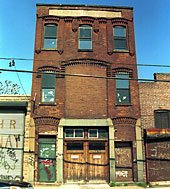
It’s the beginning of the end for a 19th-century stable house in
Gowanus, one of the last of its kind still standing in the wake of rising
property values and rapid residential development in the canal-centered
neighborhood, the owner said this week.
Jim Plotkin, the owner of the building and the man responsible for The
Mill, a recent condo renovation on President Street, said demolition of
the four contiguous properties owned by his company, 340 Bond Street LLC,
which includes 340, 346, 350 and 352 Bond, between Carroll and President
streets, began this week.
The city Department of Buildings issued a permit on April 20 allowing
the demolition.
“It will probably be down by the time this story runs. I’m not
sure what they’re working on now, but they began this week,”
he said Tuesday.
Plotkin said it was still up in the air what would be developed on the
property — high-end luxury condos like The Mill, rentals or commercial
property. “All that’s still being discussed,” he said.
But in the meantime, area residents have been discussing the beauty of
the empty stable’s decrepit facade online, and many were happy to
discuss with The Brooklyn Papers the loss of the old building.
“This is yet
another example of the kind of houses that we’re losing for no apparent
reason,” said Simeon Bankoff, executive director of the Historic
Districts Council.
He said the Gowanus area is overlooked due to its less-than-glamorous
industrial working-class history.
“That area of the world, the area right around there, has been kind
of discarded by the people of Brooklyn,” Bankoff lamented. “It’s
got this terrible reputation, they’ve forgotten what the history
is about.
“I refuse to believe that a sensitive and adequate read of a 19th-century
building is a bad idea. I do not countenance the destruction of a 19th-century
building without a full understanding of it,” Bankoff said, adding
that he preferred the idea of a renovation that would include the original
facade, or an adaptive re-use.
“We’re losing our history by doing this,” he said. “We
don’t need any more of these big, boxy, ugly things that are ruining
the landscaping of Brooklyn.
“Clinton Hill has a whole mess of carriage houses and they’ve
done their best to rescue them and save them, they’ve even gone through
an attempt to contextually rezone to try and save them,” added Bankoff.
But Erik Fortmeyer, a Boerum Hill researcher who delights in the neighborhood’s
pre-Civil War history, said that given the condition of the old building,
it was unlikely to be saved.
“It’s a shame that that place is going,” he agreed. “It’s
unfortunate that it’s located [outside a landmark district]. In another
place, it might be preserved, but near the Gowanus Canal area, it probably
wouldn’t be worth the effort from a landlord’s perspective.
“There’s no practicable way to use that stable, and it’s
a real darn shame,” said Fortmeyer, who dated the Bond Street building
back to 1870.
“Renovating it would be hard,” he said. “When you start
seeing more like the mews-type arrangements, those little carriage houses
were designed more for human habitation, but [this] particular situation
was designed just for horses.
“It’s kind of hard to renovate that in an effective way that
could be used for humans,” Fortmeyer said.
“It’s just a terribly unfortunate tragedy that it has to go,
but there’s no way to make it useful, unless the city owned it or
a rich person owned it and could just write it off as a curiosity.”