


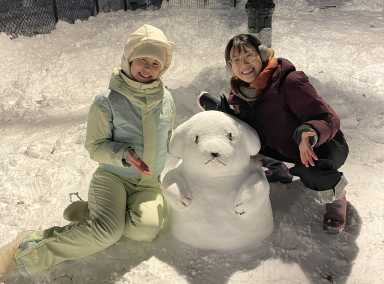







Spy magazine used to have a popular segment called “Separated at birth” that featured pictures of celebrities who bore an uncanny resemblance to each other. Forgive real-life twins Paula Bernstein and Elyse Schein if they fail to find humor in the photographic juxtaposition — after all, “Separated at birth” is their life story.
The twins, adopted by different middle-class Jewish families in the 1960s, were the victims of a New York adoption agency’s bizarre — and since repudiated — theory that identical twins would flourish if raised separately.
To add insult to this gross injury, the adoption agency — the once-silverplated Upper East Side firm Louise Wise —Â brought in a psychiatrist to conduct a secret study of the twins. So not only were the twins separated by the adoption agency, but the agency claimed to be doing it in the name of science.
All of this might have never become known — and Bernstein and Schein might never have met — had Schein not decided to search for her birth mother. That search proved fruitless — her biological mother was long dead — but a new administration at Louise Wise gave her the shocking news that she had an identical twin living in Brooklyn.
The result is the stunning book, “Identical Strangers: A Memoir of Twins Separated and Reunited” (Random House), which touches on some of Mankind’s biggest questions (“What does it mean to be an individual?”) and some of its most intimate (“Is this woman I’ve just met my ‘sister’ just because we share the same DNA?”). Along the way, Schein and Bernstein introduce us to the adoption agency officials; the psychiatrist who conducted the study (and to this day remains guilt-free about it!); and their biological uncle, who was initially standoffish, but later gave precious details about the life of their birth mother.
This week, Bernstein, who lives in Park Slope, and Schein, who lives in Fort Greene, checked in with Brooklyn Paper Editor Gersh Kuntzman.
GO: Elyse, why did you even begin the quest that led to you meeting Paula?
ES: In my late 20s, I began to say to people, “I feel like I’m missing a twin.” Up to that point, I never searched for my biological family, but eventually, there was this mystery that I wanted to resolve.
GO: And you eventually found Paula, but, truth be told, she wasn’t as ready to fully accept you into her life so quickly. Why not, Paula?
PB: I’d always grown up feeling like my adopted family was my real family and that I didn’t necessarily feel that biology was significant. On top of that, I had just had my first child and moved to Park Slope. I was in a phase of life, the nesting phase, where I felt very comfortable and happy. I wasn’t looking for any complications.
GO: But then you got a call out of nowhere from the adoption agency — and then your sister — telling you that you had a twin. Kind of an atom bomb, no?
PB: I was in a physical state of shock, so I just went into reporter mode and took notes. Then I broke down into tears.
GO: I realize there is some pain about the fact that you and other separated twins were studied, but it does raise fascinating questions about the old nature vs. nurture argument. In the book, it’s pretty clear that you guys come down on the side of nature.
PB: Meeting Elyse challenged my belief. As an adoptee, I went overboard on the side of nurture and thought nature was not relevant. I am so much like my adoptive dad.
ES: I always thought it was a combination of both because I imagined my birth parents were Bohemians because I was so interested in traveling and the arts even though my adoptive parents were not.
GO: And it’s funny how similar you guys realized you are — right down to taste in movies.
PS: There was an element of excitement, as in “Oh, you do that? I do that, too!” And we both bonded over “Wings of Desire.”
GO: Now the big question: was the adoption agency right that twins should grow up apart?
ES: Paula and I are not the people we would have been if we had grown up together, and we lead happy lives. But it was wrong that we were separated.
PB: It’s a paradox. Intellectually, I know that twins should not be separated, but I can’t negate the life I’ve led. Yes, it’s probably true that we were able to develop our own personalities because we were separated, but does that mean twins should be separated? No. We lost the bond that we were entitled to. I don’t think the agency was malicious, but they were incredibly shortsighted.
Q: But you’re truly sisters now, right?
ES: We really are part of each other. We finish each other’s sentences now.
©2007 The Brooklyn Paper
By submitting this comment, you agree to the following terms:
You agree that you, and not BrooklynPaper.com or its affiliates, are fully responsible for the content that you post. You agree not to post any abusive, obscene, vulgar, slanderous, hateful, threatening or sexually-oriented material or any material that may violate applicable law; doing so may lead to the removal of your post and to your being permanently banned from posting to the site. You grant to BrooklynPaper.com the royalty-free, irrevocable, perpetual and fully sublicensable license to use, reproduce, modify, adapt, publish, translate, create derivative works from, distribute, perform and display such content in whole or in part world-wide and to incorporate it in other works in any form, media or technology now known or later developed.