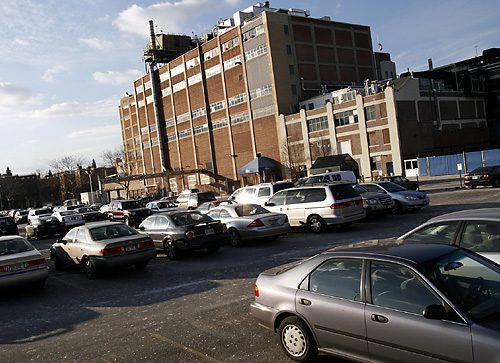
Pfizer, the drug giant best known for Viagra and Zoloft, will fire all 600 workers at its Williamsburg plant, ending a relationship with the borough that dates back to 1849.
The drug maker, which posted a $9.45-billion profit during the last quarter of last year, said it will sack the workers next year as a cost-cutting move in advance of some anticipated losses from the end of patent protection on some of the company’s biggest drugs.
“This was a very difficult decision for the company to make,” MacDara Lynch, a Pfizer vice president of manufacturing, said in a statement Monday. “Our colleagues at the Brooklyn plant have contributed significantly to Pfizer’s success over many years.”
Employees echoed that on Tuesday.
“It’s a sad day,” said 16-year employee Victoria D’Agostino. “I put a lot of hard work and time into this place and my job disappears. I’m not happy.”
“I’m not happy, either,” added her colleague, who did not want to give his name. “I’m close to retiring and I’m being pushed out the door.”
Local politicians called the layoffs a sad fact of life in modern Brooklyn, where large-scale manufacturing is a decreasing part of the economy.
“I am profoundly disappointed,” Borough President Markowitz said in a statement. “Apparently market forces have trumped history and local roots, and another piece of our city’s industrial heart and soul will be lost.”
Councilman David Yassky, whose district includes the Pfizer factory, said the Pfizer layoffs show that the city must renew its efforts to support small manufacturing businesses.
“Let me tell you, the saddest thing I ever saw was the day when the Domino Sugar plant closed in Williamsburg [in 2003],” Yassky said. “Those jobs, which are well-paying union jobs, won’t be replaced. That’s reality.
“But that doesn’t mean we can’t have a manufacturing economy,” he added, calling for the city to expand an existing program that relocates manufacturing businesses squeezed out by high real-estate costs, and another that helps businesses reduce their energy costs.
Both programs were part of the Williamsburg-Greenpoint rezoning that Yassky backed in 2005.
Other officials moved quickly to debate a future use for Pfizer’s 660,000-square-foot plant, which is part of a complex of buildings and land on Flushing Avenue between Marcy and Tompkins avenues.
Also on the site is the historic building where cousins Charles Pfizer and Charles Erhart founded the company in 1849. A spokesman said that the building would be restored and made available to the public.
Mayor Bloomberg said he would pursue a rezoning so that the plant could be turned into affordable housing in an area whose population is booming.
The mayor also suggested one way to pay for it: He said the city will look into recapturing some of the $46 million in tax breaks and subsidies that Pfizer received in 2003 to expand and add jobs in New York City.