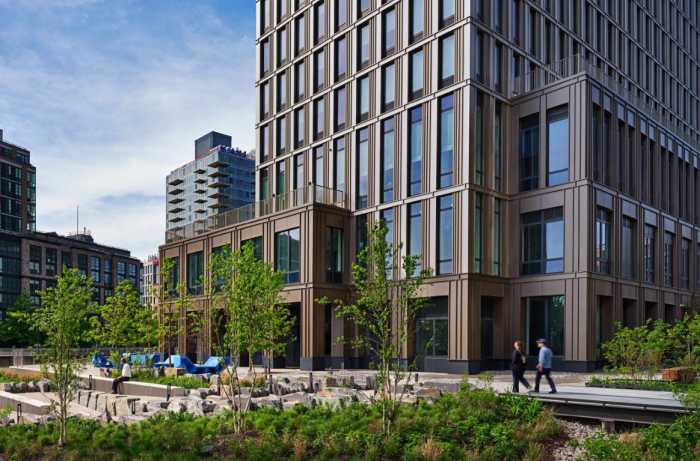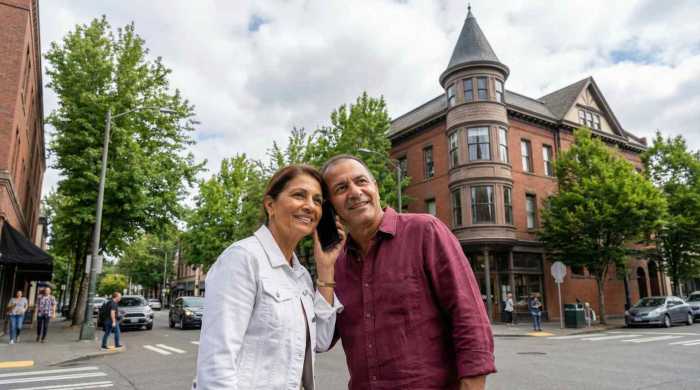
The creation of a DUMBO historic district moved closer to reality this week when the Landmarks Preservation Commission agreed to discuss the topic later this month, the first step in a process to protect the waterfront warehouse district from the wrecking ball of redevelopment.
When it was still called Fulton Landing, DUMBO was at the center of American industry. There are more artists than workers in the neighborhood these days, but its blue-collar heritage lives on through its majestic and sturdy buildings — and local preservationists want to keep it that way.
“DUMBO is incredibly significant as an intact neighborhood on Brooklyn’s waterfront,” Simeon Bankoff, director of the Historic Districts Council, told The Brooklyn Paper. “It was spared a lot of the demolition that happened in many other waterfront warehouse areas because it was isolated by the Brooklyn–Queens Expressway and fell into disuse for 40 years.”
Brooklyn was once the fourth largest manufacturing district in the U.S. and DUMBO contributed to that by churning out coffee, tea and beer, not to mention shoes, machinery and Brillo pads.
Among the still-standing DUMBO factories where history was made is the E.W. Bliss foundry building at 205 Water St., between Jay and Bridge streets, where the tin can pioneer also made torpedoes used by the Navy in World War I. Then there’s the Arbuckle Company building at the corner of Plymouth and Adams streets, where John Arbuckle warehoused coffee and sugar at the turn of the 20th century.
“It would not be exaggerating to say that the vast majority of the world’s coffee and sugar went through DUMBO at one point in history,” said Bankoff.
A DUMBO historic district — which is pretty ironic considering the neighborhood wasn’t even called “DUMBO” until the 1980s — would not mean an end to residential conversion of the cherished warehouses.
But such projects would get another level of public scrutiny.
Last month, the city landmarked part of the Domino sugar refinery in Greenpoint — and those buildings are being incorporated into a proposed $1.5-billion residential development.
Landmarks Preservation Commission hearing on designating DUMBO as a historic district will be held in the Municipal Building (1 Centre St., at Chambers Street, in Manhattan, ninth floor) on Oct. 30 at 9 am. For information, call (212) 669-7817.