
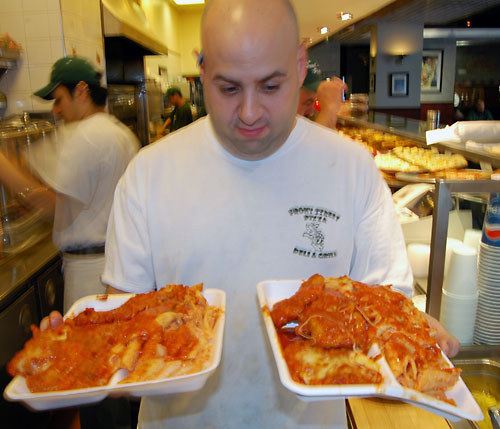
The Brooklyn Paper obtained samples of the new sugar-cane food tray and the old Styrofoam trays and exposed them to a battery of experiments at our test kitchen, also known as Front Street Pizza in DUMBO, home of the famous taco slice.
The results? Styrofoam may be hated by environmentalists, but the relic beats its eco-friendly counterpart.
First, Front Street’s Larry Leonardi loaded up both trays with normal (for him) servings of baked ziti and chicken Parmesan, allowing The Brooklyn Paper to judge the platters’ ergonomics, structural integrity, and, most important, leakage.
Ergonomics: The Styrofoam tray was the clear winner — Leonardi easily carried it with one hand, while the “green” tray needed two, becoming flimsy after just a few minutes.
“If a kid had books in his hand, he wouldn’t be able to carry it,” he said.
Structural integrity: Some studies claim that microscopic toxins can seep from Styrofoam into hot food. While we didn’t see any toxins on the Styrofoam trays, it was clear that particles of the wet sugar cane tray had flaked off into Editor Gersh Kuntzman’s ziti.
“I hate it when that happens,” Kuntzman said.
Leakage: Here again, Styrofoam displayed its superiority. Besides being cheaper and lasting years longer than the biodegradable tray, Styrofoam naturally insulates against extreme temperatures. After a few minutes, condensation built up on the underside of the sugar cane tray — a mess.