It’s not your granddaddy’s Hippie commune.
In fact, a group of Brooklynites who want to buy a nice building near Prospect Park and share common areas with like-minded friendly people aren’t even hippies at all.
They’re called “co-housing enthusiasts.”
And they’re coming soon — they hope — to a neighborhood near you to create a vibrant form of social living in an otherwise indifferent city.
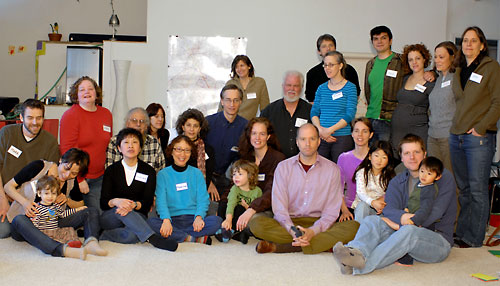
“We want more out of life. We want more community. We were lonely and felt too isolated,” said Alex Marshall, who started planning the first co-housing dwelling in the city with his wife last summer.
Alas, the 1970s are dead. This will not be a pot-smoking, patchouli-filled, free-loving, anything-goes compound.
“Take a commune and a condo, put them in a blender and this is what you get,” said Ben Watts, a likely resident of the building, which will probably be in Park Slope, Prospect Heights or Windsor Terrace.
Drug use and promiscuity — the hallmarks of the golden age of commune living! — will be purely coincidental. But there will be a shared mindset about how to live.
Marshall and about 20 other families say they want to solve what they perceive as the breakdown of capitalist civilization by doing more than acknowledging their building-mates with a slightly perceptible “New York nod” in the hallway.
Inside their walls, there will be communal meals, activities and relaxation. Members are expected to congregate with the group on a semi-regular basis, though there’s no stipulation to do so. It’s dorm living — without the studying.
And without the dorm: Families or individuals who want to participate in the co-housing experiment will have to make a significant financial investment. Marshall estimates that it will cost $15–$20 million for the building, or around $600,000 per unit.
The co-housing model emerged in Denmark in the 1970s. In the United States, it’s rooted in the blue state bastions like Seattle, the Bay Area and college towns.
Shelling out lots of money to live in a group setting sounded a bit strange to 1970s-era commune residents.
“One advantage [of our commune] was that we had three families sharing one mortgage,” said Alice Radosh, who lived in a Sixth Street brownstone for much of the 1970s.
Elaine Archer, one of Radosh’s housemates, continues to be a proponent of non-traditional housing arrangements.
“We didn’t focus so much on nuclear families … so I’m glad to see co-housing, because that looks like a different approach.”
As a veteran of both worlds, Radosh reflected on the benefits of each.
“With co-housing, you still pretty much run your own house — that’s the advantage,” she said. At the commune, “there wasn’t the same amount of privacy, but there were a lot more services collectively.”
The new commun-ists
Urbanites of the world, unite! Brooklynites hungry for a sense of a community, but wanting a privates space of their own, can plant a foot in both worlds by getting involved with the borough’s, and the city’s, first co-housing group. It sounds great, but history is dotted with failed utopian housing schemes.
| Co-housing | LIFESTYLE | Communism |
|---|---|---|
| 1970s Denmark | FOUNDED | 1848 Britain |
| “The Co-housing Handbook: Building a place for Community in Crisis,” by Chris ScottHanson | ESSENTIAL BOOK | “The Communist Manifesto,” by Friedrich Engels and Karl Marx |
| Scandinavia, the Bay Area, college towns | POPULAR IN | Cuba, Israeli kibbutzim, college towns, liberal arts school coffeehouses |
| No, but mix it with collectively owned common space. | ABOLISH PRIVATE PROPERTY? | Yes. |
| Hectic, impersonal modern life. | SOURCE OF CONFLICT | Unequal ownership of the means of production. |