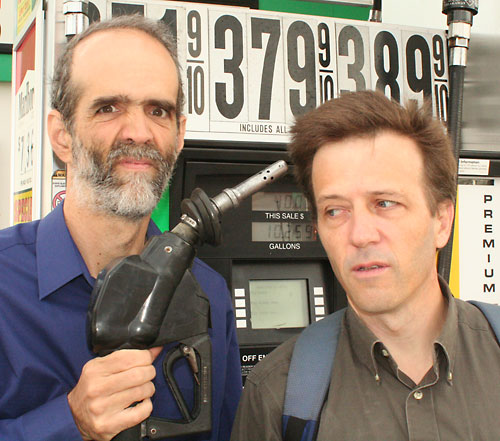
In a style of problem-solving that resonates with many Park Slopers, two green activists says they have the answer to rocketing fuel prices and environmental pollution — they’re forming a cooperative.
Inspired by a West Coast environmentalist’s call for alcohol-based fuels and the shared-labor philosophy of the Park Slope Food Co-op, the duo wants to create a members’ only alternative fuel club by next year.
The goal is to provide a supply of fuel made almost entirely from ethanol, an alcohol distilled from grains like corn.
“There are a lot of obvious, environmental advantages of not relying on fossil fuel or gasoline,” said Michael Winks, a veteran of the Park Slope Food Co-op and the neighborhood’s baby-sitting co-op. He also said the fuel co-op would be part of a move towards national energy independence and shift American foreign policy away from oil-based decision-making.
Plus, Winks and his collaborator Kevin Burget, say people who buy their cocktail of 98 percent corn-based ethanol and two percent gasoline will line their wallets with extra cash.
“We believe you’ll pay 75 cents a gallon less [than gasoline],” Winks said, adding that cooperators would have to buy a $375 device (and a little more for installation) to enable their gas-guzzlers to run on an almost pure alcohol diet.
And yes, the co-operators would be expected to pool their money up front to buy or lease a site. Neither Winks nor Burget said he had a site in mind, nor could they specify the total start-up costs.
Neighbors think Winks and Burget chose the perfect area for their money-saving (and, some say, earth-friendlier) project.
“This neighborhood is a good place because there are plenty of people with cars and plenty of touchy-feely liberal people who would be into it,” said Claire McCarthy, a Slope resident and former food co-op member.
Critics say ethanol, which is currently made mostly from corn, is not environmental manna. First off, corn prices are high right now, in part due to increased demand as a fuel and as a food. Experts — from Columbia University economics guru Jeffrey Sachs to layman Bill Clinton — say that diverting corn and other vegetables away from the food chain and into energy production can increase food prices.
The Renewable Fuels Association — a national trade group — blames high oil prices for the inefficiency that Clinton decried. “Numerous statistical analyses have demonstrated that the price of oil — not corn prices or ethanol production — has the greatest impact on consumer food prices because it is integral to virtually every phase of food production, from processing to packaging to transportation,” the organization says on its Web site.
And David Blume — the West Coast environmentalist and author (with Winks as editor) of “Alcohol Can Be a Gas!” — says no one is going hungry because corn winds up in gas stations and not on plates. In fact, there was a bumper crop last year.
“The line at the cocktail party is that it’s food versus fuel. But it’s not true,” Blume said.
Winks said that if he gets 100 committed members, the group could buy ethanol from an upstate producer. If everything goes well, ethanol would eventually be produced from more efficient crops than corn.
The plan is for each member to be issued a card to activate the fuel pumps and record usage. Each co-op member would be billed every month.
Don’t worry, though; this fuel co-op not like the food co-op in one important way: members won’t have to pump other members’ gas, squeegee their windows or put air in tires for a few hours a month in order to fill up their tank.
Michael Winks will discuss the Park Slope Ethanol Co-op on Thursday, Sept. 25 at the Park Slope Food Co-op (Union Street, between Sixth and Seventh avenues), 7:30 pm.