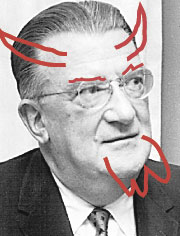
Baseball fans willfully tore open the deepest wound in sports history by sitting there on Saturday to hear Peter O’Malley, the son of the hated Walter O’Malley, defend his dad.
But even before the younger O’Malley’s first pitch, the crowd was suspicious.
“The Dodgers leaving Brooklyn was like tearing down the original Penn Station,” said Cathy Gavin of Park Slope, the daughter of an aggrieved Brooklyn Dodger fan. “Imagine if they were still here,” she added wistfully.
Gavin and about 60 others showed up to the Brooklyn Historical Society to hear O’Malley and author Michael D’Antonio, author of “Forever Blue: The True Story of Walter O’Malley, Baseball’s Most Controversial Owner and the Dodgers of Brooklyn and Los Angeles,” which partly argues that the real bogeyman for Brooklyn’s lasting psychic scar is Robert Moses, the borough’s other legendary villain.
D’Antonio, who gained access to thousands of previously private documents from O’Malley’s heirs, says the master planner stubbornly blocked O’Malley for a decade from building a replacement for Ebbets Field next to the railyards where Bruce Ratner now hopes to build a basketball arena for the Nets.
Finally, in 1957, O’Malley packed his bags for warmer climes, though Moses offered the Dodgers a site in Queens that eventually became the publicly financed Shea Stadium, the Mets’ home.
But Peter O’Malley said his father didn’t want a public handout.
“He had no interest in a taxpayer facility in Flushing,” he told the audience, a statement that could burnish O’Malley’s legacy considering the scandals involved in building the new Yankee Stadium. Indeed, the Dodgers’ Web site claims that their Los Angeles park is one of only two privately built stadiums from the 20th century, though it doesn’t mention that eminent domain was necessary to evict residents of Chavez Ravine.
D’Antonio, being a historian and thus prone to the long view, said the Dodgers’ flight to the West Coast became inevitable when Brooklyn ceased to be an independent city.
“What cost Brooklyn the Dodgers was 1898 when Brooklyn became part of New York City,” the scribe said. He said the borough’s voice was drowned out by the rest of the city, which didn’t care if the Dodgers stayed or went.
The crowd was civil, but not convinced that the loss of their Dodgers more than a half century ago was the product of circumstances beyond the infamous O’Malley’s control.
“Moses and O’Malley were two men with huge egos,” said Kevin Norton, who grew up in Sheepshead Bay. “Each was saying, ‘It’s my way or the highway,’ and O’Malley took the highway and left.” (Actually, he flew.)
The proof of O’Malley’s ruined local reputation was evident when attendees compared him negatively to frequent public enemy number one, George Steinbrenner, the Yankees owner who toughed out a longer fight to get a new stadium for his club.
Others stood up for Moses, saying the great builder and condemner of homes, did not deserve all the blame for the Dodgers’ exit.
After the crowd thinned, O’Malley told The Brooklyn Paper that the talk and the book were not a posthumous public relations campaign to reverse his father’s image.
“I didn’t come here to convince anybody of anything. I don’t think there is a villain, not my father, not Robert Moses.”
In spite of the simmering animus towards his family, he has only good things to say about Kings County.
“I lived here, I went to school here, and I continue to love Brooklyn to this day.”