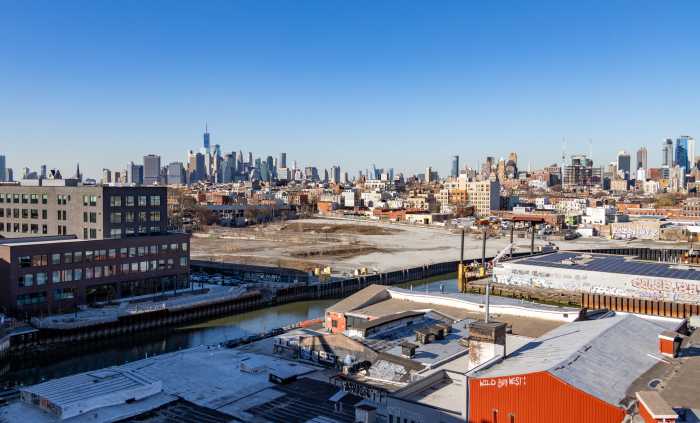
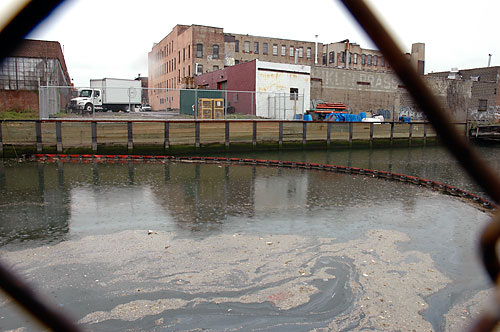
The ongoing fight between Mayor Bloomberg and the federal government over the cleanup of the heavily polluted Gowanus Canal is not just about protecting proposed real-estate projects, but also the city treasury.
Thus far, coverage of Bloomberg’s opposition to a federal proposal to add the 1.8-mile canal to the Superfund clean-up program has focused on the mayor’s stated goal of protecting $400 million in anticipated residential development in the industrial neighborhood.
But the mayor could also be trying to save the city from being hit with the clean-up bill.
Despite its name, the Superfund is not a pool of money that federal officials tap into for environmental remediation. In fact, one goal of Superfund designation is to identify guilty polluters and get them to pay to clean up toxic sites.
But there is a long history of towns and municipalities being forced by the EPA to open up their checkbooks to pay for decontaminating polluted land. In February, for example, the upstate cities of Poughkeepsie and Newburgh were held responsible for hazardous material on a car and metal processing plant, and had to cough up $12 million.
Cleaning up the Gowanus, with its dioxins, PCBs, coal tar — and, more important, tens of millions of gallons of raw sewage that spills into it on rainy days — would be considerably more expensive.
The EPA says local governments are usually minor defendants in their suits, but industrial companies have sought big bucks from cities to defray the costs they have to pay to the EPA. In a case from 1989, companies joined together to sue 29 California cities for $500 million as part of a Superfund battle.
The EPA says it does not yet know who would be targeted if the Gowanus Canal is added to the national priority list of Superfund sites, a controversial proposal first floated earlier this month.
Amid this new debate, a clearer picture began to emerge this week about why Gov. Paterson secretly appealed in December for federal assistance with the cleanup of Brooklyn’s infamous channel. It turns out, state officials now believe that their highly touted efforts are neither adequate to clean the area, nor powerful enough to identify parties responsible for the pollution.
The state is currently overseeing the remediation of three brownfields neighboring the canal that were formerly the site of gas plants. Not only is the soil heavily polluted, but the coal tar sludge leaches into the canal, continuing to poison it.
“It became apparent that it made no sense to remediate the canal in isolated areas near the [gas plant] sites when there was contamination present throughout the canal,” said Department of Environmental Conservation spokesman Yancey Roy. “A comprehensive approach to the remediation of the canal is required, one that will not only cut off all upland sources to the canal, but will also include an overall remedy to the canal itself.”
Prior to the possible Superfund designation, there was a mix of efforts to clean parts of the canal and its uplands. In addition to the state-led brownfield program, the city had budgeted $175 million to reduce the amount of untreated sewage that dumps into the canal after heavy rains. The city also planned to dredge 1,000 feet of the waterway.
Private developers, such as Toll Brothers, which wants to build 460-units on two blocks next to the canal, are mandated to clean their sites and build sewer systems that would not add to the waste stream that flows into the Gowanus. But Toll Brothers continues to threaten to nix the project because Superfund designation would stigmatize the neighborhood.
It has already divided the neighborhood.
Some environmentalists say the Superfund designation is the only way to get a comprehensive clean-up of the so-called Lavender Lake. But other do-greeners point out that remediation can take decades, cost far more than anticipated, and not always work.