A controversial city plan to tear down a historic schoolhouse on Fourth Avenue in Park Slope and build a new one with triple the capacity just doesn’t add up, neighbors say.
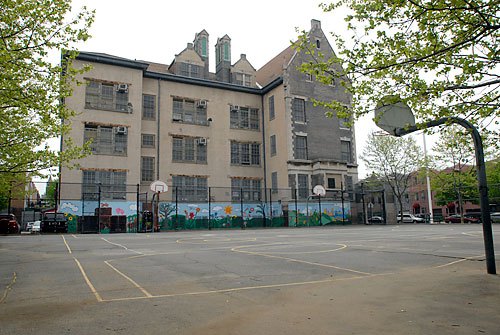
Parents and residents of the block between Baltic and Butler streets have a long list of complaints about the city’s plan to tear down the 108-year-old, 300-seat PS 133 and replace it with a 960-student elementary school — not the least of which is the demolition of the Charles Snyder-designed edifice.
“Tearing down that building would be like a dagger to the heart,” said Butler Street resident S.J. Avery, who claims the school serves as an “anchor” for the community of rowhouses that were built by the city in the 1980s with pitched roofs to match PS 133. “It means that our sense of place and neighborhood is really seriously violated.”
But architecture is just the window-dressing on their castle of complaints.
Neighbors also railed against renderings that depict the new building including two distinct schools with separate entrances: one that would seat about 300 students from within PS 133’s school district 13, which spans Fort Greene, Clinton Hill and Bedford Stuyvesant; and one for about 660 students from the more-affluent, but neighboring, school district 15 that includes Park Slope and Sunset Park.
“What’s very distressing is that the school will have two entrances,” said Avery. “The notion of ‘separate-but-equal’ schools doesn’t sit well.”
Opponents of the new building also scorned the city for plans that would pave over about half of a three-decade-old community garden on the Fourth Avenue side.
But the School Construction Authority stands behind its plan — and has an answer for just about every critique:
• Agency official Kenrick Ou told a Community Board 6 committee last week that in order to provide enough seats for the predicted residential boom on Fourth Avenue, the city must tear down the school and construct a larger building — one so large, in fact, that it would require a zoning override to be built.
“We looked at [an annex],” said Ou. “An addition would actually end up being a larger, [but] less effective structure overall.”
• The school’s agency dismissed questions about combining two school districts under one roof by noting that the proposed project would fill the desperate and growing need of students from district 15, while providing current district 13 students with “a new, state-of-the-art school facility” boasting art and music programs, science labs, and a gymnasium, according to an environmental impact study.
• The agency defended plans to eliminate half of the garden by claiming it needs to pave over part of the greenery to provide “an adequate amount of outdoor recreation space for the student population,” according to the study.
In the end, Ou begged for support.
“I encourage you to try and trust us,” he said. “At the end of the day, we are responsible for, and accountable for, delivering this project in a safe and timely manner.”
If approved by the City Council — which will first hear the issue at a subcommittee on Landmarks, Public Siting and Maritime meeting on Tuesday — and the mayor, construction could begin over the summer. During the three-year demolition and construction period, PS 133 would relocate to the former St. Thomas Aquinas School on Fourth Avenue.