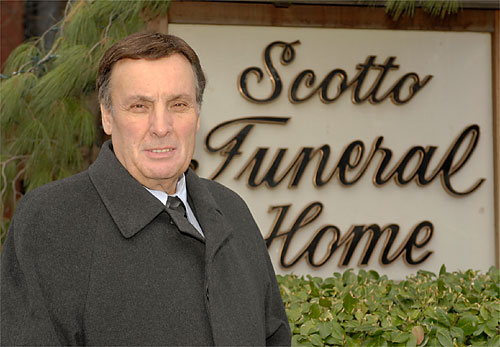
Buddy Scotto, a local funeral home director and community activist, once considered leaving Carroll Gardens and moving to Long Island. But his father didn’t want to move to the suburbs, as many New Yorkers did as the city was heading downhill in the 1960s. So Scotto stayed, too.
Like so many other neighborhoods in Brooklyn at the time, the Italian enclave of Carroll Gardens was in a gradual decline. A plan to bring a container shipping facility to Red Hook meant big changes to the community that had always been tied closely to Brooklyn’s waterfront.
“Everyone I grew up with was the son or daughter of a longshoreman, stevedore, or trucker,” said Scotto.
“Everything on the waterfront was to be demolished to make way” for the container port, Scotto said. People would have to be relocated. The little mom and pop shops on Union Street and Columbia Street — like Cioffi’s, where people would line up to buy Italian pastries during the holidays — what would become of them?”
The plans led to panic.
“A cloud of condemnation fell over the place,” Scotto said. “It got so bad, it felt like a bombed-out area.”
Thus spawned Scotto’s activism in the community. Over the next several years, he would form various organizations, work with politicians (regardless of party affiliation), and even rub elbows with Rockefellers and Astors to get money for improvements to the area. Through the Carroll Gardens Association, he helped create housing in abandoned buildings on Columbia Street.
In the end, of course, the massive container port never came to Brooklyn, opting for New Jersey, but Scotto remained active.
Through the Gowanus Canal Community Development Corp., he helped reactivate a 1911 flushing canal system that pumps fresh water into the highly polluted canal, and got funding to create a sewage treatment plant in Red Hook.
His belief was, if you help the depressed areas surrounding Carroll Gardens, you end up actually helping the neighborhood.
That belief holds true today as much of what’s left of the neighborhood’s Italian flavor gets diluted by a steady influx of young professionals that began decades ago.
Scotto calls them “Beatniks” because they were “doing counter to what was going on, which was you move to the suburbs as you move up the economic ladder.”
The “beatniks” moving in now, though, are making it very hard for the original community to stay. That’s why Scotto is against the current plan to designate the Gowanus Canal zone a Superfund site — it would block hundreds of millions of dollars of investment, he said, some of which will be spent on affordable housing that will help stabilize home prices in Carroll Gardens.
“We’re a so-called ‘in’ neighborhood and they’re pushing the Italians out,” Scotto said. “They are people that can afford the neighborhood, that’s why we want affordable housing in the Gowanus.”
— Michael P. Ventura