Mayor Bloomberg’s proposal to reshape Coney Island’s ramshackle “People’s Playground” with rides, attractions, hotels and thousands of apartments collided with scores of critics in the first public hearing of the controversial plan on Tuesday night — but the biggest challenge could be the unrelenting standoff between the mayor and Coney Island land baron Joe Sitt.
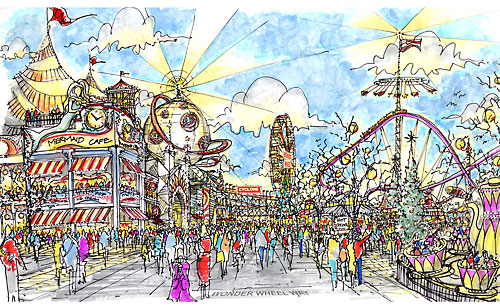
Residents, merchants, amusement enthusiasts and good ol’ Coney freaks crammed Community Board 13’s public hearing at Lincoln HS on Ocean Parkway to denounce — and, in fewer cases, endorse — Bloomberg’s vision, which is actually a revised offering from an initial plan that provoked stifling resistance from Sitt. The current plans calls for a city-owned theme park bordered by privately built hotels and year-round attractions like bowling alleys and movie theaters in the area between Keyspan Park and the Cyclone roller coaster.
Testimony from Sitt’s lawyer, Jesse Masyr, had attendees on the edge of their seats. Expecting fireworks, the attorney did not disappoint and blasted the plan that was largely crafted to settle the dispute between his client and the mayor over the control of Coney Island’s destiny.
“In light of the decades of neglect and current economic climate, there has perhaps never been a more important time to get Coney … on the right track,” said Masyr. “Regretfully, the proposal before you falls significantly short of such a goal.”
Masyr’s submitted testimony blasted several aspects of Bloomberg’s plan, such as its need to spend hundreds of millions of dollars to acquire private land (namely Sitt’s), potential difficulties obtaining state legislation regarding a long-term theme park operator on parkland and the prohibition of retail stores from the core amusement area.
“The city’s proposal will almost certainly doom [the amusement area] to further decades of neglect,” said Masyr.
Community Board 13 will vote on the city rezoning plan on March 11. After that, the plan will be reviewed by Borough President Markowitz, the City Planning Commission and the City Council.
Interestingly enough, one of Sitt’s loudest opponents, Dick Zigun, also testified against the city’s plans, though for different reasons.
“This plan was significantly watered down and the interests of the amusement industry were betrayed,” argued Zigun, the founder of the Coney Island Circus Sideshow.
Zigun supported the city’s initial proposal for a 15-acre amusement park, but that plan became bogged down because Sitt did not want to sell his beachfront property to the city for the new amusement park.
To break the impasse, the city decreased the area for outdoor rides to nine acres and enlarged the zone for private developers.
In response, Zigun resigned from the Coney Island Development Corporation in protest last year.
But other carnies lauded the city’s attempt to attract investment in the sand-swept pleasure zone, home to many empty lots by loosening the definition of amusement zoning to allow more attractions besides rides.
“The plan is a step, if not a leap, in the right direction,” said Dennis Vourdaris, the owner of Deno’s Wonder Wheel, the only remaining theme park in Coney Island since Astroland closed last year.
Pessimistic observers, who have seen other Coney revitalization projects come and go through the decades, said this plan to restore the faded playground’s past glory won’t get off the ground either.
“The pie-in-the-sky promises of the current rezoning are all too familiar,” said Charlie Denson, who wrote the seminal local history book “Coney Island Lost and Found.”
A core battle has been over what variety of rides, attractions and hotels would be permitted, but for many Coney Island residents this is a fight to improve their neighborhood, which is beset with high crime rates, poverty and limited employment opportunities.
“I’m for the redevelopment of Coney Island — but [fix] the west end first!” an area resident, Ken Jones, said to applause.
Many other Coney denizens said the city’s plan neglected their hardscrabble corner of the neighborhood, while others supported the Bloomberg plan, because of the prospect of construction jobs and later, permanent employment from the rides, hotels and retail outlets that crop up.