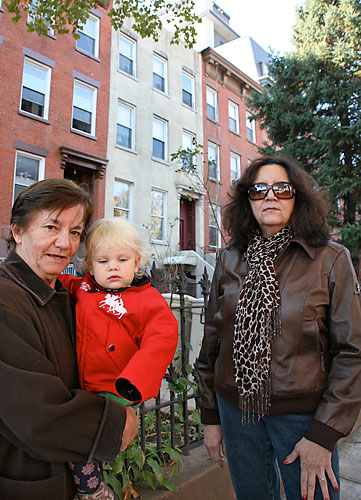
The city is moving ahead with a controversial plan to establish a second historic district in Carroll Gardens — a plan that critics say would only make it more expensive to preserve the very buildings that the city hopes to save.
The Landmarks Preservation Commission revealed last week the working boundaries of the proposed historic district — an area bounded by Court, Henry and Huntington streets, and First Place — that would dwarf the existing postage-stamp-sized zone bounded by President, Carroll, Smith and Hoyt streets.
A second zone is unnecessary, said John Esposito, co-founder of the anti-expansionist group Citizens Against Landmarks.
“Landmarking will force the old-timers out,” he said. “All the new people who have $100,000 income a year think this is a great idea.”
But a study by the Independent Budget Office suggests that landmarking does not, in itself, cause higher home prices.
Supporters said a second district offers the necessary protections benefiting both old-timers and newcomers.
“This will make it harder to tear down historic homes,” said Bob Furman, president of the Brooklyn Preservation Council.
Homeowners in a historic district must get approval from Landmarks for any exterior alteration, which often adds to the cost of the work.
Indeed, concrete magnate John Quadrozzi cited the additional cost and extra bureaucracy when the city fined him for allowing two historic properties in Cobble Hill decay to the verge of collapse.
Landmarks spokeswoman Lisi de Bourbon described the new area — which is supported by the Carroll Gardens Neighborhood Association and the Brooklyn Preservation Council — as “a natural extension of the existing district,” though the two zones are not contiguous.
The boundaries of the new zone are not set in stone yet, and could still be expanded or contracted, depending on the agency’s findings. Establishing the new district is expected to take years.
Carroll Gardens was rezoned last year to discourage oversized growth, and supporters of the district’s expansion say it is critical to add another layer of protection to foil developers who would otherwise run roughshod over the neighborhood’s unique aesthetic.