All Brooklyn news
Neighborhood Map
Bay Ridge
  • Bensonhurst, Dyker Heights
Brooklyn Heights
  • Downtown, DUMBO
Carroll Gardens
  • Cobble Hill, Red Hook, Boerum Hill
Fort Greene
  • Clinton Hill, Crown Heights
North Brooklyn
  • Williamsburg, Greenpoint, Bushwick
Park Slope
  • Prospect Heights, Windsor Terrace, Greenwood Heights
GO Brooklyn
Dining Guide
Where to GO
Events calendar
Classifieds
The Brooklyn Wire
Not Just Nets
Police Blotter
Perspective
Parenting
Politics
Transit
Podcasts
Brooklyn Cyclones
Special sections
About The Paper
Mobile site
Twitter
Facebook
RSS Feeds

House training! Bridge Park supporters say condos are the best way to raise dough

The Brooklyn Paper

Supporters of housing inside Brooklyn Bridge Park brought out the big guns last week to support residential units inside the park as the best way to meet a state mandate that the park generate enough revenue to cover its maintenance budget.

At a hearing last week, the head of the private Brooklyn Bridge Park Conservancy and the former head of the Prospect Park Alliance testified that condos within the park footprint are more reliable sources of cash — and better for the public — than charging fees to use the park’s facilities, hoping for money from film crews permits and renting out space to more snack carts.

“Limited residential development actually privatizes the park less,” Brooklyn Bridge Park Conservancy Executive Director Nancy Webster told a crowd of 100 at the hearing last Thursday at St. Francis College.

Tupper Thomas, who until this year was Webster’s counterpart at the venerable Prospect Park Alliance, also backed housing as the most stable option, explaining the woes maintaining cash-strapped open space.

“All of these gray hairs on my head will show you how hard it is to raise private money for a public park,” said Thomas, who retired in January. “[Housing is] a great mechanism to maintain the park in the future.”

That assertion didn’t convince neighbors like Roy Sloane of the Cobble Hill Association.

“I will never support housing in this park until there are high-rises in Prospect Park, Central Park and every other major park in this city,” he said.

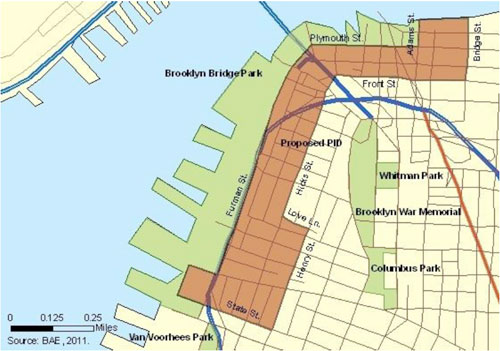
Sloane and other foes of housing have been on their own campaign since February, when the Park’s Committee on Alternatives to Housing unveiled a study that predicted that non-housing options could at most generate $7 million, not even half of the ballooning $16-million maintenance budget. And half of that revenue would come from a new tax on residents and businesses inside a “park improvement district” whose borders would comprise all properties within one-quarter mile of the park — as such, it is unlikely to gain political traction.

Opponents of housing say that the consultant report low-balled the figures to make it seem like high-rises were the best option.

For example, the Brooklyn Bridge Park Defense Fund claims that the report only accounted for the $300 cost of a city film permit for a total of $1,500 to $4,500 annually. Yet park officials charge an additional fee to film in the park — to the tune of $30,000 for a single major shoot. The group also said $1 million more could be generated from parking and $365,000 more could be generated from concessions.

Most important, committee rules forbade it from considering the largest pot of money: the revenue generated after the Watchtower Bible and Tract Society sells dozens of currently tax-exempt properties that it owns in Brooklyn Heights and DUMBO.

“All the numbers are to justify one goal: building high on the waterfront,” said Judi Francis, president of the Brooklyn Bridge Park Defense Fund, which has sued to keep housing out of Brooklyn Bridge Park.

The construction of housing and other revenue-generating uses stems from a 2002 agreement between the city and state that the $350-million park raise its own maintenance budget so it would not be a drain on city coffers.

But the proposed 20- to 30-floor luxury high-rises have long been the waterfront development’s most-controversial feature, so park officials created the committee to search for alternatives to housing.

Reader Feedback

Tall from Bklyn Heights says:
Hooray for Roy Sloane and Judi Francis, and the rest of the opponents to this Bloombergian development scheme! Writing the rules to stack the deck to produce a desired income...yeah, that's a really honest study! Right up there with all those AKRF studies the city uses to justify crap like Atlantic Yards! They insist that housing in a park will produce income; they can't even fill the one building that god grandfathered into the development through Pataki cronyism!
Parks are parks, not front lawns for rich people.
April 4, 2011, 9:16 am
Paco from Cobble Hill says:
Look at Battery Park as an example - Beautiful waterfront views, Yes; a park for the masses? No. If we want a private enclosed park, sure condos are the answer... but I think Brooklyn deserves a real public park, not a privatized backyard. And can we all see the fallacy of relying on housing as a constant source of revenue? Have these people not been around the past 5 years as the entire housing market fell apart. The one building unfortunately already in the park had been less than half sold for years!
April 4, 2011, 11:25 am
Ace from New Utrecht says:
"Tupper Thomas, who until this year was Webster’s counterpart at the venerable Prospect Park Alliance, also backed housing as the most stable option, explaining the woes maintaining cash-strapped open space."

This from the person who looked the other way while the geese were exterminated last year. Pretty easy to tell right from wrong based on which side she takes.
April 4, 2011, 3:50 pm
Joe from Brooklyn Heights says:
Nancy Webster says limited residential housing makes the park less privatized? Are you kidding me? What part of the park is made less privatized? You have citizens that stake their claims inside the park to claim as their own residences and this makes it less privatized? She needs to get some medicine to cure that sickness real fast.
April 8, 2011, 12:41 am

Enter your comment below

By submitting this comment, you agree to the following terms:

You agree that you, and not BrooklynPaper.com or its affiliates, are fully responsible for the content that you post. You agree not to post any abusive, obscene, vulgar, slanderous, hateful, threatening or sexually-oriented material or any material that may violate applicable law; doing so may lead to the removal of your post and to your being permanently banned from posting to the site. You grant to BrooklynPaper.com the royalty-free, irrevocable, perpetual and fully sublicensable license to use, reproduce, modify, adapt, publish, translate, create derivative works from, distribute, perform and display such content in whole or in part world-wide and to incorporate it in other works in any form, media or technology now known or later developed.

First name
Last name
Your neighborhood
Email address
Daytime phone

Your letter must be signed and include all of the information requested above. (Only your name and neighborhood are published with the letter.) Letters should be as brief as possible; while they may discuss any topic of interest to our readers, priority will be given to letters that relate to stories covered by The Brooklyn Paper.

Letters will be edited at the sole discretion of the editor, may be published in whole or part in any media, and upon publication become the property of The Brooklyn Paper. The earlier in the week you send your letter, the better.

Links