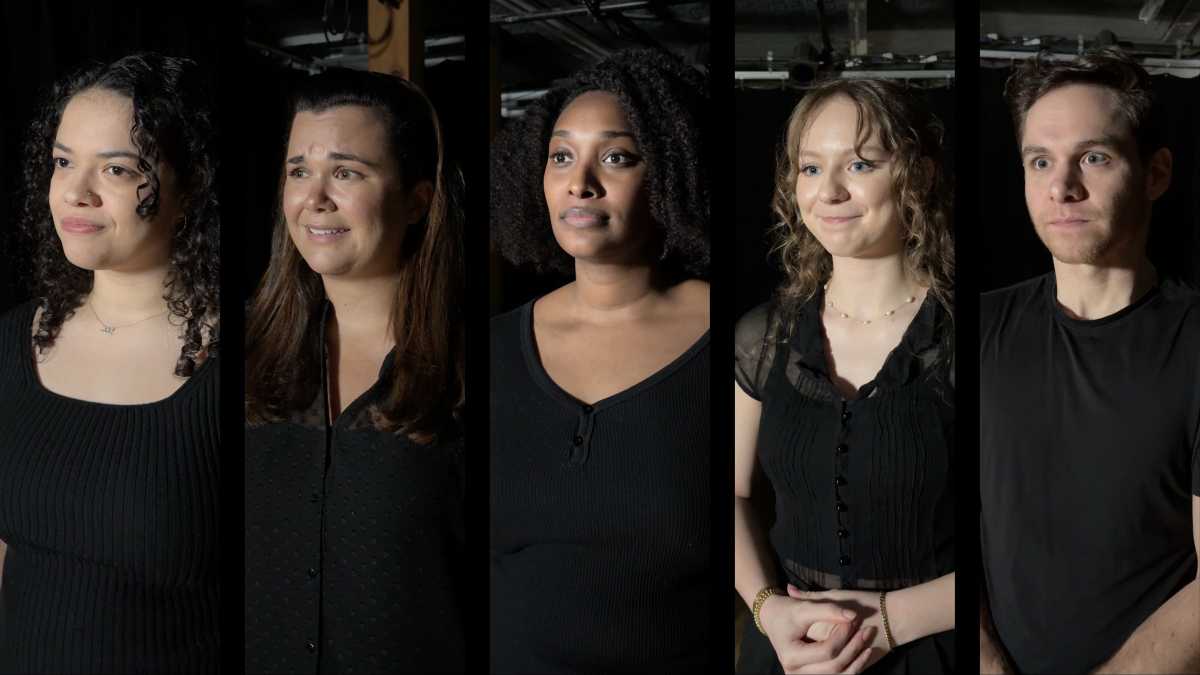
On a largely stark stage with five chairs, five performers gather for what looks like a self-help group. Over the next hour, the characters take the audience not through Alcoholics Anonymous, but through a sometimes comic and sometimes dramatic struggle not with a substance — but with … “sorry.”
“Sorry” may seem to be the “hardest” word (per Elton John), but Mary Corigliano, in her new play, reminds us it can also be the easiest to say too often — and the hardest to stop saying.
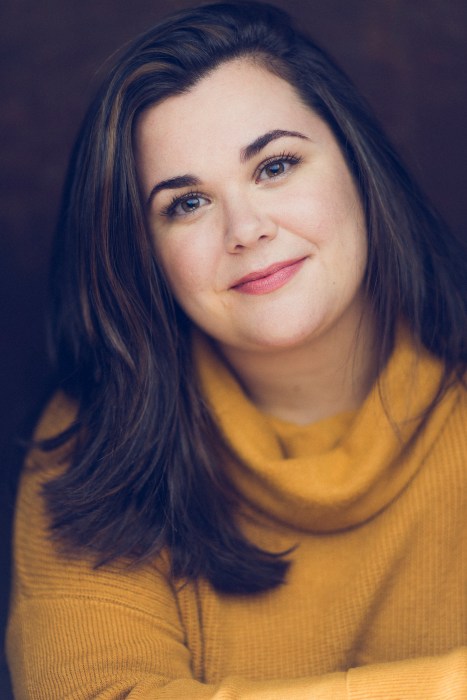
A Brooklyn-based performer and playwright, Corigliano wrote and appears as part of the cast of “Apoloholics: Based on True Stories of People Who Apologize Too Much,” running April 1, 8, 11 and 13 at The Chain Theatre’s Main Stage in the New York Fringe Festival.
“There’s a lot of insecurity,” Corigliano said of the reasons people over-apologize. “There’s that feeling of needing validation, not feeling you deserve to say and feel what you say and feel.”
Apologizing becomes a kind of attitude, where “sorry” can be spoken or expressed in other words, undermining statements and introducing uncertainty.
“There are other ways of saying it, like disguised apologizes. Sorry if I’m taking too long, sorry if I’m bothering you,” Corigliano said. “Am I taking too long? Am I bothering you? There are indirect ways of apologizing. It interrupts the conversation.”
The production features four female actors — Corigliano, Marguerite A. Boone, Gabby Franco Ferro and Blair Tate — with voiceover artist Terri Corigliano as the Counselor. Zack Watson portrays the male roles.
“The average person apologizes eight times a day,” Corigliano said, with the count easily reaching 3,000 annually and eclipsing 200,000 in a lifetime. “I thought it was a good thing to apologize and not take up too much space. It wasn’t until a couple of years ago that somebody I didn’t know turned to me and said, ‘It’s annoying that you apologize so much.’”
Born in Old Saybrook, Connecticut, Corigliano moved to the Upper East Side 10 years ago and, five years later, to Brooklyn.
“I fell in love with a guy who lives here. We’ve been together for five years,” she said. “We’re getting married this year.”
They met in 2020 at a party in a Crown Heights apartment where he was rooming with some of her friends.
“He proposed with a scavenger hunt through all of Brooklyn,” she said. “We biked to our favorite spots. The proposal ended in our apartment, which is where we first met.”
Someone who has done theater for around 20 years, Corigliano spent the last decade primarily doing comedy, including her sketch comedy show “That Just Happened,” at the PIT, Upright Citizens Brigade, the Asylum and elsewhere, headlining the Chicago Sketch Comedy Festival.
“[During the COVID-19 pandemic], it was tough to do that. I did a couple of virtual shows,” she said. “After COVID, I tried to come back with the show.”
Audiences hadn’t returned, but “Apoloholics,” Corigliano added, “was everyone’s favorite,” so she decided to change, expand and develop it into a play. Nora Alexander signed on to direct, and Caitlin Malczon is stage manager.
“It seemed like we just were having a conversation,” she said of scenes with the entire cast. “We have incredibly strong women on stage and we all have done what we’re saying.”
They rehearsed at the Brooklyn Arts Exchange in Park Slope and Art Haus in Williamsburg after she expanded it beyond sketches.
“I tried to focus on people going through more unique experiences,” Corigliano said. “That allowed us to explore the idea in a more layered, in-depth way.”
A new mother grapples with the loss of her old identity, while a woman amid the Black Lives Matter movement who realizes she is Afro-Latina decides to stop straightening her hair and embrace her true identity.
A woman whose father passed away delivers a monologue. “She doesn’t want people to say, ‘Sorry,’” Corigliano said. “She’d rather share a memory than have them apologize for his passing.”
While apologies transcend gender, Corigliano said many women apologize more than men, who typically utter three or four mea culpas daily.
“I feel that’s part of the reason I’ve been taught to apologize. Don’t take too much space. Be agreeable,” she said. “My mother and my grandmother are strong women. I don’t even know where I picked it up.”
Male characters wish they could talk more openly and honestly without having to bring up sports to divert conversations.
“In one of the group scenes, we all have puppets,” she said of an exercise. “The puppets are our inner critic.”
She wrote a kind of “mantra” group members say, reminding themselves sorry is not something to be squandered.
“My apology is sacred and should not be abused,” the cast says. “Nor is it a default when I am confused. Saying it too often is an annoying trait and will push away my loved ones, not to mention irritate.”
Corigliano believes many of us need to change from within, as well as those around us, if they feed the apology beast.
“You need a supportive group around you,” she said. “That’s why I set this in a support group. If you’re with people who make you feel there’s something to be sorry for, it’s like an alcoholic surrounded by their favorite alcohol.”
Cast members are happy with a play that, they believe, blends reality with creativity.
“Every scene brings you in emotionally, and I’ve found myself being able to relate to so many of our characters’ circumstances,” Gabby Franco Ferro said, adding Corigliano “captured real life stories and wove them into a hilarious and tear-jerking play.”
While a real group for those who overly apologize could find support, Corigliano wouldn’t want to run it.
“I don’t think I could,” she said, “although if someone wanted to start one from this, I fully support that.”
She’s happy in Brooklyn, where she enjoys cycling through Prospect Park and has run the Brooklyn Half Marathon as well as the New York City Marathon. She enjoys grabbing a bagel at the Bagel Pub on Franklin Avenue on weekends — and some weekdays.
She also likes going to trivia nights hosted by her friends Walker Snow Harrison and Kate Romero on Thursdays at Paddy’s of Park Slope.
Corigliano believes if you stop feeling sorry over small and large things, you can be happier and more fulfilled.
“I think you believe in yourself more,” she said. “When your brain doesn’t hear you apologizing for everything you say, you inherently believe in yourself.”
While some may feel emotionally cleansed, others will enjoy the comedy, and others may gravitate to the drama.
“A lot of people should be able to identify with at least one story. The point is to make people feel seen,” Corigliano said. “It can be therapeutic, if you identify with the show. If not, you will probably laugh and say, ‘I know this person.’”
“Apoloholics: Based on True Stories of People Who Apologize Too Much” runs April 1, 8, 11 and 13 at The Chain Theatre’s Main Stage as part of the New York Fringe Festival. Tickets are $20 in person and $10 for livestream and are available at apoloholics.org.