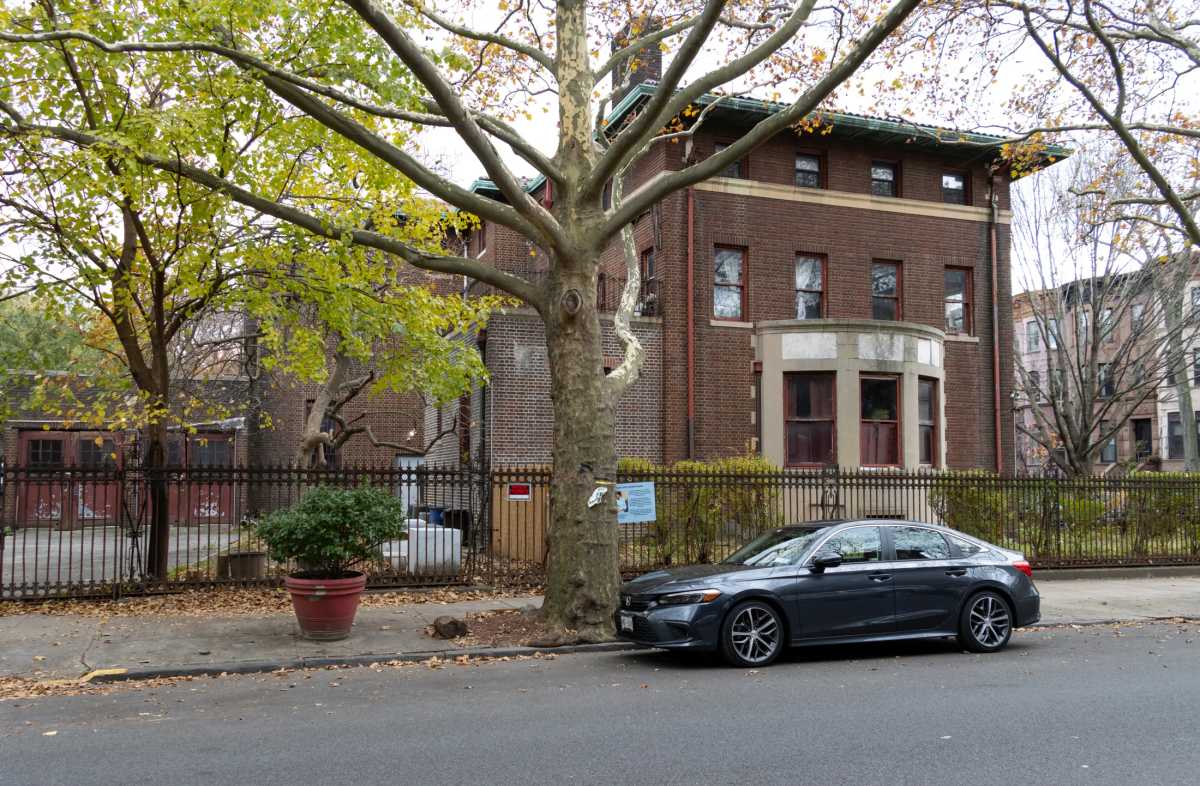
A group of Bed-Stuy residents is scrambling to take community ownership of a historic early 20th-century mansion on Stuyvesant Avenue following a court-ordered sale, organizing to form a community land trust and raise millions of dollars to buy and repair the property before it is sold to a private buyer.
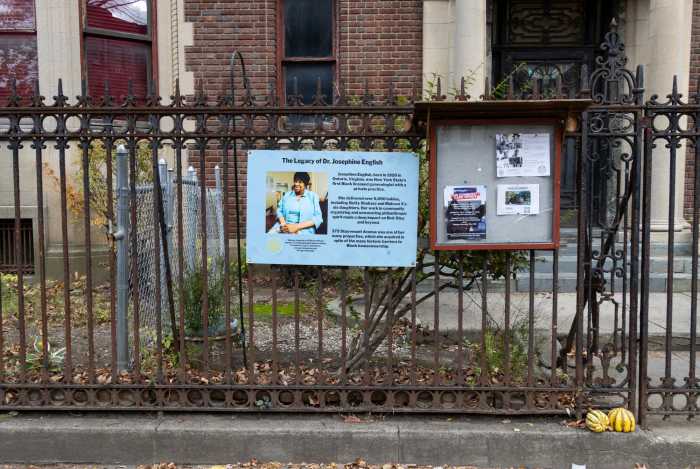
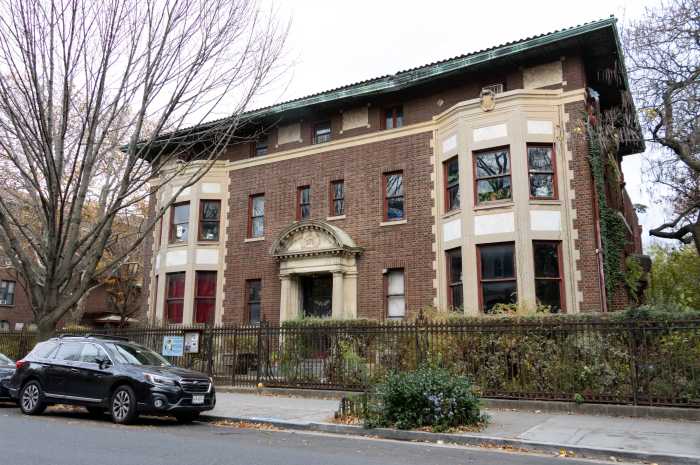
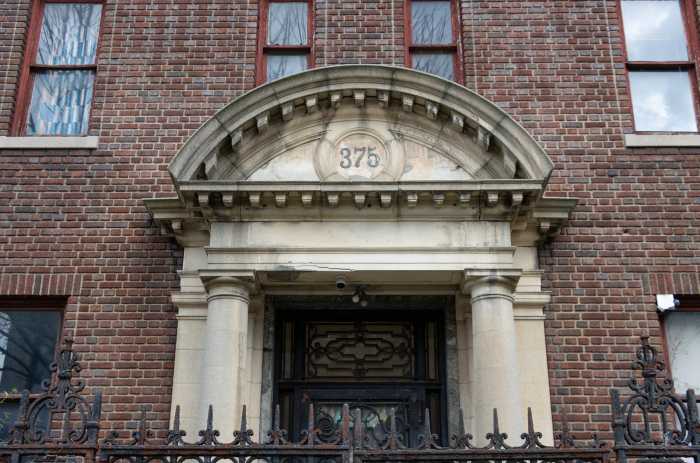
The Renaissance Revival brick mansion at 375 Stuyvesant Ave., on the corner of Decatur Street, was built in 1914–1915 by Henry P. Kirby and John J. Petit in what is now the Stuyvesant Heights Historic District. It was purchased by Dr. Josephine English in 1973, the state’s first Black woman gynecologist and the first to open a private practice.
For years, the eye-catching mansion has served as a hub for local businesses and nonprofits. The building is classed as a “community center,” and contains one residential unit and one commercial unit, according to PropertyShark. The interior has Arts and Crafts details and should be preserved, said a recent story in the Amsterdam News. From the 1970s through the 1990s, it was used as a community center for seniors, a certificate of occupancy from 1976 shows, and more recently it has housed a school, Seasons plant nursery, cafe, and exercise and art classes. It has also been used as a film set, including for the HBO series “Boardwalk Empire.”
But since English’s death in 2011, the future of the mansion, and other properties she owned, including the landmarked Paul Robeson Theater at 40 Greene Avenue and the former Adelphi Medical Center at 54 Greene Avenue, has been uncertain. All of the properties have fallen into states of disrepair.
Disputes between her sons and grandson over the management, ownership, and sale of the properties have resulted in yearslong court fights. Most recently, court documents show that a stipulation signed by the legal reps for all parties was entered in October, stating that the properties will be sold together for at least $9.2 million.
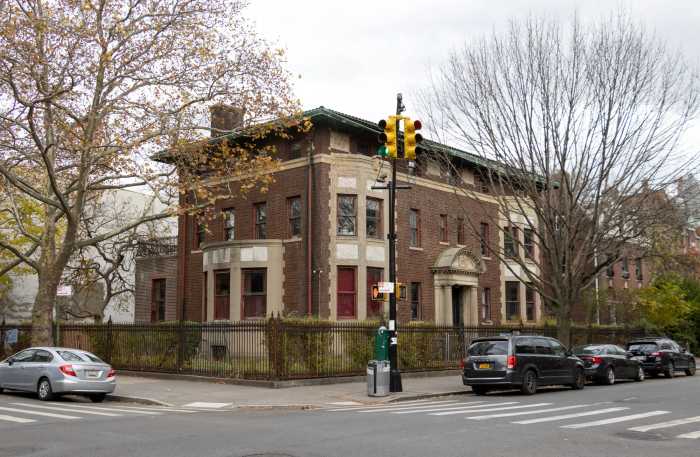
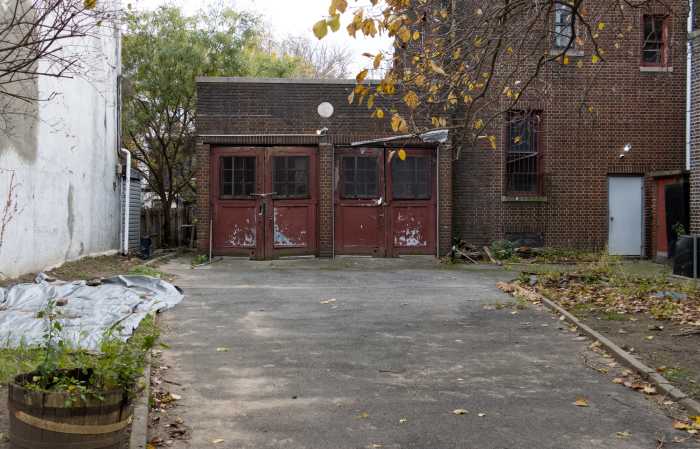
English’s son Ira Barry Sheppard was named executor of her estate, and his attorney says in court documents that in an effort to fund repairs, maintenance, and taxes, he has “diligently engaged in efforts to, inter alia, redevelop, rehabilitate, rent and/or sell the Estate Properties in connection with his administration of the Estate.” At one point, those efforts included a partnership with DXA Studio, where plans were made, but ultimately rejected by the community and the Landmarks Preservation Commission, to build a five-story residential building on the Stuyvesant Avenue site.
Preserving a legacy
Over the past couple of months, after locals learned the mansion could fall into the hands of a private buyer and no longer be available for community use, a mobilization effort has taken shape to try to bring the building under community ownership. One of the lead organizers is Shanna Sabio, who in 2017 formed the artist collective GrowHouse with her son out of their former Bed-Stuy brownstone.
In 2020, as the pandemic hit, Sabio began looking into community land trusts as a way to stabilize longtime Black residency and create safe, creative spaces during a period of what she called intense gentrification and change in the neighborhood, the same motivations that had spurred GrowHouse. Community land trusts are generally nonprofits that take ownership of land for community benefit, while buildings on that land can be owned by individuals, groups, or businesses that follow the trust’s mission. There are a handful of land trusts in New York City, largely overseen by the NYC Community Land Initiative.
The goal, Sabio said, was to build creative incubator spaces and stabilize community buildings through a nonprofit organization led by legacy Black residents. From that vision, the BLAC Land Trust was formed, and it received its 501(c)(2) status earlier this year.
It was also this year that Sabio, who was born and raised in Brooklyn and lived in Bed-Stuy for 30 years, first went inside the mansion after walking past it countless times. She was searching for a space to house a GrowHouse pop-up after receiving funding. While her pitch to the landlord was ultimately rejected, she said she never gave up on trying to find a way to bring 375 Stuyvesant Avenue into community ownership through the BLAC Land Trust.
“It’s just too important of a building to be speculatively developed and to have the community go ‘oh there goes another building’.” That importance, Sabio said, stems from English’s legacy and accomplishments, including her work with Malcolm X’s wife, Dr. Betty Shabazz, to strengthen Black maternal health. English delivered the couple’s six daughters.
“These are things we’re still talking about now, but they were pioneers,” Sabio said. “How do we keep our community safe, continue our legacy, continue our lineages?”
In addition to English’s work in maternal health, Sabio described English as a “multifaceted Renaissance woman” who was a patron of the arts, created affordable housing and healthcare through the buildings she owned, and sought to educate her community. “She just seemed like she was moving with this mandate that I think we have to continue, that’s what moved me.”
Landmarks Preservation Commission documents prepared during the landmarking of the Paul Robeson Theater detail how English moved to Brooklyn in 1956 and, within two years, opened a women’s health clinic on Bushwick Avenue. She later opened the Adelphi Medical Center, a senior center, a daycare center, an after-school program, and a summer camp for neighborhood youth.
“In 1986 she opened a freestanding ambulatory surgical center, the first woman licensed to do so by the state,” the documents say. “Dr. English also recognized the role that the arts played in the community and purchased St. Casimir’s Church in 1980, converting it into The Paul Robeson Theatre… ‘to enrich and strengthen the community through art, culture and education.’”
Building a land trust
Over the past couple of months, the BLAC Land Trust has organized dozens of neighbors passionate about achieving community ownership of the storied building and has begun fundraising in order to make an offer.
“It’s been really heartening to see how many people have expressed interest in sitting on the BLAC Land Trust’s board,” Sabio said. Some have experienced the loss of family property in the area, she said, and have told her they want to “transmute my grief into actually preventing this from happening again.” Some, she said, are bringing a range of technical expertise.
A petition calling for community ownership has attracted more than 8,000 signatures, and a GoFundMe has raised $5,800, a sign that “both newcomers and legacy residents” are eager to work together, Sabio said.
“I think if we offer an opportunity to develop communities together and bring people together to have conversations about what attracted you to our neighborhood, it’s the culture, right? How do we preserve that culture and ensure that the culture doesn’t disappear? I think having those kinds of conversations is what we’re about, and then beyond conversations, putting action to it.”
Sabio said the group has been in touch with lawyers for English’s sons and that an offer from another potential buyer may already have been received. Court documents indicate a potential buyer made an offer of $8.5 million for the three properties. If the group is too late to purchase the mansion directly from the family, it will try to approach the new owner, she said, adding the BLAC Land Trust would be willing to offer $5 million.
The group is currently trying to raise at least $1.5 million over the next 60 days for a down payment. In addition to community fundraising, organizers have reached out to local politicians, whom Sabio said have signaled interest in supporting the effort, as well as impact investors. The group is also exploring a loan from the New Economy Project. Beyond the purchase price, Sabio said they have been quoted roughly $5 million for a low-cost renovation.
If the land trust is successful in acquiring the property, Sabio said it would be managed by a board structured in three parts: one-third made up of people who live or work in a community-stewarded space; one-third community members from the surrounding area; and one-third people with technical expertise, such as architects, urban planners, lawyers, and developers.
“The fact that the Community Land Trust is a not-for-profit venture for us, baked in this anti-gentrification, anti-displacement, community guided vision and mission, that’s what really appealed to us.”
A plan for community growth
If acquired, Sabio said it would be up to the board to decide how the building is used. At a late November community meeting, residents discussed using the space as a small business incubator, event venue, and health and education hub. Over the last month, weekly meetings have seen ideas develop around membership models for use, co-working, and special programming, as well as having some revenue-generating food and beverage space.
Sabio said anyone operating out of 375 Stuyvesant Avenue would be required to adhere to the mission of community ownership, but could potentially run a revenue-generating business in a way that allows for profit sharing and debt repayment. The group has even discussed issuing an RFP for a small food-service business, offering a place for a new business to grow.
The group has looked to other land trusts across the city for guidance, including the East New York Community Land Trust, which last year acquired a residential property, and South Bronx Unite’s Mott Haven–Port Morris Community Land Stewards, which was recently granted a 99-year ground lease by the city to transform the former Lincoln Recovery Center into a hub for health, education, and the arts.
Sabio said that alongside the nonprofit land trust, focused on helping longtime residents who are asset rich but struggling to remain in their properties, the group is also exploring a more investment-focused vehicle. That structure, she said, would allow people with greater financial resources but aligned values to invest in local commercial spaces to support a more stable small business ecosystem.
If the BLAC Land Trust is unable to acquire the mansion, Sabio said the group will continue fundraising, noting that while 375 Stuyvesant is unique, it is far from the only building at risk of imminent sale. “There are tons of people who are probably struggling in silence to hold onto their assets, so we want to be prepared and not always operating from a place of urgency, so we have a fund if you will,” she said.
Attorneys for English’s sons did not return requests for comment.
Whoever ultimately buys 375 Stuyvesant Ave. will need approval from the Landmarks Preservation Commission for any planned work, as the property sits within a historic district. During that process, the public will have an opportunity to weigh in on any proposed changes to the building’s exterior and its architectural relationship to the surrounding neighborhood.
For now, Sabio is encouraging others interested in the mission to visit the mansion, get involved with the land trust and, if able, donate, adding that the level of support so far shows there is significant drive in the community to preserve the building and Dr. English’s legacy.
This story first appeared on Brooklyn Paper’s sister site Brownstoner