
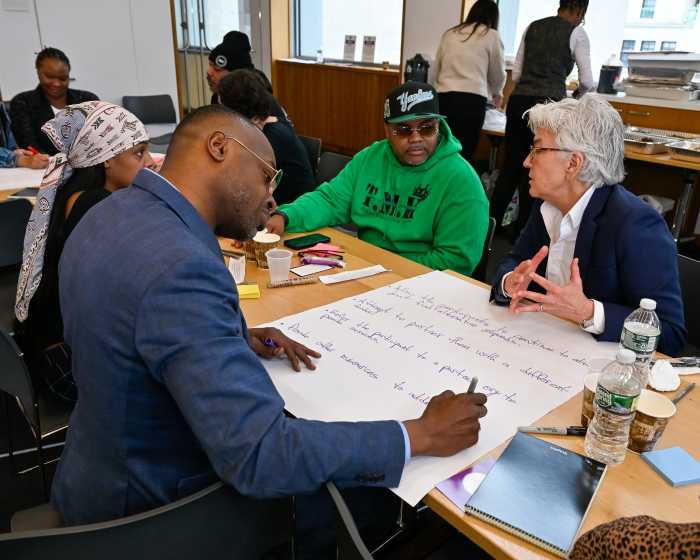
Building on the success of Project Restore Bed-Stuy (PRB), a 12-month, community-based gang-violence intervention pilot program launched in 2023, the Kings County District Attorney’s Office (KCDA) and its partner organizations convened for a brainstorming session at the NYU campus in Downtown Brooklyn on March 11, seeking to strengthen cross-agency collaboration and clarify the roles of each organization ahead of the planned launch of Project Restore Brownsville in the coming months.
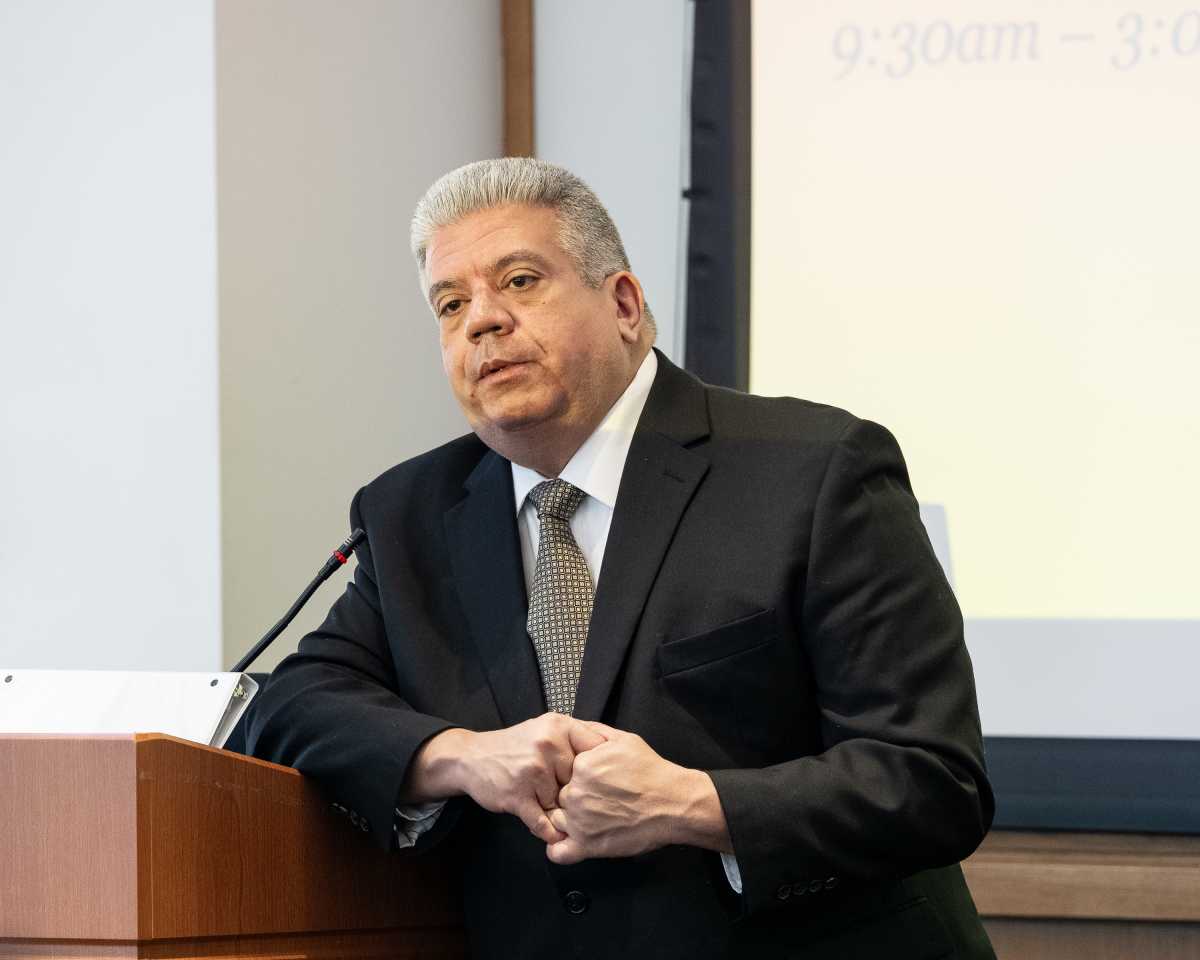
After the takedown of two rival Bed-Stuy gangs in 2021, Brooklyn District Attorney Eric Gonzalez, in collaboration with Columbia University’s Center for Justice, the Mayor’s Office of Criminal Justice, KCDA, Bridge Street Development Corporation and Inside Circle, launched PRB based on a joint policy proposal drafted in 2019 by New York City lawmakers and the Justice Ambassadors Youth Council (JAYC) program at Columbia University.
The community-based initiative aimed to de-escalate and reduce gang violence, limit law-enforcement interactions, and provide 30 young men ages 18 to 30 from two rival gangs or street crews with a holistic, structured path toward stability. The program offered education and workforce development, internships, life-skills training, individual and group therapy, and mentorship from former gang members on issues such as conflict resolution.
The program had a 100% success rate: all participants graduated; seven enrolled in college, one completed high school, three enrolled in GED programs, and 43% earned employment credentials, according to Columbia University’s Center for Justice post-evaluation report. Participants also contributed to community safety by holding speaking engagements and organizing community events.
Gonzalez said programs like PRB contributed to a substantial reduction in shootings and homicides. The initiative in Bed-Stuy led to a 28% drop in shooting incidents and a 22% decrease in felony assaults, and prevented five retaliatory shootings and an estimated 12.5 years of incarceration.
“Programs like this are the cause of that,” Gonzalez told Brooklyn Paper, noting that 2025 was the safest year in Brooklyn’s history. “What’s amazing about these young men’s transformation is that they choose to participate. They’re not being mandated by a court, the US attorney, or the district attorney to be involved. They choose to be involved, and so they create the right mindsets for themselves, and we provide the right stimulus.”
Gonzalez said the project’s next phase in Brownsville — a neighborhood that saw the largest decline in homicides in 2025, with seven murders compared with 21 the previous year — will build on recent gains in crime reduction.
“We’re investing in Brownsville now because we want to keep that progress,” Gonzalez said, adding that, contrary to arguments that gentrification drove falling crime rates, “there’s no real significant gentrification in Brownsville or East New York.”
“We look at the crime stats, the shooting numbers are down in Bed-Stuy, in Brownsville, in East New York; neighborhoods that have not seen that type of gentrification,” Gonzalez said.
De’Shawn Willis, Darnell Bowers, Tahari Spencer, Titus Smith and Jonathan Arroyo are among the 30 participants who graduated from the project in 2024. They described the program as a “game changer” and told Brooklyn Paper it gave them a “second chance at life” while also benefiting the broader community.
De’Shawn works as a participant engagement coordinator at the B.R.O. Experience Foundation, a nonprofit that offers trauma-informed mentorship and programs, including cognitive-behavioral therapy. He told Brooklyn Paper that before joining PRB, he spent “a lot of time in the streets.” When he turned 30, he realized he needed to change his life. He joined the program and completed it with a perfect attendance record.
“I was motivated,” De’Shawn said. “I had perfect attendance when I was outside in them streets. Why wouldn’t I do it for something positive?”
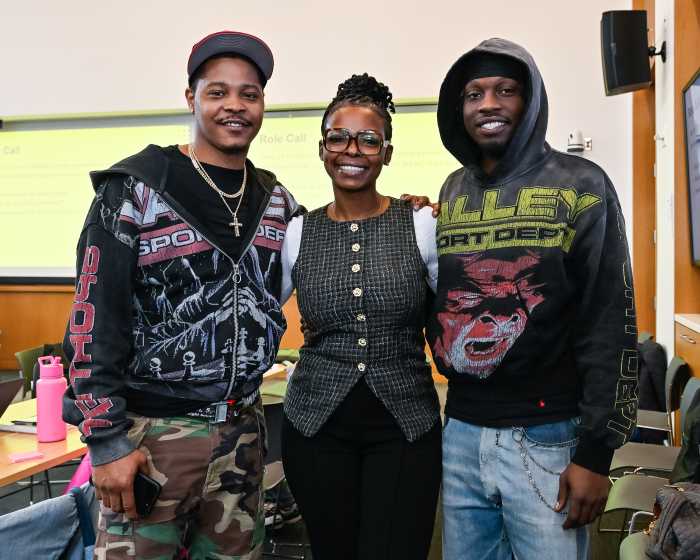
About two years ago, he joined the B.R.O. Experience Foundation as a community coordinator and community change facilitator. The work, he said, is fulfilling.
“I want these young guys to experience freedom. I want these young guys to experience life. I tell them all the time, ‘If you stay in just one neighborhood, one area, and you’re not going out exploring this world, you’re still technically in jail. You’re still technically incarcerated,” De’Shawn said.
Darnell, who also works for the B.R.O. Experience as a program outreach coordinator and serves as a Center for Justice ambassador at James Baldwin High School in Manhattan alongside Tahari Spencer, said PRB helped participants find the tools to build bridges toward the future.
“I’m just trying to make sure all the things that I learned, that helped me change my life around, that I can just spill back into the community. Because I always believed that not everybody has the chance to leave where they grew up, but that doesn’t mean that you can make it better and livable,” Darnell said.
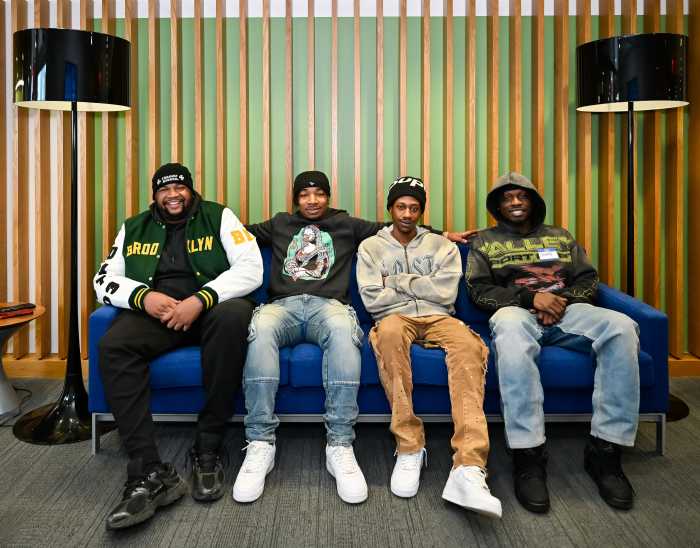
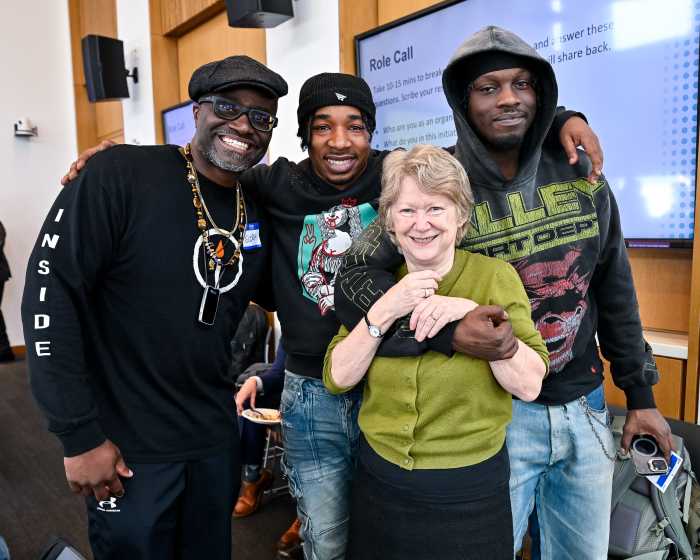
Tahari, a journalism student at Kingsborough College, and Titus, a full-time student at Kingsborough Community College who is preparing to graduate with a major in mental health and human services — both now full-time outreach coordinators at Man Up Inc., a Brooklyn-based violence-prevention organization — said programs like PRB are an antidote to overpolicing.
“These types of programs, if you had these in neighborhoods, [there] would be less violence. You would not have to put more police in,” Titus said. “I’m glad we had the opportunity to be the examples to show that it actually can work. Now we talk about [expanding the program]. I’m glad that the city is taking a shift into changing how we react to crime, and letting the community be a little more hands-on about the situations that happen in their community.”
Tahari said that after graduating from high school, he lacked a “sense of direction,” and that PRB gave him a blueprint for his life by providing opportunities and connections.
“It’s easy to just put more police in the neighborhood and just send more people to jail, but that will never be the answer to the problem,” Tahari said. “There are circumstances and underlying issues and needs that aren’t being met that cause people to be desperate and do these things that they’re doing. It’s never as simple or as black-and-white as someone just wants to commit a crime. It’s never like that.”
Jonathan, a violence interrupter and supervisor at Man Up! Inc., said that in addition to providing a foundation, PRB helped bring the community together.
“I didn’t see this in over 20 plus years; to see how we are as a community now, and see how me and my friends, Titus, Tahari, and Darnell, how we are now, and coexist with each other, it’s been a beautiful thing, and that’s what Project Restore actually did,” Jonathan said.
Implementing a program like PRB showed that the Brooklyn district attorney valued them as human beings, he said, and that community members finally received the attention they needed.
“We have someone who actually humanized us and said, ‘Hey, listen, it’s more than just crime. It’s about pain. It’s about agony. It’s about the other things that come with crime, and not just crime alone.’ And to have someone to pay attention to that that’s important to not just only me and us, [but] to the whole community, to the next generation,” Jonathan said.
Representatives of Inside Circle, an organization that provides reform programs for people affected by the justice system, highlighted the importance of investing in justice-involved communities by addressing underlying problems.
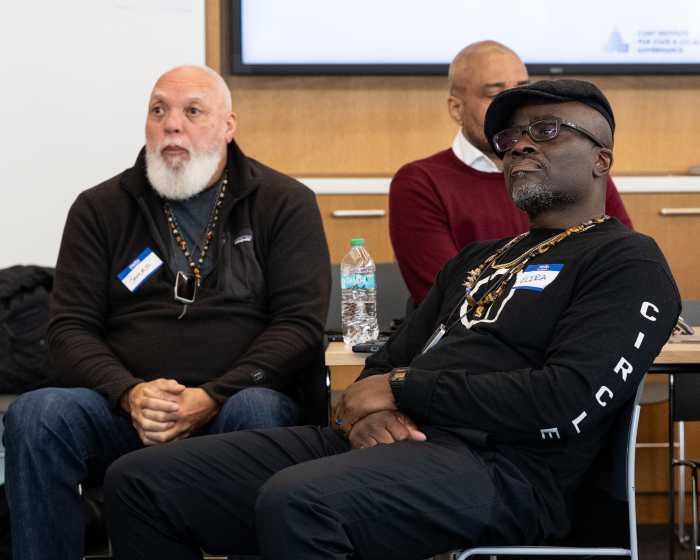
Dr. James McLeary, an Inside Circle elder and board member, said many justice-impacted young men struggle to find purpose.
“The work we do is about wellness and wholeness. If you ask most young men what they want to be in their lives, they don’t know. If you ask them when they think they’re going to die, they think it’s going to be sometime in their early 20s. So when they discover their purpose, they see beyond the life that they’ve been living,” McLeary said.
Inside Circle Executive Director Eldra Jackson III said Gonzalez took a “leap of courage” in launching the initiative.
“There’s no such thing as community safety without whole and healthy individuals who feel safe within themselves. That’s where it starts,” Jackson said. “[Gonzalez] understands the problems and the issues that are at epidemic levels in our communities. He understands that you cannot arrest your way out. You have to have community members be a part of the solution.”