
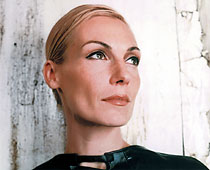
"Everything’s good here," gushes
the ebullient voice at the other end of the phone.
Ute Lemper, the naughty goddess of European cabaret, the German
ex-pat Manhattanite who has forged a career carrying the torch
songs of her native country and neighboring France (think Weimar
era, think Edith Piaf) forward into the 21st century, sounds
positively girlish. Not what one would expect from the almost
menacing sexuality of her publicity photographs, typified by
a withering, Dietrich-like, eyebrow-arching glare that contains
an implicit challenge: "I dare you to break my heart – just
try it."
Lemper is preparing for the next in a series of Brooklyn Philharmonic
50th anniversary shows, "Weill Goes Brooklyn" (March
26 at 8 pm in the Brooklyn Academy of Music’s Howard Gilman Opera
House), where she will bring her sensual theatrical persona to
bear on a concert version of Kurt Weill’s ballet chanté,
"The Seven Deadly Sins."
But this woman on the phone, this other Ute, is an Upper West
Side mother of two – a girl and boy, 8 and 10, respectively –
with workaday New York concerns ranging from the cost of the
city’s private education system to the cost of its real estate.
"I think those two personalities – it’s an opposition that
needs to exist for me," says Lemper. "There’s this
very extravagant, sexual performance identity and the intelligence
and provocation that goes with it. And in order to let this live,
I need to have this center in my life, which is the complete
down-to-earth life with the real worries."
That’s how Ute the enthusiastic, girlish mom, can cross the park
to the Cafe Carlyle and slip so easily into the skin of the other
Ute, whose jaded sexuality and knowing world-weariness is so
perfectly attuned to the European cabaret repertoire she’s known
for celebrating on the world stage. Lemper’s BAM performance
later this month will require a similar juggling act as she takes
on the role of Anna of "Seven Deadly Sins," whose opposing
halves were represented by Weill and his librettist Bertold Brecht
as Anna I (a singer) and Anna II (a dancer).
"It’s so special to be doing this in Brooklyn with the Philharmonic,"
says Lemper. "The story is a bit dated, the whole psychological
split between the two Annas – the whole super-ego of Anna I imposing
the laws of capitalist society on her under-ego, Anna II, who
is subject to temptation. It’s dated, but it’s still funny, and
it captures the revolutionary spirit of the time."
Musically, Weill’s superb, lively score has a way of counteracting
the mustiness of Brecht’s textual polemic. The BAM lineup will
include Hudson Shad, an internationally renowned vocal ensemble
that will interpret Anna’s "family," and conductor
Carl St. Clair, currently in his 14th season as music director
of Orange County’s Pacific Symphony.
The concert represents Lemper’s BAM debut and is yet another
door opening for this Euro-chanteuse whose busy international
touring-schedule did not initially translate to her New York
reality (she first moved here in 1998 to play the vixen Velma
Kelly in the long-running Broadway revival of "Chicago").
"This whole New York experience has finally kicked in for
me," she says. "I was actually waiting for this to
happen thinking, ’OK, here I am touring. I’m in San Francisco,
Los Angeles, Washington, Boston, all over Europe, in Australia
– what’s up with New York?’"
Lots, if the past year is any indication. In addition to her
evolving recording career and the upcoming BAM performance, recent
Gotham gigs include a show at Central Park SummerStage last summer,
a performance with Orpheus Orchestra at Carnegie hall last December,
a two-month run at the venerable Cafe Carlyle, a one-week run
at Neue Gallery, and a two-week stint at Joe’s Pub.
Back in ’98, of course, it was "Chicago" – which she
also performed on London’s West End, winning the 1998 Olivier
Award for Best Actress in a Musical – for eight shows a week.
"After ’Chicago,’ I went straight back on the road with
my own stuff and got back to my own recordings," she says.
Currently, Lemper’s in the studio working on her first album
of self-penned songs. She’s also preparing for the June release
of a live album recorded during her recent run at the Carlyle;
it will be her first live release since 1987.
"This schedule is so rewarding," says Lemper, "because
it offers such a larger variety for a performer than just to
be inside one Broadway role."
There is one role, however, that Lemper will likely never give
up, and that is her unofficial role as torch-carrier for a certain
era of European cabaret repertoire.
"It suddenly dawned on me that there is a responsibility
there," says Lemper, who continues to bring songs by the
likes of Weill, Piazolla, Eisler and Brel to a contemporary audience.
"At first, it just seemed the most daring and fun and meaty
repertoire for me to explore. And then it was too many times
that I read and heard from people that I’m the true inheritor
of this repertoire."
Lemper pauses, as if considering the implications of this professional
obligation for the first time.
"I’m very happy about this responsibility, and I treasure
it."
Jeff Breithaupt is the co-author
of "Precious and Few: Pop Music in the Early ’70s"
and "Night Moves: Pop Music in the Late ’70s" (St.
Martin’s Press).
The Brooklyn Philharmonic presents "Weill
Goes Brooklyn" on March 26 at 8 pm in the Brooklyn Academy
of Music’s Howard Gilman Opera House, 30 Lafayette Ave. at Ashland
Place in Fort Greene. Vocal soloist Ute Lemper and conductor
Carl St. Clair will participate in a post-concert talk titled
"For Good Measure." Tickets are $20-$60. For more information,
call (718) 636-4100 or visit www.brooklynphilharmonic.org.