
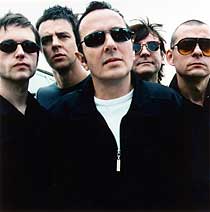
Joe Strummer is, at age 49, a punk rock
legend who feels he has a lot left to prove.
With his 3-year-old band, the Mescaleros, Strummer broke an almost
11-year album recording drought in 1999 with the well-received
"Rock Art and the X-Ray Style." Last year, the Mescaleros
released "Global A Go-Go," an 11-song CD whose music
and lyrics rival his best work with the Clash.
Recorded on Epitaph’s Hellcat Records label – an association
that Strummer credits with allowing him the freedom to record
his music, his way, free of the trappings of major-label demands
– the CD explodes with the energy of a poet-musician who has
been muzzled for too long.
The London-based Mescaleros — Martin Slattery on keyboards and
horns, Scott Shields on bass and guitars, Pablo Cook on percussion
and drums, Richard Flack on various effects, and Tymon Dogg,
one of Strummer’s oldest mates dating back to their days busking
in the London Underground (Dogg wrote "Lose This Skin"
from the Clash’s "Sandinista" album) on violin, mandolin
and Spanish guitar — paint a musical masterpiece infused with
world beats and out-of-this-world playing.
At the core is Strummer, picking up as if these were the records
that followed the real Clash’s finale, "Combat Rock."
It was with the Clash, though, that Strummer forged his legacy.
The Sex Pistols may have fired the opening shots in the punk
revolution of the late-’70s but it was Strummer’s Clash — "The
only band that matters" — who led the charge.
Where the Pistols merely shocked the sensibilities, the Clash
took up the cause — whatever cause might be handy, in fact,
from London squatters to Salvadoran rebels. More importantly,
they delivered the goods, both in the studio, and even more so
in the most electrifying, balls-to-the-wall live rock ’n’ roll
performances before or since. Strummer, Mick Jones, Paul Simonon
and Topper Headon left it all on the floor, every night they
played.
The Clash reached their recording zenith with 1979’s "London
Calling," which Rolling Stone magazine declared "the
album of the decade" in the ’80s, as if fans needed that
clarified.
And then, just as major headliner success was biting at their
ankles in 1983, the principles, Strummer and Jones, split up.
After disbanding the already shattered Clash in 1985, Strummer
tooled around on a few film soundtracks, acted in a few movies,
played on Bob Dylan’s "Down in the Groove," served
as occasional sideman with the Pogues and in 1989 released his
first solo record, "Earthquake Weather."
He didn’t release another until "X-Ray Style."
"It wasn’t a deliberate decision to take an 11-year breather,
but in the long run it’s turned out well," Strummer has
said. "Sometimes you save the best for last."
Indeed, Strummer’s pent-up lyrical and musical energy is in full
flow now with the Mescaleros, a band that seems to feed off his
energy and punk sensibilities without being overshadowed. Strummer
finally has a band again.
This week, Strummer and the Mescaleros settle down in DUMBO at
the St. Ann’s Warehouse on Water Street for a five-night stand
(April 1, 2, 4, 5 and 6). Strummer spoke with GO Brooklyn this
week in a telephone interview from his home in Somerset, England,
where he lives with his wife, Lucinda, and three daughters.
Interviewing Strummer, who takes a hands-on approach to promoting
the Mescaleros, spending by his account, about a third of his
time on telephone interviews worldwide, is like chatting with
an old pal in a pub.
"What time is it there?" Strummer asks a reporter.
"2 o’clock," the reporter answers.
"In the afternoon?"
"Uh huh. What is it 7 o’clock by you?"
"Yeah, which means I can have a glass of wine and you cannot,"
Strummer says, emphasizing the ’not’ and then chuckling. "Sorry
for rubbing it in there."
GO Brooklyn: How
did you guys come up with St. Ann’s Warehouse as a venue for
all five dates?
Joe Strummer:
Well. I think trial and error. What were we looking at, I think
the Bowery Ballroom … and then I think maybe we thought of
this late in the day and then probably those things are booked
and so therefore we scout around the city and you turn up things.
I’d actually been there before once, years and years ago to a
kind of charity/comedy ’30s boxing match.
GO: Really, in Brooklyn?
JS: It
was in the same joint, yeah. It was put on by actors and, for
some reason I can’t remember, this must have been 10 years ago,
the theme was of Damon Runyon, everyone was in ’30s dress. And
it was pretty good fun in there, actually.
GO: Did you come dressed up?
JS: No,
like a fool I just got off from the airport so…
GO: The five-night gig at St. Ann’s is reminiscent of
the Bonds gigs, when you were scheduled for a week and it turned
into two weeks on Broadway. [In June 1981, the Clash were
slated for five nights at a former Times Square clothing store
converted into a huge nightclub, the Bond International Casino.
The promoter oversold the shows, and then someone called in the
fire marshal and the band wound up playing an additional five
nights to even things out.]
JS: Right,
well, um, actually I think five days does it here. (laughs) Yeah,
but it’s the same idea, because we’re really, we’re doing it
for us, to be honest, because it means the band and the crew
can have it in a town and hang out, and generally get a flavor
of the town. ’Cause you can imagine what it’s like when on the
usual road trip bang … you’re in, you’re out.
Your feet don’t even touch the ground, really, literally, and
it can get a bit odd, you know, if you race through 20 cities
like that. You start feeling a bit strange. It’s a bit like walking
through walls or you know, like you’re not exactly existing in
the same level or plane of reality that everyone else is ’cause
you go in and out of cities so fast. It’s just bizarre. You’re
not even traveling.
GO: Have
you had a chance with the Mescaleros to play any long gigs like
that?
JS: Well,
yeah, we started doing it, let me think, in October, no November,
last year when we put up for five nights at the LA Troubadour
on Santa Monica Boulevard, and that was kinda nice. I think it
gave us the [idea that] if any city’s big enough we’ll probably
try and just kick in for a few days and just chill out.
GO: Plan
on checking out the nightlife in Brooklyn a bit?
JS: Well,
I’d like to check out whatever’s going on, even if it’s DJs or
groups, or, yeah, I’d really like to have a look around. We hear
there’s a renaissance in New York.
GO: Absolutely,
especially in Brooklyn.
JS: Alright!
GO: You
played Irving Plaza about a month after Sept. 11 [Oct. 9 and
10]. What was the mood like for those shows?
JS: Well,
for us it was great because people were glad that people were
coming into town. It was just the right moment, because at first,
when I saw, when that thing happened and I saw we were like booked
three weeks later into DC, and then New York, I thought, "God,
a rock ’n’ roll group’s the last thing they’re gonna wanna hear,"
you know? But finally, by that time we got there, people were
going, "Yeah let’s have something. Let’s go out for a night."
And so, yeah, it was good.
GO: What
was your take on Sept. 11? You were in England at the time?
JS: Yeah,
I mean, yeah after the shock you begin to think, you have the
time to evaluate what they were capable of, like did they have
an encore? I think we can probably say now — what is it six
months later? — now we can probably, hopefully think that they
haven’t got anything that big in the pipeline. Maybe that was
their finest hour.
GO: I
guess you hope so, although the government thought the 1993 WTC
bombing was the worst that could happen, too.
JS: Yeah,
I see, right, God.
GO: What
do you think of the U.S. response to the attacks?
JS: Well,
I think that it had to be done, because we shagged around in
Europe when Hitler — Hitler was putting his machine together
from about, I don’t know ’33 — so we gave Hitler six years really,
to build that thing into a gigantic machine, and each one of
those tanks we had to fight, each one of those shells and bullets
we had to take on, boats and submarines and what have you. And
so I think that over here there’s a very much, you get brought
up with that feeling of, "Next time we don’t let ’em get
away with it."
That was always the unsaid thing in my childhood, you know, when
your fathers and people would sit around talking about the war,
that was the underlying theme — alright, next time we’ll do
the guy in ’36 and not wait until 1939. Fifty million people
died! So, um, from over here in Europe we’re very much of the
"nip it in the bud" school, ’cause who knows what the
guy [Osama Bin Laden] — you know there was definitely, he would
have had a nuclear bomb for sure. For sure, he would have.
GO: You
were kind of critical of former Mayor Giuliani’s enforcement
of night club rules and anti-smoking regulations. What did you
think about his national hero status after Sept. 11?
JS: I
think he was really just magnificent, you know, and it’s kind
of like, I’m kind of like a street rat moaning about it down
on the street but you know, perhaps you’ve got to look at the
wider aspects of getting the city free of fear and crime, which
is something that we’re gonna have to do now. You know
it’s getting quite out of hand here in London. I certainly wouldn’t
drive around London in a car worth more than a certain amount
or wear a watch worth more than a certain amount.
GO: Not
just in certain areas anymore, but throughout?
JS: No,
exactly, good point, everywhere. There’s a lot of gun spraying
going on around here.
GO: Are
these the only US dates scheduled so far?
JS: Well,
yeah, they’re the only ones. Yeah. They’re kind of a one-off,
’cause really we’re in the middle of trying to come out with
a new — a new masterpiece.
GO: A
new Mescaleros album?
JS: Yeah,
we’re really trying to come up with something and, um, I think
it’s quite good ’cause if we can get some stuff ready we might
be able to bring it out and judge and get an audience reaction
on it. A couple of tunes maybe. Also, it keeps you from becoming
like a studio boffin. You know, you gotta get out on the road
and interact with people. I think if we were an electronic dance
act probably we’d sink into the studio and never come out.
GO: But
you need to get that live response…
JS: You
do really, yeah. I think it really helps to push your music forward,
as well, because you’re not in a vacuum. In a room it’d be easy,
if you kinda never came out of that room, you might spin off
into your own kind of stratosphere, but taking it on the road
and playing it for people is a great thing in a million ways.
GO: What
do you do when you’re not touring?
JS: Well,
mostly, I’m either on the phone, OK, so you can say my year,
you can divide it into three really – singing and recording and
writing and rehearsing with the Mescaleros, and then a third
of the year talking about it on the phone to Brazil, or Czechoslovakia,
Uruguay, you know these are all places that I do phone interviews
to, and then the other third, get on a bus and take it out. But,
uh, it is bizarre. I’d like to get rid of the phone third. (laughs)
GO: You
need to get someone to do all that promotion work for you.
JS: Well,
yeah, I missed the chance, ’cause Bob Dylan doesn’t have to do
any. I should have — I don’t know, just making fun. Also, I
get to talk to people like you, it is fun, although I moan about
it in advance, but when you actually come to do it, it is quite
informative.
GO: OK,
lets talk about your music a bit …
JS: [Deadpan]
Oh, f– that.
GO: So,
how did "The Minstrel Boy" wind up on the "Black
Hawk Down" soundtrack?
JS: Oh,
it’s a really weird chain of events, and it again tied into New
York, but for some reason, connected to nothing really, we decided
to record that tune and then put it on the record. And of course
after the Sept. 11 s– went down, that tune suddenly became the
famous tune at wakes and funerals for the firefighters and the
victims.
About a year before that we started to play that, as an intro
number anyway – kind of weird little warm-up number – and so
we continued doing that and when we hit Hollywood, or hit LA
… a music supervisor down in Hollywood was in the audience
and just thought, "This is just what we need" after
all the shooting and God knows what in "Black Hawk Down,"
for the song that would fit in the credits, the song that you
get up and grab your coat to.
It got in like that.
GO: It’s
a slightly different and shorter version on the soundtrack than
what closes "Global A Go-Go" …
JS: Yeah,
they figured, do a bit of singing on it and stuff so we went
and cut it again.
GO: The
"Global A Go-Go" version is really long, but also very
moving and you just sort of want to leave it on…
JS: I
know, isn’t that strange? I had to decide that. I knew that there
was something really strange here, a really long bit of music
but there’s something mesmerizing, and there’s not a lot on that,
there’s three guys twice on it, but yet it’s something and it
has that vibe — you know, it’s a first take, one of those real
moments in time. I really enjoy those. But usually you hash over
and over things and like re-take them, redo ’em, but now and
then something pops up that’s just fine like it is.
GO: Corporate
takeover, especially of artistic outlets seems to be a theme
of the song, "Johnny Appleseed."
JS: Yeah!
GO: Do
you think there’s still bands out there, besides you guys, that
are not taken up by that?
JS: Well,
it’s always easy for us to say, ’cause I’ve got a really good
relationship with Hellcat Records, and we have a kind of punk
thing going, but punk reliant of respect. But in other situations
it’s really difficult ’cause they do have bands over a barrel.
’Cause you’re a young group, you’re teens, you want people to
hear your music, you’re in a great place to be levered, and you’ve
got really no defense from people to make it sound more bland
or take the sting out of it or whatever, when there really, there’s
a lot of carrots to be dangled.
So it’s very difficult isn’t it? I mean, I don’t know if you’ve
heard, but over here they’re cutting 1,800 jobs from EMI, and
then they’re blaming poor Mariah Carey for it. (Laughs)
GO: There
won’t be any Clash or Mescaleros songs hawking merchandise will
there?
JS: Yeah,
I mean, um, we’re up for anything really, but I have a kind of
– we get asked a lot. Especially Clash, obviously, Clash stuff.
You know we’ve turned down a lot of beer companies, some cosmetic
companies, but I still think it’s good to be available. You know,
I wear jeans every day, hey, why not advertise jeans?
GO: Why
not get paid for it? …
JS: Yeah,
and if there was some good liquor that you thought was good,
I wouldn’t balk at that either. Providing it was decent liquor
and not some cheap trick stuff, but yeah I think definitely we’ve
had, uh, Levi’s adverts, all kinds of things [offered].
GO: Is
that something that you and Mick and Paul would have to get together
and decide?
JS: Absolutely.
It goes through a very rigorous — yeah once there was a big
row, I remember, about Spanish whiskey, a mark called Ballantine,
and Mick was against it, and me and Paul were for it. But Mick
didn’t understand that me and Paul were whiskey drinkers, therefore
we knew it was a good — it was a good, wee dram!
GO: Do
you still see them from time to time?
JS: Well,
mostly it’s, um, drinks at Christmas. Maybe an odd kid’s birthday
party or phone or fax.
GO: "Global
A Go-Go" sounds tighter than "X-Ray Style." This
sounds like it was the next step …
JS: Yeah.
GO: Did
you feel more confident when you went in to record this?
JS: Yeah,
I think so, ’cause we’d held it together and we’d done a lot
of road work, which really hammers things together. ’Cause you’re
either gonna fall apart or keep it together on the road. There’s
no middle way. So you get to the end of a road tour and you think,
"Yeah! We’ve kept it together," and it really makes
people feel strong, trust each other, you know.
GO: Is
it tough, though, keeping the band together, because they get
offers for other work?
JS: Yeah,
this is tough, because we’re kind of bottom feeders, if you like,
but it has its advantages in that we can do more daring music,
and a lot of musicians kinda like that because the more wages
they’re getting paid, say in a more popular band with a wider
audience, the music conversely has to be less interesting. So,
although we’re bottom feeders, we always seem to attract the
best players on the London scene ’cause we’re the ones who are
really going out there doing the maddest stuff, ’cause we’ve
got nothing to lose.
GO: That’s
something that the Clash always brought to every performance,
that kind of ’nothing to lose’ attitude.
JS: Yeah,
exactly.
GO: It’s
a necessary attitude to keep it at this level …
JS: It’s
really a great thing and, you know sometimes I look at people
who are top of the pops and you think, "God, they will not
have any freedom." Imagine if you’re some young, U.S. punk
group and just sold 2 million records, it’s gonna put a lot of
pressure on you to remake that same record. That’s what kills
it. They always want the same record again.
GO: Do
you think that would have happened if the Clash had had that
kind of success after, say, [the Clash’s second album] "Give
’Em Enough Rope"?
JS: Yeah,
yeah ’cause it — well it’s inconceivable really, at that time,
that punk records … today they sell 12 million, but "London
Calling" sold 300,000. So, that would be inconceivable,
but yeah, it would have happened.
GO: You
booked a lot of interesting, and often local support acts, when
you were on tour with the Clash. Are there gonna be any supporting
acts at the St. Ann’s shows?
JS: Yeah,
we’re booking, well this is what Fuzzy, the road manager, told
me, we’re booking some local acts to sort of pick them up a bit.
I don’t know exactly who they are. But I could have Fuzzy call
you.
[Joe calls back about an hour later with the band names. On
April 1, the Realistics, a NYC-based band opens; on April 2,
Brooklyn’s own Nada Surf opens; on April 4, another Brooklyn
band, Radio 4, opens; and on April 5, Manhattan-based Dirty Mary
opens. The opening act for the April 6 closer was uncertain.]
GO: You
sprinkle some Clash songs into the sets, is that something you
enjoy doing or just do to appease the fans?
JS: Well,
I think both come into play, because —
It’s my Bee Gees theory — I don’t want to go and see the Bee
Gees if they’re not at least going to play, hey, at least "Massachusetts"
or "Stayin’ Alive" or "1941 Mining Disaster."
And you have to look at yourself like you’re somebody who’s into
the music of that person. You have to put yourself into the audience
position and say well you know, what are you gonna do, come along
and be like some pompous ass (breaks into cheesy rock star impersonation)
and say, "Hey, this is all the new stuff off our new record.
Hope you like it."
You know, you’re up there damn it, after all, to — people want
a night out, and we’ll take them into all kinds of territory,
but we’re certainly going to go through the rockin’ territory
or dancing territory.
GO: What
was the highlight of being in the Clash and what was the worst
moment?
JS: I think the worst moment was realizing
that there was no way forward, like the gap between the rhetoric
and the actuality. For example, talking about all the issues
that the Clash raised and what your daily life would have been
like if we’d have stayed together. I knew it would tear us apart,
’cause I could see after we went Top 5 with "Rock the Casbah"
there was a way for us to sort of smash forward and get up there
on a U2-type level, yeah. But then I realized that your whole
thing could be — get up, interview, video shoot, photo shoot
— you know, you’d never really have a life that would be real
and yet you’d be expected to say something real about life to
real people and make some real sense. You know, sing something
really new, and you’d just, you’d end up lying.
GO: That
honesty is at the heart of what the Clash meant to their fans
…
JS: Right,
yeah exactly, and you have to take that in.
GO: Did
playing the stadium tours in support of the Who at that point
feed in to that?
JS: That
added all into it, because then you could see this is how gigs
would be, while we were used to very closely communicating with
a crowd inside a theater, or a cinema, you know, inside a club,
and this kind of hugest, sprawled out, strange – you know you’re
looking at 19,000 people in Shea Stadium and you gotta realize,
well a fifth of them must be going up to take a leak or buy a
hotdog, so that makes about, I don’t know, 20,000 people walking
around. All the time! It’s kind of very odd.
GO: Did
you have any bad flashbacks when the Mescaleros opened for the
Who in support of "X-Ray Style"?
JS: No,
no not at all. They’re gentlemen. They treat you well and make
you feel welcome and, in fact, they were better, as a musical
force, this time.
GO: Is
that how Roger Daltrey wound up singing on the title song of
"Global A Go-Go"?
JS: Sure
is (laughs). He started hanging out in our dressing room too
much.
GO: Will
the new album follow the global theme of the first two or are
you experimenting with some new stuff?
JS: Yeah,
I think we’re always trying, as we say, to push the envelope,
and we’re always gonna try and inch it one way or the other.
It’s hard to really say which way we’re going to inch it but
we’re gonna try and get into another style maybe, slightly, or
go a bit berserk. That’s basically — we’re most happy when we’re
going berserk, as all musicians are.
GO: Thanks,
Joe.
JS: See
you at the shows. Cheers.
Joe Strummer and the Mescaleros play
St. Ann’s Warehouse (38 Water St. at New Dock Street in DUMBO)
April 1, 2, 4, 5 and 6 at 8 pm. Tickets are $35 and are available
with no service charge but for cash only at the Irving Plaza
Box Office (17 Irving Place in Manhattan). They can also be purchased
at select Ticketmaster outlets and charge by phone at (212) 307-7171
or online at www.cc.com. There is a four-ticket limit per person.
The April 5 and 6 shows are sold out. For more info on Joe Strummer
and the Mescaleros, visit www.strummersite.com,
for St. Ann’s, www.artsatstanns.org.