
The Brooklyn edition of the recently published
"Zagat Survey" lists three restaurants under the heading
"Nuevo Latino": Beso in Park Slope, The Latin Grill
in Carroll Gardens and Sol in Fort Greene.
To understand Nuevo Latino cuisine, I visited two of their recommendations:
Latin Grill, described by Zagat surveyors as a "Nuevo Latino
newcomer," which serves Cuban and Mexican cooking, and Sol,
a "Nuevo Latino" restaurant serving Caribbean-fusion
dishes offering "hearty cooking and quite the bar scene."
Which raises the question: what is Nuevo Latino? Is the term
so broad that it encompasses South and Central America and the
Caribbean?
Starting on the Internet, I typed "Nuevo Latino" into
a search engine. Seconds later stories of chefs cooking in the
"Pan-Latin," "New World," "New Caribbean,"
"New Floridian," "Global Cuisine" and even
"Floribbean" style appeared on the screen.
"Floribbean?"
The contraction of Floridian and Caribbean refers mainly to the
early cooking of chef Douglas Rodriquez, mentioned in every article
as the "Godfather of Nuevo Latino cooking." Rodriquez,
then based in southern Florida, is credited with starting the
trend in the early 1990s, and coining the expression "Nuevo
Latino." He, and several experimental chefs cooking in Florida,
were dubbed "The Mango Gang" when they began incorporating
then-exotic ingredients like passion fruit, boniato (a sweet,
white potato) and Caribbean fish, such as grouper and yellowtail,
with traditional black bean and rice dishes.
Rodriquez is now the chef at Chicama (named for the fishing port
of Lima, Peru) and Pipa, both restaurants housed on the ground
level of ABC Carpet & Home in Manhattan – itself a multi-level
"Nuevo Decoro" of antique and cutting-edge modern home
furnishings.
The Mango Gang’s broad palette of flavors, and the classic cooking
techniques they favored, inspired chefs nationwide. Embracing
the Nuevo Latino aesthetic, chefs crossed cultural boundaries
with dishes like barbecued pork ribs with a guava glaze and a
cocoa and cinnamon dusted roasted breast of duck served with
plantains in a poblano chili and red wine sauce.
As Nuevo Latino cooking evolved, the term came to include both
South America and Central America and incorporate the cooking
of American-born Hispanics, with chefs serving lightened versions
of a single region or a personal hybrid of several cultures.
How personal? On Rodriquez’s menu at Chicama he serves an appetizer
of oven-baked saffron-orange duck confit empanada with sliced
foie gras terrine and a prune sherry sauce. If that doesn’t cover
all the culinary bases, then what does?
And the Brooklyn chefs labeled Nuevo Latino by Zagat? Whether
their cooking was a contemporary take on one culture or a fusion
of many, all the chefs exhibited finesse in technique and fearlessness
in their mixing of ingredients.
The result? A culinary bravado yielding complex yet clean and
vibrant dishes: an exciting, sexy salsa on a plate.
To feed Brooklyn diners ready to eat to the Latin beat, a restaurateur
must offer this cuisine in settings as chic as the blonde wood
and silvery green velvet banquets of Sol and as exuberant as
the brightly tiled, deco-diner decor of Latin Grill.
Chefs Eric Nanevie and Kalifa Sissoko share equal billing in
the kitchen of Fort Greene’s Sol. Owner Charles McMickens describes
the dishes as "referencing Caribbean and Latin cooking."
The cuisine "departs from sauce and stock-based Italian
and French cooking by showcasing, not masking, the essence of
the ingredients, with an emphasis on tropical fruits and vegetables,"
he said.
I would agree with Zagat’s surveyors, if they define "hearty"
as satisfying, and yes, there is "quite the bar scene."
What I found at Sol were exceptionally light dishes, strongly
Caribbean in their flavorings, with some contemporary American
pairings – fish over baby greens for example.
Nanevie and Sissoko also dip into France and Asia with combinations
like codfish served over couscous with bok choy; or a sandwich
(listed on the menu as a light entree) of grilled vegetables,
goat cheese and a garlic and lemon aioli (a French, garlic-flavored
mayonnaise) with a side of fries.
A great beginning to a meal at Sol is the curried mussels, one
of the more traditional dishes on Sol’s menu. The mussels sit
in a briny coconut milk broth flavored with Jamaican curry, ginger
and garlic. The licorice taste of aniseed adds complexity to
the broth’s flavor. Dip a piece of the restaurant’s chewy, sesame
seeded rolls, served hot, into that broth, and it’s magical.
A salmon filet with a perfectly brittle, pan-seared crust was
served over a fresh mix of delicate lettuces and topped with
spicy mango and pineapple salsa. Salsa may seem like nothing
new, but it was Rodriquez’s influence that broadened it from
the watery Mexican dip served with beer and nachos, to this heady
mix of sweet and spicy – a refreshing accompaniment to the richness
of the fish.
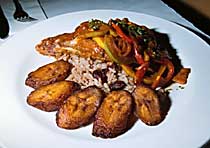
Red snapper, crisp from pan sauteing and moist from a fast roast
in the oven, was served with a traditional Trinidadian sauce
called a brown stew. This tomato-based sauce was given heat with
red peppers, complexity with rosemary and thyme and sharpened
with vinegar. The snapper rested over simple mashed potatoes
and a side of crisp-edged plantains.
Cooling our mouths with house-made ginger ice cream, one of a
selection of ice creams and tropical fruit sorbets, made the
perfect finale.
On the Mexican side of chef Arturo Tellez’ menu for the casual
Latin Grill is the addictive corn on the cob rubbed with an aged,
tangy cheese called cotija, as well as chili powder and lime
juice. On the Cuban side, Tellez offers a pressed sandwich of
ham, roast pork, Swiss cheese and pickles. Things turn fusion
when chicken wings are marinated in a chipotle-guava barbecue
sauce and served with lime-sour cream dipping sauce.
For this "newcomer," opened last December, Tellez prepares
a ceviche mariscos of shrimp and calamari "cooked"
in limejuice. Ceviche, a traditional South American appetizer,
has crossed over into the menus of seafood restaurants of all
persuasions. Picadillo, a ground pork hash flavored with onions,
garlic and tomatoes, can be served two ways: Mexican style, as
a stuffing, or, as it is served here, Cuban style, over white
rice with black beans.
Is Nuevo Latino here to stay or just a flash in the paella pan?
Some would say the cooking was red hot a year ago, about the
time that Jennifer Lopez and Marc Anthony’s careers were hitting
their stride, and argue that the cooking is already on the down
swing, while others would insist that the cuisine is still being
discovered and may eventually become an American staple along
the lines of Chinese and Italian food.
We’ll just have to eat and see.
Latin Grill, 254 Court St. between Kane and Degraw streets
in Cobble Hill, accepts cash only. Entrees: $8.50-14.50. For
reservations, call (718) 858-0309.
Sol, 229 DeKalb Ave. at Clermont Avenue in Fort Greene, accepts
Visa, MasterCard and American Express. Entrees: $7.95-$17.95.
For reservations, call (718) 222-1510.