
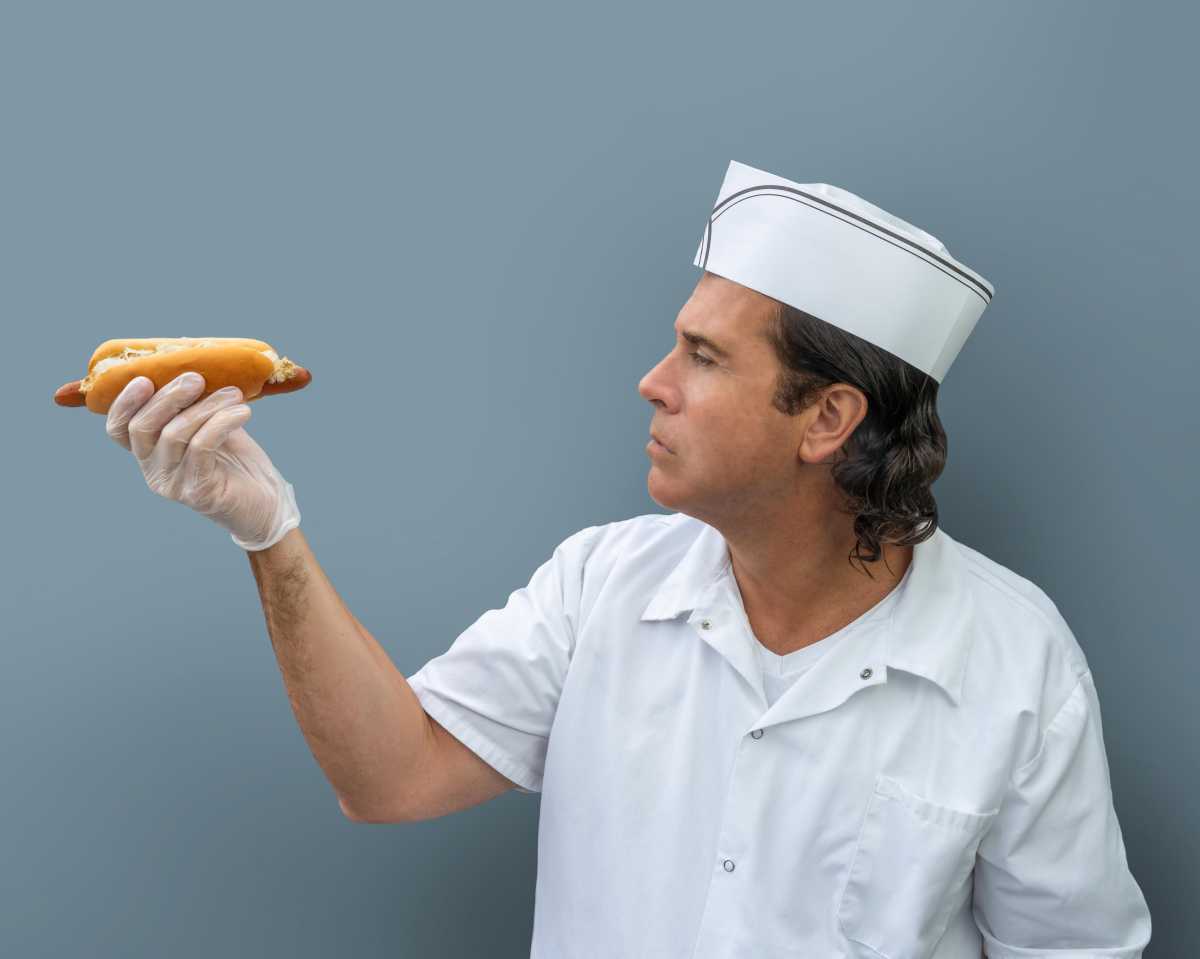
Long before the bright lights of Nathan’s Famous became synonymous with Coney Island, there was another name that defined the boardwalk: Feltman’s.
Now, Coney Island native Michael Quinn is bringing that forgotten story back to New York audiences in his one-man play, “Feltman: World’s First Hot Dog,” running at 36th Street Theatre from March 18 through June 14.
The 70-minute solo show premiered at the 2025 Edinburgh Fringe Festival to packed houses and glowing reviews. Now, Quinn is back on home turf — telling a story rooted in Brooklyn history, immigration and resilience.
From the sidewalk to the stage
Quinn’s journey back to the stage is deeply personal.
He worked as an actor in the 1990s and studied at H.B. Studio and the American Academy of Dramatic Arts, but stepped away from performing after losing his younger brother in the September 11 attacks.
“I lost my little brother on 9/11,” Quinn told Brooklyn Paper. “He was my biggest fan. I couldn’t go back to the stage after that.”
What followed was a 25-year absence from performing. Quinn became a high school English teacher, led tours of Coney Island and immersed himself in the borough’s civic life. But something lingered.
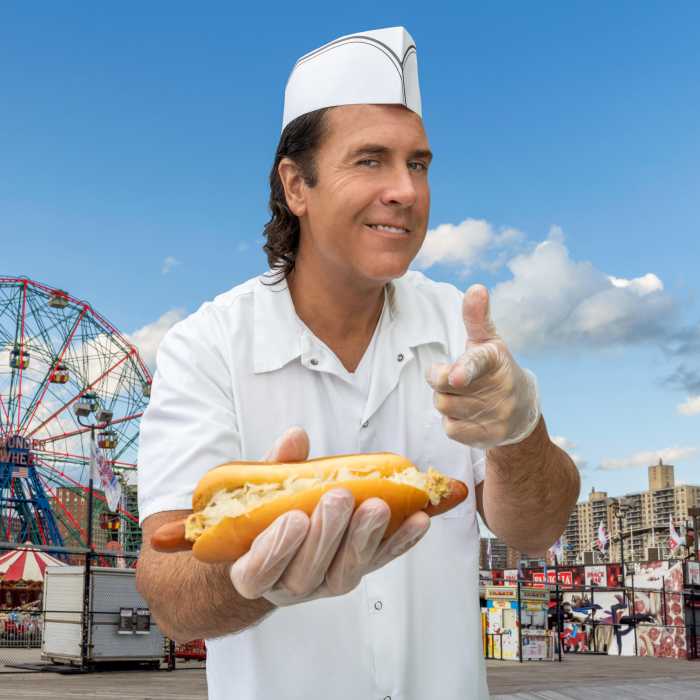
“There was something inside of me that felt unfulfilled,” he said. “I felt like my brother died and then I gave up acting. It’s like I felt like I had to do it.”
At 50, Quinn returned to the stage for the first time at the Edinburgh Fringe. He lived in a dorm for the month-long festival, rewriting and refining the show as he went.
“It was definitely an emotional journey,” he said. “A lot of doubt. I hadn’t been on stage in 25 years. And then it just went really well. It got better after each performance.”
The original ‘top dog’ of Coney Island
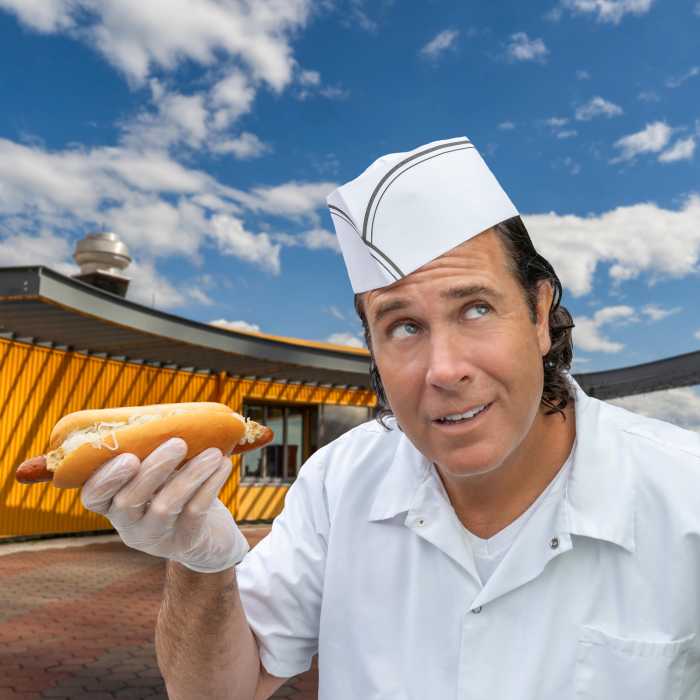
The first half of “Feltman: World’s First Hot Dog,” transports audiences to 1867, when German immigrant Charles Feltman first placed a sausage in a bun on the sands of Coney Island.
But Quinn insists the story is bigger than the classic American food.
“Feltman’s was more than just hot dogs,” he said. “It was the largest restaurant in the world.”
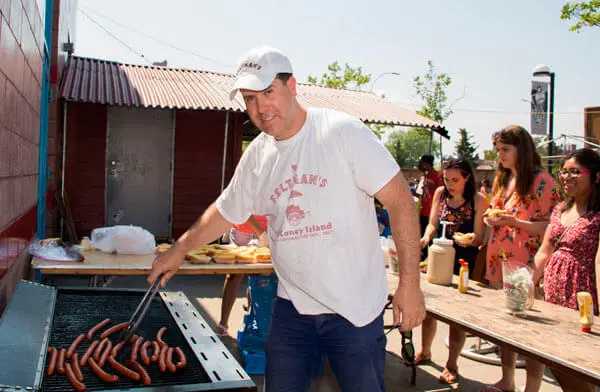
At its height, Feltman’s stretched two city blocks, employed 2,000 workers and could seat 10,000 guests at once — “the population of Battery Park City,” Quinn noted. The sprawling complex included nine restaurants, a hotel, rides, live entertainment and even what became the largest outdoor movie theater on the beach.
“It wasn’t just the hot dog stand,” Quinn said. “It was basically a resort.”
He believes the brand faded from memory largely because of time — and because Nathan’s eventually eclipsed it in popular imagination. Few realize that Nathan Handwerker once worked for Feltman before launching his own stand.
Parallel struggles, centuries apart
The play’s second half turns inward, drawing direct parallels between Feltman’s 19th-century entrepreneurial struggles and Quinn’s own modern-day experience reviving the Feltman’s brand before eventually selling it.
“Many of the struggles he faces in the play — my struggles parallel his,” Quinn said. “He was trying to come up with something to survive. He built a business from nothing. I had this recipe that was passed down to me, and I started with nothing.”
In recent years, Quinn said he has also dealt with challenges and canceled projects. In response, he chose to take creative control.
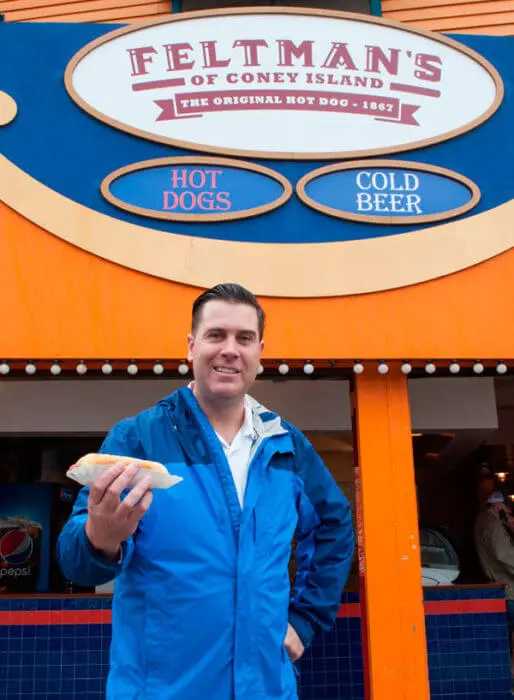
“I’m going to write it myself. I’m going to produce it myself,” he said. “Pretty much everything except direct it.”
The minimalist production reflects that independence: just Quinn, a beach chair and an umbrella, embodying every character.
“I want to tell the story and perform the story,” he said. “It’s totally from my perspective.”
A quintessential New York delicacy
Though the hot dog is often framed as an American icon, Quinn sees it as distinctly New York.
“Not only is it American — it’s very New York,” he said. “New Yorkers, we’re always running. Lunch for us is to grab a hot dog or a slice of pizza. We’ve got to get to the next meeting.”
He believes Feltman recognized that impulse as early as the 1860s, a portable and affordable meal that allowed customers to stroll the beach, ride a carousel or move on with their day.
“It’s more than just the hot dog story,” Quinn said of Feltman’s invention. “It’s really a comment on society — immigration, the state of capitalism, what it takes to be an entrepreneur. Persistence. There’s a lot of pain in it. A lot of struggle. A lot of loss.”
From Brooklyn to Edinburgh — and back
Taking such a Brooklyn-specific story overseas required adjustments. Quinn edited certain language and cultural references for U.K. audiences and hired a publicist to help introduce the story.
Still, European theatergoers were captivated.
“They were fascinated by it,” he said. “They liked my Brooklyn accent. I made the decision to play Charles Feltman with a real working-class Brooklyn accent.”
The Edinburgh Fringe, with nearly 3,000 shows running simultaneously, was “bananas,” Quinn said — but the response affirmed that the play’s themes transcend geography.
“It’s a very human experience,” he said. “Resilience. Survival. The human condition.”
When New York audiences leave the theater, Quinn hopes they walk away with more than a craving — though many do text him photos of hot dogs afterward.
“I don’t want them to just think, ‘I want a hot dog,’” he said. “I want them to feel something.”
In telling the story of Charles Feltman, Quinn is also reclaiming his own — returning to the stage, to New York, and to a borough whose history is woven into every bite.
“Feltman: World’s First Hot Dog” runs March 18–22, May 6–10 and June 10–14 at 36th Street Theatre (The Chain), 312 W. 36th St., 4th Floor. Performances are Wednesdays and Thursdays at 7 p.m.; Fridays and Saturdays at 5:30 and 7:30 p.m.; and Sundays at 5 p.m. Tickets are $40.