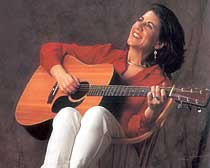
"This is beshert," Peri
Smilow says when I visit her in her Park Slope apartment.
The word is Yiddish for "meant to be," and Smilow,
43, an educator and singer-songwriter of contemporary Jewish
music, feels destiny has brought her to Brooklyn.
Today, fate has found the perpetually smiling, petite musician
home instead of on the road, an anomaly since Smilow’s third
CD, "The Freedom Music Project: The Music of Passover and
the Civil Rights Movement," often has her traveling.
Passover honors the story of the Jews’ exodus from the enslavement
of the Egyptians, and a key component of the Seder, the traditional
Passover ceremony and dinner, is to acknowledge the plights of
other struggling groups. Smilow’s own journey has led her to
do just that, through music. The CD is a culmination of many
years’ work in entertainment, education and Jewish spirituality,
but it’s the first time she’s been able to bridge these various
worlds.
Smilow grew up singing. Her father, a doctor, performed regularly
in the community theater in her hometown of East Brunswick, N.J.,
and her mother played piano and danced. For her eighth birthday,
her parents bought her a guitar, but no lessons.
"I told them to hire babysitters who could play guitar,
and after my little sisters went to sleep I would stay up and
learn a little from them," said Smilow, who now has a 10-month-old
baby of her own who’s perfecting her crawl.
Smilow came to New York in the early 1980s, and worked in theater
by night and afterschool programs for underprivileged children
by day. When she realized she cared more about the kids than
her audition schedule, she moved to Boston to head an interracial
and intergenerational non-profit group. She earned a master’s
degree in education from Harvard, and was happy to leave entertaining
behind sort of.
For fun, she joined a songwriting group that met monthly, and
sang for her congregation. As technology changed and home-recording
studios grew, Smilow found she could satisfy the requests of
her newfound fan base, and lay some tracks down. Her first album,
"Songs of Peace," came out in 1993, and included four
of her own songs.
"It was amazing," says Smilow. "People began to
call and say, ’Hey, do you do concerts?’"
And suddenly, as if fated to be, a folksinging career was born.
The only problem was, the educational career was still in full
swing.
"I was working 60 or 70 hours a week, and then on nights
and weekends I would go sing," says Smilow. "At a certain
point I realized I could no longer do both."
That point came when she was driving from work to a concert,
changing into pantyhose while trying to steer. She realized that
entertainment – albeit Jewish spiritual entertainment – had called
her back.
Smilow is not the first artist to take on contemporary Jewish
music – music that marries the sounds of modern folk, like Joan
Baez or James Taylor, to the spiritual presence and liturgy of
Judaism. There’s Debbie Freedman, who also has a line of Hallmark
cards, and Jeff Klepper, who both created the sound.
"But I’m different in that I focus on issues of social justice,"
says Smilow. "I talk about politics. I encourage the Jewish
community to reach out."
In 1996, Smilow teamed up with Minister LeRoix Hampton from the
New Covenant Christian Church in Mattapan, Mass., to provide
music for the Anti-Defamation League’s annual Black-Jewish Seder
in Boston. When she had Hampton and his family over to dinner,
he told her he had lived in Boston for 20 years and had not once
been in the house of a white person.
"We’re still a segregated society in some very fundamental
ways," Smilow says sadly, but adds that she found music
was a way to move integration forward. "It became apparent
through the music that the two communities had more in common
than they thought."
Hampton and Smilow put together the "Freedom Music Project,"
mixing Passover tunes with black spirituals. The 10 songs range
from "Wade in the Water" to "Avadim Hayinu (Once
we were slaves, now we are free)." She was finally able
to join her disparate worlds of spirituality, education and entertainment.
Fate brought Smilow back to New York when she married NY 1 newscaster
and fellow folksinger Budd Mishkin, and now the buffet table
in their railroad apartment is crammed with pictures of the Smilow-Mishkin
clan.
Of late, she is designing "Concert-in-a-Box," a 10-week
program to bring black and Jewish communities together through
spiritual music. The groups not only sing together, they have
a list of suggested activities, including having one another
over for dinner.
Can that program apply to our very own Brooklyn, where blacks
and Jews have had a long and hard history of confrontation in
neighborhoods like Crown Heights? Maybe, says Smilow.
"What you need to make change is to have areas of common
interest," she says. "Music is one way that can happen."
Although Smilow performs around the country, destiny has not
handed her a concert in Brooklyn – but she wants one.
Says Smilow, "All I need is an invitation."
Peri Smilow’s CDs, "The Freedom
Music Project: The Music of Passover and the Civil Rights Movement,"
"Ashrey" and "Songs of Peace" (Sign of the
Dove Music) are available at www.cdbaby.com or www.soundswrite.com
or by calling (800) 9SOUND9. For more information, visit www.perismilow.com.