
The NBA is in a golden age of statistics.
The advanced stats movement, once confined to nerdy corners of the Internet, has taken hold across the league in a very real way. Several general managers are now true believers, and coaches are expected at least be familiar with the new metrics, if begrudgingly.
The league has bought in, as well, installing cameras in NBA arenas that track each player’s movement on the court at all times, giving stat geeks a slew of new measurements to explore. Never before have we had this many numbers with which to dissect professional basketball.
And yet, how do you explain Andrei Kirilenko?
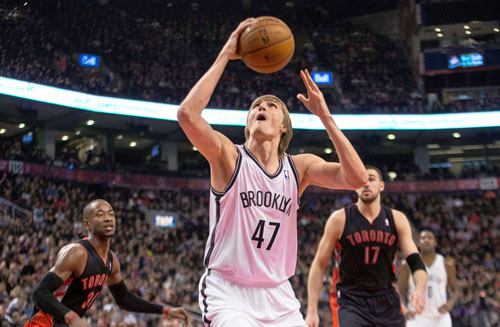
The 6-foot, 9-inch Russian returned to the Nets on New Year’s Eve after missing all but the first four games of the season with back spasms. Before his return, the Nets were 10–20. In the first seven games with AK–47 back, Brooklyn went 5–2.
To the naked eye, Kirilenko’s impact is obvious. Rangy but smooth, he is rarely out of position defensively and gives the opposing ball handler little room to work with. He has a knack for coming up with loose balls. In Brooklyn’s overtime win over Miami last week, it was Kirilenko who earned the charge call on LeBron James that caused him to foul out for the first time since 2008. Before that call, Kirilenko’s D had clearly gotten under James’ skin, resulting in flashes of anger rarely seen from the King.
But James still scored 36 points that night with an absurd 57-percent shooting. Consider, too, that Kirilenko’s plus-minus rating (the number of points scored for or against a team when a player is on the court) is still -34, despite his having missed practically all of the Nets’ abysmal November and December games. And when he is on the court, the Nets’ opponents out-score them by 9.4 points per 48 minutes, the third-worst mark on the team.
Part of Kirilenko’s hidden impact may be that he is a perfect fit for the Nets’ new small-ball lineup, ushered in by a season-ending injury to center Brook Lopez. Kirilenko’s size and agility allow him to play both the small forward and power forward position, easing Paul Pierce’s transition to playing big at the four-spot and preventing the Nets from having to rely on Reggie Evans for more than a handful of minutes per night. He also shows discretion on the offensive end, adding just 6.7 points a night, but on 50-percent shooting.
The Nets are a better team with AK-47 than without. So far, how and why are better explained on the court than in a stat sheet.
Matt Spolar is a nearly 6-foot-1 journalist with a middling high school basketball career who is sure the Nets win thanks to team’s top-tier guards.