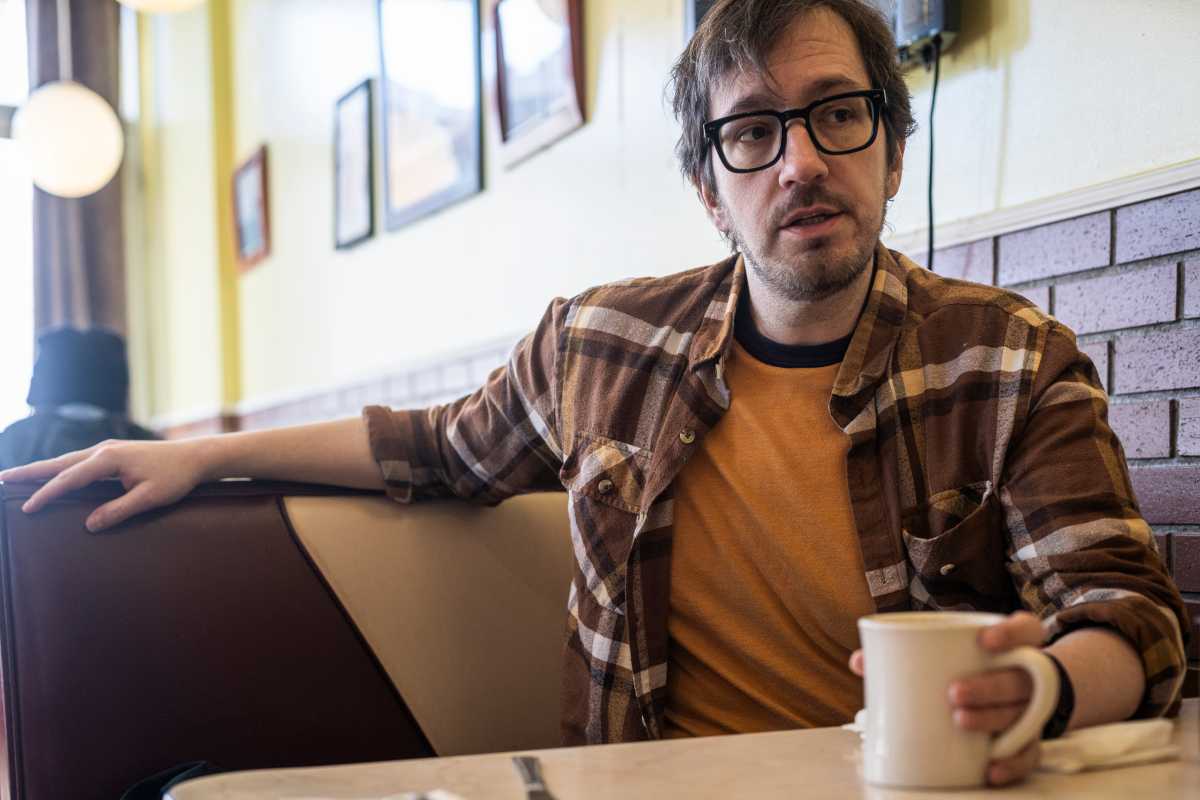
Theater in the 21st century, transformed by the introduction of digital technologies, is designed to immerse the audience in an augmented reality. Where building a set used to require carpenters and set designers, now theatermakers like Kevin Laibson, a Brooklyn-based performance technologist, rely on tools of the virtual reality trade to devise innovative and compelling work.
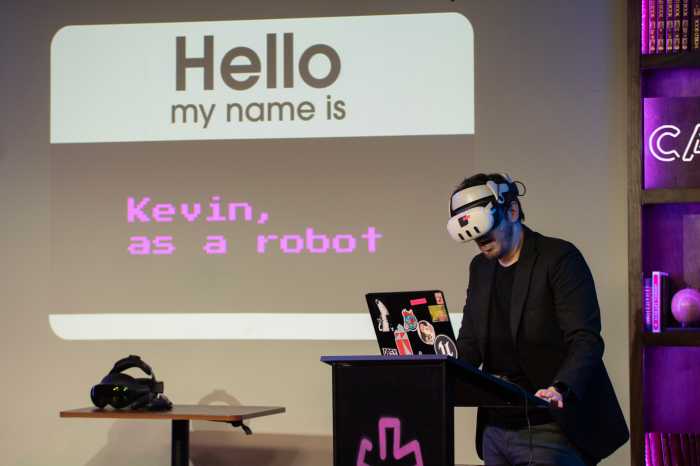
To Laibson, 44, who is staging an adaptation of Anton Chekhov’s “The Harmfulness of Tobacco,” the theater’s next frontier is best navigated with gewgaws and gadgets like Snapdragon processors, telepresence software, and multi-source motion-capture devices.
His one-man show, The HARMNF, which is showing at Caveat in the Lower East Side on Sunday afternoon, is about his experience working with a series of artificial intelligence platforms and uses tools regularly employed in virtual and mixed reality to deliver a 70-minute lecture that, much like the Chekhov play, consistently veers off topic and is never completed.
“I’ve been kind of obsessed with this play because it is like a practical joke,” Laibson said. “The audience shows up and they discover there’s a new contract than they were privy to — surprise! You’re in this play. You don’t have to do anything, but you are a part of it.”
Working with Agile Lens, a virtual reality design firm that spun off of the theater planning and design firm Fisher Dachs Associates, Laibson has focused on researching solutions that use future performance technologies to create prototype theater projects.
“A lot of my work in the last five years has been about taking really good software and using it for really stupid shit,” he said.
A longtime theater arts teacher, Laibson found that devising work in VR is exactly like making work in a black-box theater.
“The thing about virtual reality is that it is spatial activation,” he said. “In VR, the audience is an absolute agent of framing, which is theater.”
Laibson first became aware of Chekhov around age 11 while riffling through his father’s collection of plays. His father caught on to Laibson’s interest and made a deal: Laibson could have any of the plays, so long as he read them first.
He read as many as he could, and while the memory of some plays is lost to time, Chekhov’s Harmfulness stayed with him.
The idea that, as a creator, Laibson could devise work where the audience itself was a diegetic character stuck with him because of the innovative way it exploits the medium.
As Laibson grew into his career in the theater, he started where anyone would, as an actor. But after starring in a few productions and one unfortunate experience in which the audience was deeply affected by his performance, he decided that acting was not right for him.
“Having a job where your job is to have feelings all the time felt like a bad match. So I got to directing,” Laibson said.
His directorial approach hinges on a clear image that sticks in his mind, something that is unshakable until he’s had a chance to work it out.
“I know exactly what I want this moment of this play to look like,” Laibson said. “That has remained incredibly true in everything that I’ve made. It really comes down to like, if there is one moment that immediately makes itself clear.”
Then, he simply asks himself whether the rest of it will be worth it to get to a particular moment.
The HARMNF began with what could have been the worst week of his life working in performance technology, but ended with something akin to art.
His reconnection to Chekhov’s play began in 2019 with a 29-hour workshop, where Laibson attempted to use an AI system to reproduce the play. What started as a partnership between Laibson and his AI assistant director evolved into what he understood to be a “complete annexation of his work.”
He tried to have virtual humans sing and dance their way through the piece. Laibson fed it data, including a trove of Russian literature he found and thought would be useful, but instead caused the language model to stop speaking English.
Laibson was no longer a collaborator on the project; rather, he had somehow demoted himself to middle manager.
“There is a particular type of sadness that comes from building your collaborator and then having to kill your collaborator,” Laibson said. “It was the loneliest thing I’ve ever done.”
But his fixation on the lecture would not abate because of small annoyances. Instead, Laibson scrapped the Russian-language AI-generated version of the lecture and brought his own, underdeveloped lecture into the classroom. Invited to speak at Rutgers College, Laibson arrived with the intent of never finishing what he started — causing confusion and discontent in the classroom.
“I think several of them got it, but more of them were angry and the feedback was very bad for that,” he said. “They were like, he never actually talked about this thing. And I was like, okay, well, that’s true. I can’t fault you for that.”
It was clear to Laibson that most didn’t understand the underlying joke, but that was the exact reaction he wanted.
He then messaged his longtime friend and the director of The HARMNF, Parker Denton, a theatrical clown, about collaborating on the play.
“So he came to me with this like beast of a text,” Denton said. “One thing that I really kind of admired about this text was — it talked about AI art in a very honest and practical way.”
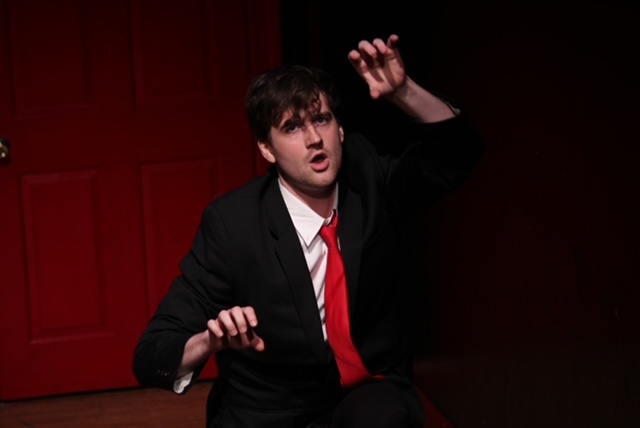
Denton was enamored with the idea and immediately began disentangling the piece so its segments would be digestible. They needed to know where in the play they were, regardless of whether the audience knew.
“It’s designed so that people can kind of zone in and out a little bit,” Denton said. “It’s already begun before they even walk in the room in many ways.”
The bore is purposeful and very much in line with how Denton and Laibson intend to influence their audience’s engagement with the inherent alienation the technology itself elicits.
“I feel like it sort of aggressively says, ‘Look, so much of our lives are online. That’s an act of faith,” Labson said.
As a performer and teacher, Laibson champions pure self-expression. And if that expression takes the form of a gentle critique of the audience — one meant to spark introspection, which he says reflects most of his adult work — so be it.
The play does have one major dramaturgical complication: any attempt to describe it risks giving away the central twist. At its simplest, it’s a 10-minute “take-my-wife” joke stretched into a 70-minute tirade, exposing the emotional and physical toll of acute loneliness and alienation in an online world.
Those heading to Caveat on Sunday afternoon won’t get the lecture they signed up for. Instead, they’ll be forced to reconcile with a form of alienation specific to our overtly digital age.