
Although his career spanned five decades,
it was only in his twilight years that master Spanish director
Luis Bunuel became a superstar of the art house.
The films he made from the mid-1960s through the mid-’70s, before
retiring at age 77, brought Bunuel (1900-1983) more fame than
he probably ever wanted. In honor of his birthday on Feb. 22,
the BAMcinematek presents a weekend series titled "Feliz
Cumpleanos, Bunuel!" showcasing the final trio of films
from the culminating period of his creative life.
Since his original success de scandale in 1929, "Un Chien
Andalou" – which was made with fellow surrealist Salvador
Dali – Bunuel became known for his savage attacks on sacred cows
like sexuality, religion and the state.
Shocking imagery was a staple of all his films – the infamous
razor slitting an eyeball in close-up and a hand with a gaping
hole from which ants pour out, both in "Un Chien Andalou,"
was only the beginning – and audiences stayed away from his unrelenting
assaults on the rampant hypocrisy of those in power, whether
religious or political.
But by his last films, after spending years toiling in Mexico
making potboilers that were subtly subversive, the name "Bunuel"
had long since lost its shock value, and thanks to such 1960s
hits as "Viridiana," "Simon of the Desert"
and "Belle de Jour" was now accepted as an ironclad
guarantee of quality.
Showing the films in the reverse order of their release, the
BAM series opens on Feb. 21 with Bunuel’s final film, "That
Obscure Object of Desire." Made in 1977, it was the sixth
film version of the dazzling 1898 novel by Pierre Louys, "La
Femme et le Pantin (The Woman and the Puppet)," and reawakened
Bunuel’s old anarchic and surrealist bent.
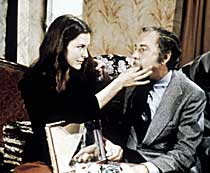
Fernando Rey stars as Mathieu, a middle-aged widower who falls
completely in love (and lust, of course) with Conchita, an enigmatic
woman who exemplifies the inability of men to ever understand
the fairer sex.
Bunuel underscores this basically naive notion by casting two
actresses as Conchita – the quintessentially French Carole Bouquet
and the fiery Spaniard Angela Molina – whom he usually alternates
in scenes with Rey.
The result is a typically Bunuelian take on the very nature of
erotic attraction, but the director doesn’t stop there. Not only
sexual politics are studied; the political world of terrorism
takes on a disturbing undercurrent that runs throughout the movie
in ever more bloody and surprising ways, paralleling the confused
emotional world of these characters.
"That Obscure Object of Desire" ends in a wall of flame
after still another terrorist explosion, and Bunuel seems to
say that, in a world devoid of any reason, love truly does not
conquer all. Fifty years of filmmaking never changed his relentlessly
cynical worldview.
The other two films in the series, "The Discreet Charm of
the Bourgeoisie" (1972) and "The Phantom of Liberty"
(1974), received far better critical and audience reactions than
"Obscure Object of Desire" upon their release but are,
in hindsight, slighter and even half-baked.
"The Discreet Charm of the Bourgeoisie" (Feb. 23) won
the Oscar as best foreign film, getting the kind of raves that
marks a true classic, but it’s actually a come-down from Bunuel’s
1969 surrealistic journey "The Milky Way," which shares
its "is it real or a dream?" structure.
As Bunuel, himself, said, the story is simple: three couples
try to sit down to dinner, but cannot. Dreams within dreams and
bizarre but realistic episodes jostle with each other, but they
never coalesce into a truly satirical vision of a segment of
society that cries out for such treatment. Instead, the movie
rather distractedly motors along in routine fashion.
Perhaps sensing this unevenness – despite the best notices of
his career – Bunuel turned, in "The Phantom of Liberty"
(Feb. 22), to an open structure with no attempt at linear rhyme
or reason.
Moving from one offbeat episode to the next with no recurring
characters on which to hang them, Bunuel seems an exhausted,
tired director.
Only one episode hits resoundingly: a sniper, after picking off
several innocent people, is sentenced in court and then let out
of his handcuffs and allowed to go free, where he becomes an
instant cult figure, mobbed by adoring fans.
This vignette vividly illustrates, long before the cult of celebrity
took over the media, the absurdity and arbitrariness of fame.
Along with the offhandedly frightening scenes of terrorist activity
in "That Obscure Object of Desire," it shows that,
at his best, Bunuel was a bitterly caustic and accurate critic
of our many excesses, a necessary corrective sorely missed in
today’s antiseptic film world.
The "Feliz Cumpleanos, Bunuel!"
film series is at the BAMCinematek (30 Lafayette Ave. at Ashland
Place in Fort Greene) Feb. 21-23. Daily showtimes are 2, 4:30,
6:50 and 9:10 pm. Tickets are $10, $6 seniors and students with
a valid ID. For more information call (718) 636-4100 or visit
the Web site at www.bam.org.