At long last, the Brooklyn Philharmonic
has chosen its new music director.
Prior to the Philharmonic’s recent announcement that conductor
Michael Christie would become its music director beginning with
the 2005-2006 season, the organization’s search for Robert Spano’s
replacement was moving along exactly as planned, according to
the orchestra’s chief executive officer, Catherine Cahill.
"It was a very deliberate, very focused plan to find a replacement
once Robert informed us of his departure, and we had ample time
to have a well thought-through strategy," Cahill explained
in an exclusive interview with GO Brooklyn. "We had a lot
of opportunity to witness as many talented candidates as possible.
And we were happy that at the end of the search we had a winner
in Michael. The board met [Aug. 11] to adopt and approve his
appointment."
The orchestra has been leader-less since the beginning of last
season, as guest conductors (including Spano, who announced his
resignation as music director in the spring of 2004) took to
the podium for all concerts during its 50th anniversary season.
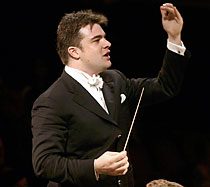
Among these was Christie, a 31-year-old conductor originally
from Buffalo, who led the musicians in an April concert featuring
the world premiere of a work by Brooklyn native Jennifer Higdon.
Christie is currently the music director of the Phoenix Symphony
and music director of the Colorado Music Festival, and also works
as principal guest conductor of the Queensland Orchestra in Australia.
He is excited by his new post in Brooklyn, Christie told GO Brooklyn.
"I remember when Bob Spano originally got this job,"
Christie said in an exclusive telephone interview with GO Brooklyn
from Australia. "We were both at Oberlin College Conservatory
of Music at the time, and as I was watching him think through
the different possibilities and kinds of programming, I was thinking
that it must be an absolutely stimulating job.
"There’s virtually no orchestra that’s had such a distinguished
list of music directors, along with the most eclectic swing in
its programs," he continues. "It’s been really special
to watch. I definitely feel the weight of history on my shoulders."
Although Christie has conducted the orchestra, he knows that
there is much work to be done.
"We had a good time performing, but I want to get to know
the orchestra better and the institution better," he admits.
One of the drawing cards for Christie is the borough itself.
"The great thing about being based in Brooklyn – and BAM
forces us in a way to do this – is that we must be on the edge
musically, because as an institution, that’s where BAM is musically,"
he explains. "Cathy [Cahill] has a particular interest in
attaching the orchestra to composers from Brooklyn like Jennifer
Higdon, John Corigliano and Aaron Copland. Few places in the
world have such eminent composers to call their own.
"There’s an enormous amount of music out there that’s waiting
for a local premiere – including American, European and even
Far Eastern from China and other Asian countries," he continues.
"We’d be missing the point if we didn’t cast our net wide.
But we also perform for a specific audience, so we must realize
that they won’t miraculously appear just because we’re performing
new stuff."
Christie is looking forward to programming the upcoming season,
which begins in January; it’s too early for specifics, but the
season outline is taking hold.
"We have four scheduled concerts, and I’m doing three of
them," the conductor says. "I’m getting acclimated
to what the goal is here: I’m having a cold-water immersion into
what’s expected."
Community outreach is important as well, since the orchestra
performs at various locations throughout the borough, including
for high-school students.
"When I was with the orchestra in April, I took part in
one of the school outreach programs, and it was fascinating how
the connection was made with the students," Christie says.
"It’s interesting how a professional orchestra interfaces
with the academic world, and how there are points of contact
outside the concert hall."
That last point also resonates with Cahill.
"Michael has the artistic integrity and excellence we wanted,
and he has a successful record of community engagement and audience
development," she explains. "He’s committed to signature
Brooklyn repertoire through his enthusiastic performances.
"Michael has a true and genuinely deep sense of how important
musical education is," Cahill continues. "He is a true
leader in the area of community engagement, which is often simply
an add-on for many orchestras, but it’s a core element for us.
I think of us as ’Brooklyn’s Philharmonic,’ with all of Brooklyn
as our concert hall."