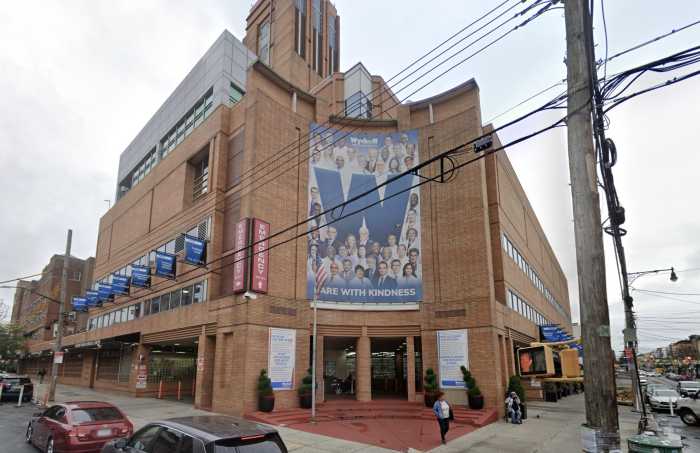


The city’s pending acquisition of Maimonides Health is “not a takeover,” the head of NYC Health+Hospitals said on Monday, and much of the status quo will be maintained, at least at first.
At a City Council oversight hearing on March 2, Health+Hospitals CEO Dr. Mitchell Katz said the merger is meant to stabilize Maimonides’ finances and improve the quality of care without infringing on the hospital’s independence.
Maimonides has long struggled financially, racking up multi-million dollar budget deficits in recent years. Katz — who was the sole representative for Maimonides and H+H at Monday’s hearing — said hospital leadership have been seeking a partner “for years,” and reached out to H+H after an attempted merger with Northwell Health fell through.
Officials announced the merger late last year, and expect it to be finalized by April 1.
Merging will boost finances, quality of care, Katz says
Though hospital mergers are nothing new in New York City, private hospitals rarely seek to partner with public health systems. Most often, independent hospitals seek to come under the umbrella of larger, wealthier private hospital systems like NewYork-Presbyterian or NYU Langone.
Katz said that wouldn’t have made sense for Maimonides, a safety-net hospital where roughly 80% of patients are insured by Medicaid and Medicare and many are not insured at all.
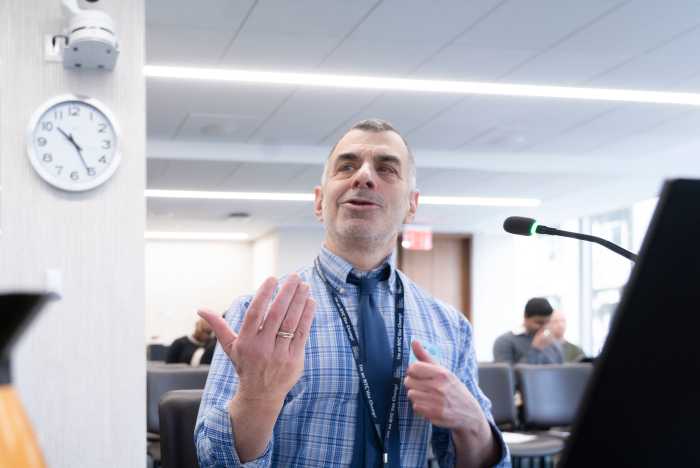
Medicaid and Medicare don’t pay hospitals for the full cost of procedures, but government-run hospitals are given higher reimbursement rates. By joining H+H, Maimonides will gain access to those higher rates, Katz said, which are expected to generate up to $9 million in additional revenue every month.
“Because we get a better rate for Medicaid patients, they saw us as being able to get them additional dollars,” Katz said. “In terms of any merger, that’s part of why we’re the right partner.”
The merger will also be supported by a $2.2 billion, five-year grant from New York State. That grant includes $200 million in loan forgiveness for cash Maimonides currently owes to the state, Katz said.
It also includes $500 million for much-needed capital improvements, Katz said, and $1.5 billion for operations as Maimonides works to get out of its budget deficit.
“By joining our system, Maimonides will be able to offer New Yorkers expanded access to high-quality care, seamless digital access to health records through MyChart, and ongoing financial stability,” Katz said. “I think that financial stability will make a huge difference, because it’s impossible to feel good about your institution and its ability to serve the community when you’re in a financially difficult position.”
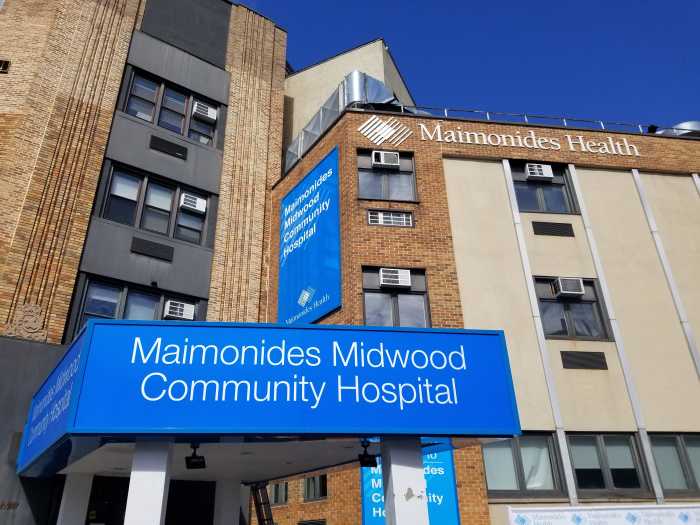
Katz said leaders are already planning capital improvements, with Maimonides’ maternity ward at the top of the list. Around 6,000 babies are born at Maimonides each year — most H+H hospitals see around 1,000 deliveries, Katz said — and the ward is in dire need of modernization.
Joining H+H will also give Maimonides access to the digital charting system EPIC and the patient portal MyChart, which allows patients to schedule appointments and access test results and health records online. It can also make it easier for physicians to keep track of their patients, he said, as Maimonides currently does not have a primary care data tracking system.
“Maimonides Hospital has more than five different primitive electronic health records and some of the physicians are still charting on paper, something I certainly did during residency but have not done recently,” Katz said.
Officials want to maintain Maimonides’ character
The merger has raised some eyebrows in South Brooklyn, particularly among the large Orthodox Jewish community in Borough Park. Local Hatzalah groups have voiced their opposition to the merger, and Katz said Orthodox residents have expressed their concerns about whether H+H could still provide culturally-sensitive care and respect longstanding traditions.
“We are interested and supportive of all cultures, we don’t produce cookie-cutter hospitals, that’s not who we are,” he said. “We intend to respect the cultural traditions that have built Maimonides and made it the amazing place it is.”
Several members of Maimonides’ Board of Trustees have filed suit in an attempt to block the merger for similar reasons. The suit alleges that the merger is politically motivated, and would restrict Maimonides’ ability to provide culturally-specific care for Jewish patients.
While Maimonides and H+H are still actively fighting the suit in court, there is no restraining order in place, Katz said, so it isn’t expected to impact or delay the merger.
Staffing, union agreements to stay in place
Brooklyn Council Member Mercedes Narcisse, a registered nurse and chair of the Committee on Hospitals, said many nurses were concerned about maintaining the benefits they’ve earned over many years at Maimonides.
H+H plans to honor existing union agreements with 1199SEIU, the Committee of Interns and Residents, and the New York State Nurses Association, Katz said.
Representatives of CIR and 1199SEIU said at the hearing that their organizations have been in regular contact with leadership at Maimonides and H+H to ensure a smooth transition.
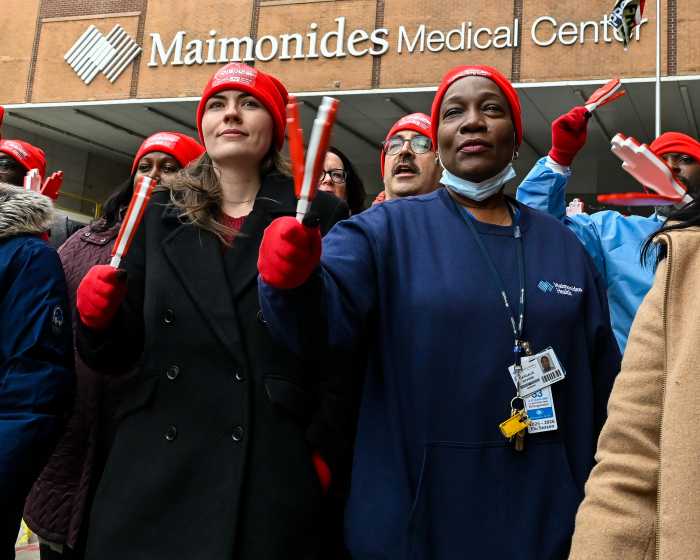
Abdul-Rahim Dahman, a pediatrics resident at Maimonides and member of CIR, said the union is still seeking concrete answers about staffing levels and the hospital’s residency training program, as well as the union contract.
“We have not been told whether or how [our] rotations will shift to other facilities, or even if the merger will preserve our teaching hospital structure and protect our residency program accreditation,” he said. “ … Maimonides leadership has said our CIR contract will not be affected, and we are in the process of formalizing those commitments in a memorandum of agreement. We are simply calling for the process to be completed promptly.”
Maimonides employees will not become city employees under the merger. Nurses, social workers and technicians will be employed by a separate company “that will come out of the existing Maimonides nonprofit,” Katz explained, and H+H will contract with that nonprofit.
So as to avoid violations of the Stark Law, doctors will be part of a different entity which will be contracted with separately.
“That was designed specifically to prevent disruptions of unionized staff,” he said. “The process of trying to bring people to city employment would have been very complicated and would have made many people unhappy.”
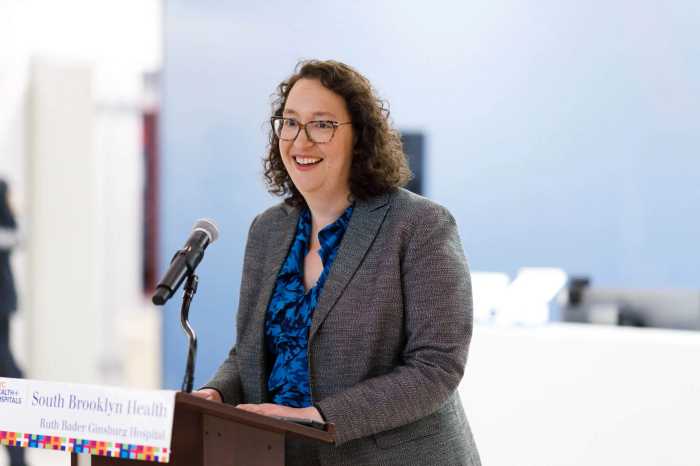
Leadership, though, must be employed by H+H for legal reasons.
“Because we are becoming the entity that holds that contract, you have to show in that that you really are running it, its not a sham,” he said. “We’re not accepting the higher rate of Medicaid without ourselves running the hospital … that means the Chief Medical Officer, the Chief Nursing Officer, Chief Executive Officer, have to be Health+Hospitals.”
Maimonides’ existing president and CEO, Ken Gibbs, will be replaced by Svetlana Lipyanskaya, the current head of NYCH+H/South Brooklyn Health.
‘They can only spend as much money as they have’
While the benefits of the merger are fairly clear for Maimonides, pols questioned the impact on H+H.
“I’m curious what that decision making process was, because we’re financially strapped in H+H as well,” said Council Member Pierina Sanchez. “Is this a revenue positive addition to the H+H system? What made us say yes?”
When the state granted the $2.2 billion for the merger, it agreed to hold H+H harmless for any financial losses incurred in the next five years, Katz said. If Maimonides does racks up more debt, H+H won’t be on the hook.
The deal will be structured in a way that gives Maimonides access to more resources but does not allow it to “borrow” money from H+H, or take resources needed elsewhere in the system.
“Maimonides will get a bigger pie and they’ll have a modern system, but they will have to live within that pie,” Katz said. “We will not support borrowing money for operating costs, I would never have supported that.”
Likewise, if Maimonides experiences significant financial success, the funds will be used at Maimonides, not used elsewhere within the system, Katz said.
“My motivation, and I think the city’s motivation, was to help Maimonides. I never wanted anyone to feel we were doing this for money, to benefit us,” he said. “We signed all the papers to say that every dollar at Maimonides’ campus stays at Maimonides’ campus. There’s no cross-subsidy. As things get better, Maimonides does better and better, good for them, we’ll invest that money in services at Maimonides.”

Katz said he does not expect to see staff reductions implemented to save costs. In many places, Maimonides requires additional staff, he said, as past reductions made due to the budget deficit have hurt doctors and reduced the quality of patient care.
“I’ve heard many doctors talk about what it’s like to not have any support staff in their clinic to help them see patients,” he said. “To me, that’s a very critical issue, and I understand that they don’t have enough support staff because they are in deficit. That’s what you do when you’re in deficit, you cut support staff and then you can’t care for patients in the proper way.”
The next steps
The merger is expected to be finalized by April 1, though it must first be approved by the state Department of Health and the Attorney General. Some of the paperwork is fairly complicated, Katz said, and most must be submitted by Maimonides.
Though he didn’t anticipate any issues — including with the lawsuit — he said it’s not guaranteed that the merger will close on time.
“There’s so much work to be done just to reach that April 1 deadline, and that April 1 deadline is so critical to Maimonides’ fiscal health that all of our energy is focused on April 1,” he said.
Some things will change immediately when the deal is done, Katz said — like hospital leadership — but daily operations at the hospital will look largely the same for a while. It will take at least 15 months for EPIC to be fully online, and years for financial systems to change over.
Some things will never change, he said.
“I respect the idea that licensed facilities operate under their CEO, and I have confidence in the CEOs that I’ve chosen, I have confidence in Svetlana being the future CEO,” Katz said. “She will run the hospital, and right now it can continue to run as it is.”