After two years of rehabilitation, the
New York Transit Museum reopened Sept. 16 to tell a more complete
story of 175 years of urban mass transportation history than
ever before.
Located underground, inside the retired IND Court Street station
at Boerum Place and Schermerhorn Street in Downtown Brooklyn,
all the exhibits are either completely new or refurbished.
The museum was closed on Sept. 1, 2001, so that an economy of
scale could be realized through a one-time overhaul instead of
a series of several smaller overhauls that would seem endless
in time and scope, according to Museum Director Gabrielle Shubert.
Even the electrical and heating, ventilation and air conditioning
systems have been upgraded. Safety and fire issues have also
been addressed.
The entire station’s rehabilitation came at a cost of $6 million,
according to Metropolitan Transportation Authority spokesman
John McCarthy. The rehab was funded from a variety of sources
including the MTA, the borough president’s office the New York
City Council, and the New York State Council on the Arts. One
of the benefits of the speeded up renovation is that the work
was completed in time for next year’s subway centennial.
The exhibits that existed in the old museum, such as "rail
transit," "fare control," and other historical
retrospectives, have been upgraded and are more visually arresting.
Plaques that explain historical artifacts have a new, improved
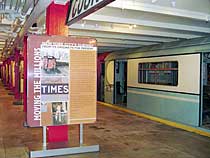
and more pleasing presentation. The historic subway cars at the
subway platform on the lower level have been spruced up and augmented
with a platform extension for the IRT and BMT elevated cars that
eliminates the need for the safety poles and gap platforms that
previously existed.
The mezzanine level, however, is where the major changes took
place.
The old screening room has been dressed up with reproduction
photographs and movie posters with scenes depicting the city’s
mass transit system.
The holdover "Steel, Stone and Backbone" exhibit still
effectively tells the dangerous story of the building of the
IRT subway by African-Americans and Italian and Irish immigrants
a century ago with just black powder and hand tools. The historical
maps and artifacts are still there and help you imagine subway
travel at a time before most of us were born. Beautiful scale
models by George Rahilly only help reinforce the daydreaming
that can happen when you put all of these artifacts and research
together.
The most noticeable changes appear in the educational and surface
transit areas of the museum. A completely new Sanford Gaster
Education Center and Internet research room should go a long
way toward helping young students (as well as the young-at-heart)
learn new and exciting lessons.
But the learning doesn’t end at the subway door because the upgraded
bus exhibit explains some of the various jobs Transit employees
perform at street level that the general public doesn’t see.
The stunning new addition to this exhibit deals with how buses
are powered, especially the "Clearing the Air" interactive
installation which teaches how air pollution is reduced or removed
from the air we breathe. The bus display, with facing buses and
trolleys, looks like an intersection that makes visitors wonder
if they should cross the street with the model "Walk/Don’t
Walk" signs.
One could venture a guess that children are not the only ones
who will learn something new here.
Joseph M. Calisi is a transportation
photojournalist and transportation industry professional who
contributes to Railfan & Railroad magazine.
The New York Transit Museum, located
at the corner of Boerum Place and Schermerhorn Street in Downtown
Brooklyn, is open Tuesdays through Fridays, 10 am to 4 pm, and
Saturdays and Sundays, noon to 5 pm. The museum is closed on
major holidays. Admission is $5, $3 children ages 3 to 17 and
seniors 62 and older. Free to Museum members and children younger
than age 3. For more information, call (718) 694-1600 or visit
the Metropolitan Transportation Authority Web site at www.mta.info.