Two failed entrants in the World Trade Center memorial design competition
are suing the Lower Manhattan Development Corporation seeking to force
the agency to re-open the contest on grounds that it did not follow the
agreed upon rules.
Both Jeffrey Johns, a Transit Authority employee, and Gregory Mango, a
freelance photojournalist who covers assignments for The Brooklyn Papers,
charge that crucial elements of the competition guidelines — established
by World Trade Center site designer Daniel Libeskind — were ignored
by the jury and shunned by LMDC officials, thus violating the letter and
the spirit of the competition.
As a result, the two men charge in separate Article 78 motions in Manhattan
state Supreme Court, that the finalist chosen, “Reflecting Absence,”
bares little resemblance to the design framework culled from countless
public meetings. An Article 78 proceeding is brought to compel a governmental
body to some action.
“I believe they arbitrarily disregarded the entire guidelines,”
Mango, a 39-year-old Park Slope resident, told The Brooklyn Papers.
“What’s so important about these guidelines is that they were
the culmination of two years of town hall meetings — those included
firemen, the families of the deceased — so if you throw that document
out, you’re really slapping these people in the face.”
Asked for an example of how the LMDC violated the guidelines of the competition,
Mango displays a rendering by Daniel Libeskind, included in those guidelines,
of a recessed memorial site.
“The slurry wall. By burying the slurry wall,” he says, pointing
to the only intact surviving portion of the WTC site, prominently left
exposed in Libeskind’s rendering. “That was the fundamental
objective, to keep this area open so you could see this, and that has
been covered over now.
“Now, they’ll argue that you can still see a little piece of
[the slurry wall] in the corner, but that’s not what the competition
was about. It was about a 30-foot-deep, recessed memorial,” Mango
said.
“It is fundamental to Studio Daniel Libeskind’s design that
the slurry wall remains prominent and visible,” Libeskind stated
in the design competition guidelines. “The great slurry wall is the
most dramatic element which survived the attack, an engineering wonder
constructed on bedrock foundations and designed to hold back the Hudson
River. The foundations withstood the unimaginable trauma of the destruction
and stand as eloquent as the Constitution itself asserting the durability
of Democracy and the value of individual life…
“ We need to journey down, some 30 feet into the Ground Zero Memorial
site, past the slurry wall …”
‘30 feet down’
In his complaint, Mango, who like Johns is representing himself, methodically
lays out statements made by competition jury members and Lower Manhattan
development officials that call for an at-grade, or street-level memorial
site, which would make exposing the slurry wall all but impossible.
“You won’t see it if the pit is filled in,” Mango said.
“The only way to have the slurry wall exposed is to have [the memorial]
30 feet down. Originally, [Libeskind] had it 70 feet down, because that’s
the full height of the wall, but it was too deep and it was also not structurally
possible.”
Mango cites as an exhibit in his case a statement by Carl Weisbrod, president
of the Alliance for Downtown New York and a board member of the LMDC,
made at the last public hearing before registration for the competition
ended: “We urge you to give weight to submissions that bring the
open area closer to grade — at grade ideally — as well as to
other means of providing access through the site.”
“We believe that [Weisbrod] violated the agreement between the LMDC
and competitors by pressing the jury to favor certain boards before the
competition started,” Mango writes in his complaint.
“So anybody who used that pit was not going to have a fair chance
of winning,” Mango told The Papers. “That’s the first statement.
“Second statement, this is a juror, ‘Most of us felt that an
at-grade solution was preferable.’ She [Julie Menin] is the president
of Wall Street Rising. He’s the president of the Downtown Alliance.
They made up their mind that they own Lower Manhattan and that’s
what they want.”
He also cites juror Michael Van Valkenburgh, including a quote he gave
the Boston Globe that referred to Libeskind’s “big hole-in-the-ground”
as “a cruel joke … on the future of the city. … All of
the schemes that were serious contenders brought the memorial back into
a relationship to the everyday life of the city.”
“They set this whole precedent before they went in, saying, ‘We’re
not going to use this plan’,” Mango says.
‘Gates of hell’
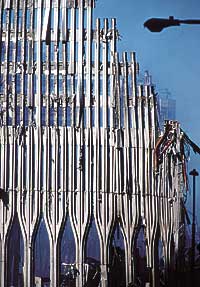
When he returned from a Brooklyn Papers assignment to shoot the destruction
at Ground Zero about a week after Sept. 11, 2001, Mango called it “a
war zone,” and “hell.” Indeed, one of his photographs is
of a large section of the WTC facade jutting from the burning mound of
rubble that recovery workers would come to call “the pile.”
Mango would call that shot “the gates of hell.”
He says he spent several days a week for three months taking photographs
at Ground Zero; Johns assisted in the recovery efforts at the site.
But it was that one image that stuck with Mango, as it did the millions
who saw similar images of the WTC steel, with its recognizable latticework,
in such an incongruous setting.
He believed then, as he does now, that at least one of those pieces of
the facade must be a prominent part of the WTC memorial.
In his design submission there are, in fact, four pieces of WTC skin that
form jarring entranceways from the pit to steps that outline the building
footprints. The exterior structural remains sit where they would if the
buildings were still standing. The sitting steps lead up from the pit
and down from street level to a platform at the center of which are reflecting
pools. The “Great Steps of Tolerance and Compromise,” as Mango
calls them in his design are duplicated on each footprint. Tulips and
nameplates around each pool remember the victims of the attack.
Also displayed prominently in his design are the Tower 1 antenna, from
which would fly an American flag, and the Fritz Koenig “Sphere”
sculpture that was recovered from the site.
“If there was a page in the rules that said, ‘This is the site
plan but the jury doesn’t like it,’ that would be one thing,
but … look how detailed this thing is here [he points to an overview].
This was a very specific thing that you had to work in. It’s a miracle
that I was able to figure out the steps.”
Mango, who has been shooting for newspapers and magazines for 12 years,
enlisted an architect friend, Jason Roberts, to help bring his vision
for the memorial to fruition.
“There needs to be a place that speaks of the tragedy but also teaches
us about this concept of tolerance,” said Mango, noting that of the
eight finalists, five filled in the Ground Zero site.
“They don’t do the job,” he says. “They just do not
do the job.”
‘Immeasurable cost to city’
A spokeswoman for the joint city-state LMDC, whose 16-member board is
appointed jointly by Gov. George Pataki and Mayor Michael Bloomberg, did
not return a call seeking comment for this article.
In their answer to the petition, however, the LMDC charges that Mango
and Johns seek “to hold up the long anticipated and painstakingly
planned process of building the World Trade Center site memorial”
for no other reason than they do “not like the design chosen by the
competition jury.”
The LMDC maintains that “each of the eight selected finalist submissions
complied with both the spirit and letter of the guidelines” and that
the agency cannot be compelled to re-review all 5,201 submissions because
the contest guidelines vested the agency and the competition jury with
discretion over all the submissions.
“Moreover, at this late stage of the process,” the LMDC writes,
“Petitioner’s requested relief would amount to a complete upheaval
of a major public works project, at an immeasurable financial and emotional
cost to the City of New York.”
In his rebuttal, Mango writes, “I contend that the ‘cost,’
not just the future monetary costs of re-doing the competition, but also
the metaphorical ‘cost’ to the future generations of our country,
will greatly exceed the administrative costs of the first competition
if we build a memorial that does not hold water and does not live up to
the goals of the competition.
“I would remind the respondent that construction has not started
yet, so if a remedy is going to be applied, better now than later.”
Downtown support
Mango and Johns are not alone in their disappointment with the LMDC.
Beverly Willis, co-director of the group R.DOT (Rebuild Downtown Our Town),
also believes the city-state agency was too willing to change the agreed
upon design tenets.
While she declined to comment on the action brought by Mango and Johns,
having not seen the complaints, Willis said, “We have been disturbed
by the way LMDC conducts a competition and then doesn’t respect the
design of the winner.
“LMDC has adopted a stance, which is quite contrary to global competition
practices, of using the winning design as a starting point for a design
— not as a final design — and this is contrary to the whole
concept of an international competition,” she said.
“[Libeskind’s design] was modified before the memorial competition
— it was modified by the memorial competition — contrary to
the guidelines posted,” said Willis, whose 500-member organization
is comprised of Lower Manhattan residents, businesses, community and business
associations, artists, colleges, professionals, architects and designers
together with public officials and appointees, according to their Web
site.
The group, formed immediately after Sept. 11, 2001, has prepared six position
papers and a comprehensive white paper on redeveloping Lower Manhattan.
Willis said R.DOT supported Libeskind’s vision for the memorial site,
which she said clearly intended to create a memorial below grade.
“Certainly,” said Willis, “that was what was shown in his
drawings.”
Whatever design was chosen based on the guidelines of the competition,
she recalled thinking during the competition, would surely include an
open area below street level and with the slurry wall exposed.
Of the chosen design, “Reflecting Absence,” Willis said, “It
seems kind of strange to hide the memorial below grade.”
In judge’s hands
Mango is due back in court on Monday, June 14, when he must present to
a judge his rebuttal to the LMDC’s answer to his petition. Johns
is back in court on June 17.
Johns presented his case first, on June 10. Backed by six attorneys, the
LMDC first sought to have the petitions thrown out, arguing they surpassed
the 120-day filing period. Johns argued his case and the judge ruled that
the LMDC must respond to both petitioners.
“I’m hoping to have the LMDC decision voided by a judge and
a reevaluation [of the submissions],” Mango says. “I believe
the LMDC failed to enforce the rules of the competition and there was
a breach of contact between us because of that.
“We paid to get into the competition, and we agreed to be bound by
the rules, and so did the jury. We had a reasonable expectation that the
rules would be adhered to by the jury and enforced by the LMDC.”