
Although their musical legacy is among
the richest in Europe, Polish classical composers have gotten
short shrift over the last couple of centuries. Aside from Frederic
Chopin – whose solo piano works have enriched the repertoire
like no other composer’s – many of the major composers from Poland
are seen as outsiders or, at best, on the periphery of the truly
important.
This is unfortunate, because several Polish composers are among
the elite of the 19th, 20th and even 21st centuries. Stanislaw
Moniuszko penned "Halka" in the 1840s, which was seen
as the preeminent nationalist opera, and Ignacy Jan Paderewski
was not only a credible composer and dazzling pianist, but also
rose to become prime minister of Poland during the tense years
during, and immediately after, World War I.
The past 100 years have been especially rewarding for Polish
music. Karol Szymanowski wrote four thrilling symphonies and
an operatic masterpiece, "King Roger," before his death
in 1937; Witold Lutoslawski (who died in 1994) sculpted some
of the most original music from serial and 12-tone techniques
without ever losing its accessibility to audiences.
Still going strong are Henryk Gorecki, whose "Symphony of
Sorrowful Songs" – featured in the 1993 movie "Fearless"
– is one of the all-time classical top-sellers, and Kryzsztof
Penderecki, who was considered avant-garde when he first appeared
in the late ’50s, but is now seen as one of the elder statesmen
of Polish music with his lush scores and frequent conducting
appearances.
Penderecki has also been a champion of the Resovia Philharmonic
Society’s annual summer festival. Although it’s one of the largest
cities in southeastern Poland, Resovia doesn’t have the cultural
or political cache of Krakow or Warsaw.
What Resovia does have, however, is a world-class symphony orchestra.
Founded in 1955, the Polish Philharmonic Resovia regularly champions
its homegrown composers as much as it does the standard orchestral
repertoire. Its concert on Oct. 26 at Brooklyn Center for the
Performing Arts at Brooklyn College’s Whitman Theatre is a typical
example of its ability to play both what audiences have come
to hear and what its musicians want to play.
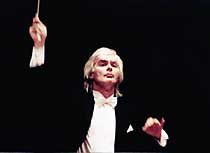
Led by artistic director and chief conductor Thadeusz Wojciehowski,
the Polish Philharmonic Resovia’s program will feature two lesser-known
works by Polish composers who are rarely heard outside of Poland’s
concert halls, Wojciech Kilar and Karol Kurpinski; the second
piano concerto of Poland’s most famous composer, Chopin – with
piano soloist Leopold Godowsky III – and lastly, the "Italian"
Symphony of Felix Mendelssohn.
The concert begins with Kilar’s nine-minute piece for string
orchestra, "Orawa," which he wrote in 1986. The 71-year-old
Kilar has had a fruitful classical career, but he’s probably
best known for his many film scores, including those for Roman
Polanski’s "The Pianist" (2002) and Francis Ford Coppola’s
"Bram Stoker’s Dracula" (1992), as well as scores for
Polish directors like Krzysztof Zanussi and Andrzej Wajda.
Following Kilar’s opener will be Godowsky’s performance of Chopin’s
superlative Piano Concerto No. 2 in F-minor. Godowsky, a composer
in his own right, is the nephew of another great Polish-American
composer by the name of George Gershwin, and his recent recording
of his uncle’s Piano Concerto in F was released to rave reviews.
After intermission, comes the most obscure piece on the program:
the overture to Kurpinski’s opera "Kalmora." This 1820
stage work was just one of some 27 operas composed by Kurpinski,
who had his brief time in the sun but has since all but faded
– even from Poland’s musical horizon. A bit of trivia: Kurpinski
conducted the world premiere of Chopin’s F-minor piano concerto
in 1830, with Chopin himself performing.
The concert’s finale is Mendelssohn’s "Italian" Symphony;
the most popular of Mendelssohn’s symphonies, the "Italian"
(or fourth symphony) has kept its hold on audiences since its
premiere in 1843. Inspired by Mendelssohn’s visits to Italy,
this impressionistic work demands both delicacy and deftness
from conductor and orchestra, and should provide a suitable climax
to an afternoon’s worth of joyous music making.
The Polish Philharmonic Resovia performs
music by Chopin, Kilar, Kurpinski and Mendelssohn at 2 pm Sunday,
Oct. 26, at the Brooklyn Center for the Performing Arts (at Brooklyn
College’s Whitman Theatre, 2900 Campus Road and Hillel Place,
one block west of "the Junction" at Nostrand and Flatbush
Avenues). Tickets are $30. For more information, visit www.brooklyncenter.com
or call (718) 951-4343.