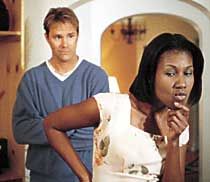
"This movie is about what people think but never say
aloud – that’s what makes people uncomfortable," says Nicole
Smith, star of the new independent feature, "Rocky Road."
Based on the real-life relationship between Smith, an actress
of West Indian descent, and writer-director Geoff Cunningham,
who is white, "Rocky Road" explores the various difficulties
affecting an interracial couple, even in today’s supposedly more
tolerant America.
Smith, a Flatbush native, and Cunningham spoke with GO Brooklyn
in an exclusive interview about how, in this case at least, art
imitates life. It all started a few years ago, the couple says.
"We were in San Francisco, noted as a liberal city, walking
through the Castro district," Cunningham explains. "And
we were attacked by a homeless black man who was upset that we
were together. He was really targeting me – it was me he wanted
to take aside and take to task- but he took it out on Geoff physically."
The scene plays out seemingly unchanged in "Rocky Road,"
as Talia (Smith) and her white boyfriend John (Will Wallace)
are accosted by a black street person who physically assaults
John after verbally attacking Talia. As Cunningham says about
their dangerous real-life brush with a racially motivated assault,
"If it can happen in San Francisco or another big city,
it can only get worse when you move away from the cities into
places where people aren’t mixing as much ethnically."
"Rocky Road" concentrates on Smith’s character Talia,
whose large, close-knit Caribbean family has mixed feelings about
her relationship with a white man. Her parents are split, but
her sister, Tina (Natasha Pearce), whose black militancy prevents
her from supporting Talia casts a key vote against the relationship,
even though Talia is deeply in love.
"The movie is a microcosm of a lot of experiences,"
says Smith. "It’s pretty much my life, from high school
on. My sister had a whole summer of being [against my relationship],
as opposed to every single day, like it is in the movie."
Often, Smith was unable to leave Talia on the set each day. "It
was really tough going through that short period of filming with
[the other characters] going at me all the time," Smith
says of her first film role. "It took me a good month after
shooting to stop being hyper-sensitive and start being reasonable
again since, through the whole movie, everybody is telling me
pretty much what to do."
Both husband and wife served as producers of "Rocky Road,"
which, like many first-time independent productions, was financed
mostly via credit cards, friends and relatives. But Cunningham
sees that as the only way to retain the integrity of what he
and Smith wanted to explore.
"The big studios discriminate against couples like us because
we are interracial and we don’t fit into any sort of niche easily,"
Cunningham says. "We’re not afraid to take issues head-on
by really talking about them, as opposed to Hollywood, which
is namby-pamby, without directly dealing with the real issues.
Our film tries to look at such things, at what’s going on in
America today."
Cunningham’s film follows on the heels of Marc Levin’s "Brooklyn
Babylon," about a Hasidic woman and Rastafarian man that
fall in love in Crown Heights. Though "Brooklyn Babylon"
was shown at various festivals, and given a short run at the
Brooklyn Academy of Music, it’s distributor, Artisan, decided
to shelve the film, which depicted violent repercussions for
that interracial couple. The end of "Rocky Road" however
is very hopeful, even conciliatory, after a violent act near
the end imperils one of the main characters.
Alluding to such recent big-budget fare as "Finding Forrester"
and "Save the Last Dance" – both of which feature uncomplicated
romantic relationships that just happen to be interracial – Cunningham
explains why such movies aren’t realistic: "Hollywood pushes
this idea of colorblindness, which is to pretend that no one
notices color any more. And that’s a lie. We do notice color
– and once we admit that, we can go forward.
"Most people aren’t racist, but most people do have prejudices,"
he continues. "Most people say, ’I don’t care (about color)
– but other people might have a problem with it.’ That means
they themselves have a problem with it. And I don’t think we
feel too good about our prejudices, which is why Hollywood thinks
audiences would rather see two people together on-screen without
anybody talking about it."
Based on early response to "Rocky Road," however, audiences
are surely talking. "We’ve gotten wonderful responses from
people who’ve seen the movie," Cunningham says. "They
like that we deal with real issues, that we show the love of
a family – her family – and the couple’s experiences."
Smith feels strongly about discussing such volatile issues. "Prejudice
can move into racism if you don’t talk about it," she says.
"If you have prejudices and you meet someone ’different’
and talk with them, if you’re a reasonable person, you’re going
to walk away a little more enlightened. If you don’t have a chance
to talk about it, the prejudices just solidify."
And a movie like "Rocky Road" just might open a necessary
path to enlightenment.
"Rocky Road," directed by Geoff Cunningham, opens
at the Flatbush Avenue Pavilion, 314 Flatbush Ave. at Seventh
Avenue, on Sept. 21. For show times, call (718) 369-0838.