
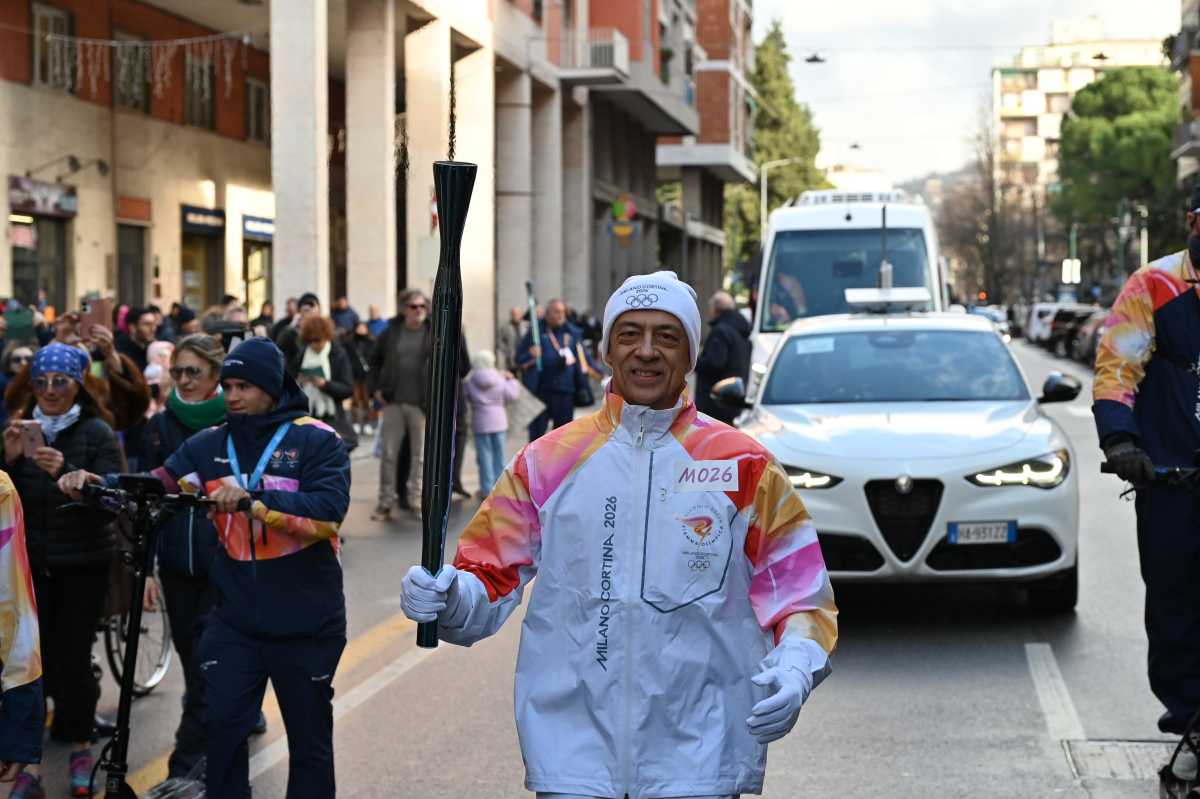
On a January morning in La Spezia, a city tucked in between Genoa and Pisa along Italy’s Ligurian coast, Dr. Riccardo Bianchi jogged down a stretch of a road he had known since childhood, with an Olympic torch burning steadily in his hand. For a few unforgettable moments on Jan. 9, Bianchi was not only a neuroscientist, educator, marathon runner or Brooklynite by way of Italy — he was a link between past and present, hometown and adopted home, carrying the Olympic flame through the streets that shaped him.
Dr. Bianchi is an associate professor and associate dean for the Foundations of Medicine at SUNY Downstate Health Sciences University, where he has spent over three decades teaching, researching and mentoring students. Born in Italy in the Tuscan province of Pisa, Bianchi grew up primarily in La Spezia, a city of about 100,000 people overlooking a “beautiful harbor,” as he described it. There, he completed his schooling before beginning university in Pisa
“I always loved science, animals and nature,” he said. That curiosity led him to pursue a PhD in neuroscience at the University of Pisa, focusing on neuronal activity in the brain, particularly in the context of epilepsy.
“I really became fascinated by these studies in the mechanisms of epilepsy,” he said, describing early research that would shape his career.
At 28, Bianchi had the opportunity to spend a year abroad in a laboratory specializing in animal models of epilepsy. That opportunity brought him to New York — specifically, to Brooklyn. He joined the lab of Dr. Robert Wong, then newly appointed chair of the Department of Physiology and Pharmacology at SUNY Downstate.
“He did invite me to join his lab a year later,” Bianchi recalled. “And in 1991, when I was 28, I came over here with an initial plan to stay for one year.”
That one-year plan quietly turned into more than 30. Bianchi found himself drawn not only to the intellectual freedom of the lab but also to Brooklyn itself. He settled in Park Slope near Prospect Park, eventually welcoming his wife — also Italian, and a fine art restorer — and building a life that blended science, teaching, family and community. Today, Bianchi balances neuroscience research with medical education, overseeing foundational curricula and teaching medical and graduate students across disciplines.
“I love this job,” he said. “It keeps you in touch with young people every day. Mm-hmm. Which, you know, keeps you young as well, directly, and it’s very stimulating.”
He speaks with particular pride about Downstate’s students, many of whom are first-generation Americans or immigrants themselves.
“Somebody here said that if we put all our students together, they can speak up to 42 languages,” he said. “Unbelievable.”
Outside the classroom and lab, Bianchi is a runner, an identity as central to him as his academic work. He joined the Brooklyn Road Runners Club in 1998 and has witnessed the growth of running culture in New York over the past few decades. As of 2025, he has completed 25 marathons.
“Sports for me is a way of living,” he said. “It’s part of daily life.”
He credits athletics with teaching discipline, self-awareness and respect for others — values he later recognized as closely aligned with the Olympic ideals.
That alignment would become unexpectedly meaningful about a year ago, when Bianchi happened to be watching the Festival di Sanremo, Italy’s iconic pop music competition. During the broadcast, organizers for the Milan Cortina Olympics announced they were recruiting 10,001 torchbearers. The application was open to Italian citizens.
“My wife joked, ‘You are a runner. This is for runners, right?’” Bianchi said. At first, he was skeptical.
The application included short essays asking why applicants wanted to carry the torch, whether they believed in Olympic ideals, and how their lives reflected those values. Bianchi hesitated, then leaned into reflections on decades of running, teaching and advocating for physical activity as a cornerstone of health.
“Exercise plays such a large role in physical activity for health and disease,” he said, noting that he regularly teaches medical students about its importance.
After submitting the application in early March, he forgot about it. Months later, in late October, an email arrived. He had been selected as a torchbearer.
“It seemed out of the blue because I had forgotten about it,” he said. The news became even more surreal when he learned his assigned date — January 9 — and later, his location: La Spezia.
“That was literally at home,” he said. “It was literally 300 meters from my elementary and middle schools.”
The Olympic torch relay for Milan Cortina spanned 63 days, beginning in Rome on Dec. 6 and concluding in Milan on Feb. 6, the day of the opening ceremony. Each city hosted a series of torchbearers, each carrying the flame for roughly 200 to 300 meters. In La Spezia, there were 23 torchbearers, and only six or seven of whom were locals.
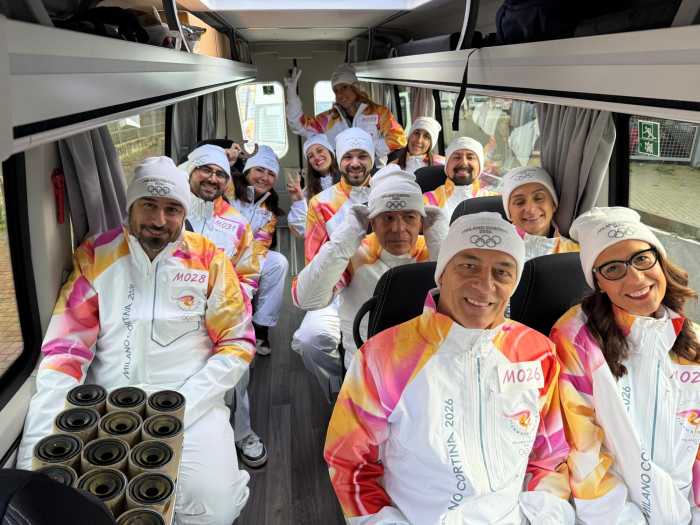
On the morning of the relay, participants gathered at the city’s sports center, received their uniforms and met one another. During a briefing, organizers shared a staggering statistic: 1.5 million people had applied to be torchbearers. Only 10,001 were chosen.
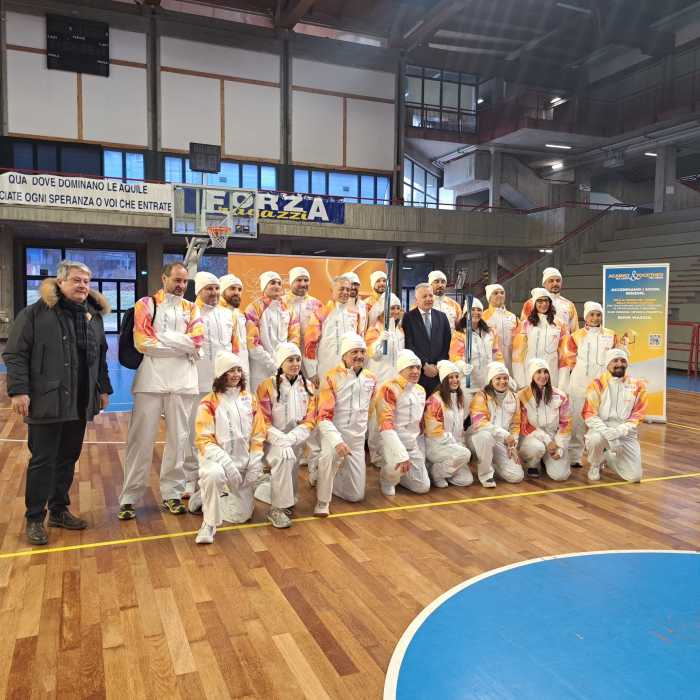
“That to me was like, oh my God,” Bianchi said. Organizers offered simple instructions: stay present, smile, and be available to the public. “You are a star today,” they told the group.
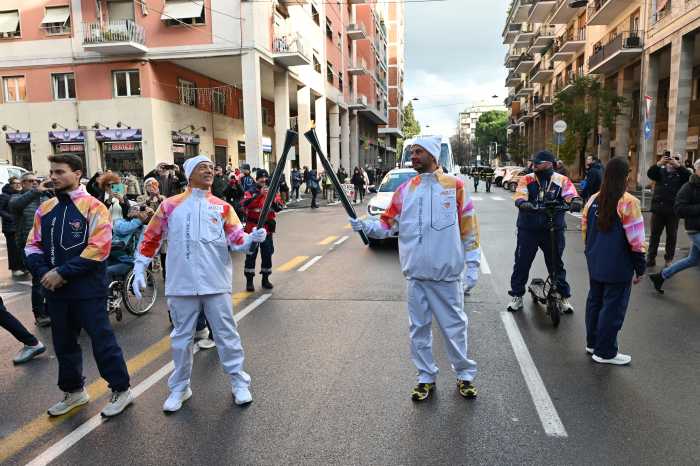
The relay itself unfolded with ceremonial precision. The flame—not the torch—was passed from one bearer to the next through what organizers called the “torch kiss,” igniting each new torch in turn. Bianchi jogged his segment carefully, resisting the urge to speed up.
“I wanted to enjoy that moment,” he said.
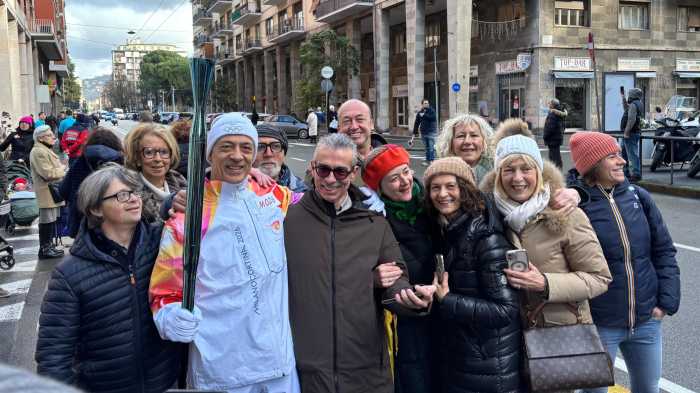
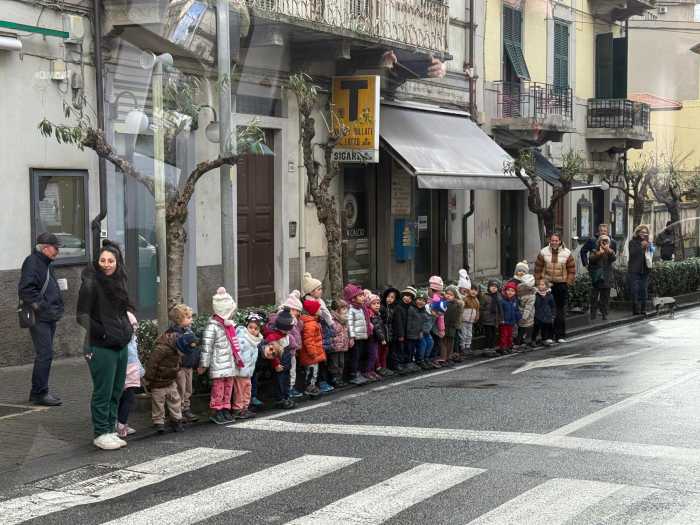
Bianchi said that friends, family and neighbors lined the streets. Children were brought out of schools to watch. After his run, strangers asked for photos, including one 87-year-old man eager to pose with the torch medal.
When it was over, Bianchi kept a pin made from the base of the torch, the official uniform and later received a certificate commemorating the experience. Local newspapers in La Spezia covered the event. Back in Brooklyn, colleagues at SUNY Downstate celebrated with him. The response surprised him.
“It was so nice that people understood why this is so exciting,” he told Brooklyn Paper.
For Bianchi, the meaning went far beyond personal achievement.
“This is very fulfilling, right?” he said. “But I felt it was more than that. It’s like you’re just carrying with you the many people that you met and the positive experiences that I had the privilege to have.”
He was especially struck by the sight of children watching the relay. He remembered being a child himself when a cycling race passed through La Spezia, a fleeting moment that stayed with him for decades.
“Imagine for them what memory that was,” he said. “I hope it will be like mine.”
In a world often dominated by grim headlines, Bianchi sees the Olympics — and the torch carrying — as a counterbalance.
“This is something that can truly bring people together,” he said. “If anything else, to counterbalance the ones that disunite us.”
Now back in Brooklyn, Bianchi is watching the Winter Olympics closely, cheering for both Italy and the United States. He favors figure skating and skiing events, marveling at athletes’ dedication and resilience.
“The discipline, the determination,” he said. “You don’t have to be a champion, win a gold medal.”
For him, the Olympic message is simple and deeply personal.
“It’s not an absolute scale of reference that matters; it’s about the best that you can do.” It’s a lesson he shares with students and carries into his own life — one he quite literally carried through the streets of his hometown, flame in hand, connecting Brooklyn to La Spezia in a moment brighter than he ever expected.