
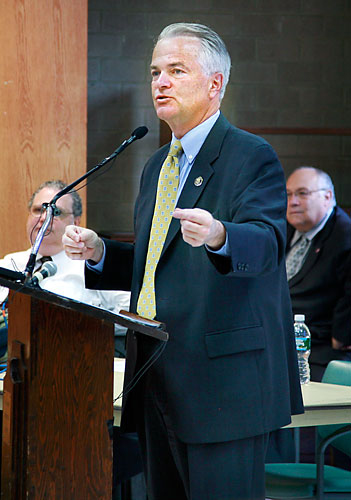
President Obama called on congressional Democrats to pass a health care bill now, rather than fearfully “head for the hills” — but freshman Rep. Mike McMahon is so far up the mountain that he risks a nose bleed!
That’s what the Bay Ridge Democrat told us just a few hours after the president’s well-received State of the Union address on Wednesday night.
Clearly, it was time to get McMahon on Line 1 again, where he spoke with our editor, Gersh Kuntzman.
Gersh Kuntzman: The president asked the House and Senate — specifically Democrats like yourself, who control both houses! — to pass a conference version of the health care bills that have already passed both houses. He specifically ordered Democrats to not “head for the hills.” Did that reach you in any way?
Mike McMahon: No, it didn’t resonate with me because I won’t vote for a bill that increases Medicaid costs in New York by $5 billion. It’s not running for the hills. I won’t do it just to be part of a stampede.
GK: Five billion dollars? Whose number is that?
MM: It’s the governor’s. It’s the mayor’s. That’s the number we’re using.
GK: But is not healthcare reform imperative for the nation? Isn’t there a larger calling here?
MM: No, because I’m hearing the people, not just the president. They are saying, “Give us things that we understand. Do away with the insurance company anti-trust exemption. Give us portability. Show us cost-cutting. Give us reform. Let’s start the process of covering the uninsured by expanding existing programs like Medicare and Medicaid.” That’s what they’re saying. The radical reform was not welcomed by the electorate.
GK: Wait a second. Did you just call the House bill “radical”?
MM: It was certainly perceived as such.
GK: Yeah, but whose freakin’ fault is that?
MM: Well, I blame the proponents of the bill for not communicating better. And they overstated the majority in the Senate and did not perceive how fragile the 60 votes was.
GK: Um, don’t the tea-baggers get some blame here, too? They completely demagogued the issue. “Death panels”? “Socialized” medicine? It’s all lies!
MM: Of course they’ve demagogued the issue. And many sectors of the media have done that, too. But when the leadership presented its proposal to the Senate, they started making all these deals to hold together the 60 votes. It became about the process and the process was bad. You can’t defend that process. The folks who are here, the leadership, should have known that they had a fragile majority, and they should have set their goals accordingly. They overshot. Not so much on the substance, but on the process. This democratic process of ours has evolved over 200 years. They should have anticipated the way the Republicans would use the filibuster. The democrats used it, albeit much more sparingly, under President Bush. Now this GOP is using it as a daily weapon. The leadership should have seen it coming. Instead, it became about making deals, like the “Cornhusker Kickback” or the “Louisiana Purchase.”
GK: We can agree to disagree here. Let’s move on. The other day, I got a press release from you calling for an extension of the Bush tax cuts, which are set to expire at the end of the year. The Bush tax cuts? Have you switched your party affiliation without telling us?
MM: I’m glad you come at this discussion without any biases.
GK: My bias is clear — tax and spend. That said, why do you like the Bush tax cuts so much?
MM: We are in the throes of a serious recession. Job numbers are stuck and unemployment is in double-digits. Basic Paul Samuelson macro economics 101 is that you don’t raise taxes during this type of recession. The nomenclature of these tax cuts [“the Bush tax cuts”] is unfortunate because it refers to the prior administration, but the fact is that working couples in New York City making $150,000 to $200,000 can’t afford a tax increase. Those numbers sound high, but you struggle to make ends meet in New York City. Yes, we need to deal with budget deficit and the government needs to reduce spending. But we need to grow the economy, and extending these tax cuts will do that. Raising taxes now will put us back into a double-dip recession.
GK: But the president said last night that he’s cut taxes on virtually everyone.
MM: A lot of those were one-time tax cuts that were important in helping people deal get through their personal troubles during the recession, but for the economy to grow, even the most liberal economist will say you don’t raise taxes.
GK: I’m a liberal economist and I don’t say that.
MM: You are an ultra-liberal economist, I guess. For me, as someone who represents a centrist district, it was good to hear in the State of the Union that the president understands that the American people want him to govern from the center and work with the other side as much as possible, as recalcitrant as they are.
GK: Don’t gloss over that. Isn’t the GOP the Party of No right now?
MM: They are. But certainly, there are some things that we can get them to agree upon, like not raising taxes, like doing the small business loan bank that the president talked about, like finding things in the health care debate that we can do now.
GK: Did you like the speech?
MM: It is exhilarating to attend a State of the Union. For people in politics and government, it’s like the Super Bowl and World Series together.
GK: Nice to see him go after the Supreme Court a bit. Usually, the justices sit there as if they’re infallible, but he specifically nailed them for their recent ruling on corporate campaign contributions. Cool, right?
MM: That may be the memorable moment from the speech. He made history. Did you see [Justice Samuel] Alito’s face? He was mumbling!
GK: Was the president right on the substance about that Supreme Court ruling?
MM: The Court was ridiculously overbroad. That ruling could change the nature of politics.
GK: Spoken like a man who has two Republicans already lined up to challenge him.