Using art as a path to violence prevention, NYC Health+Hospitals unveiled a first-of-its-kind systemwide mural at Woodhull Medical Center in Bedford-Stuyvesant on Jan. 8.
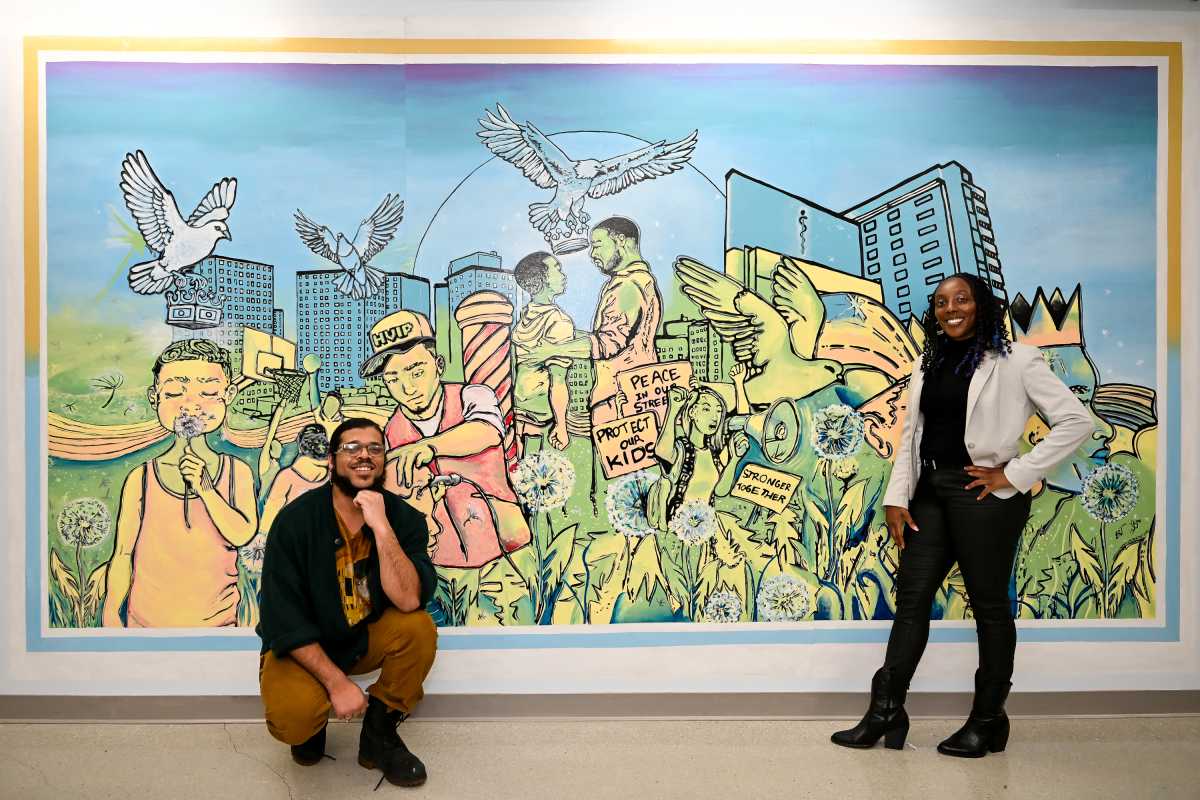
The work, by artists Shenna Vaughn and William Bentley and titled “If We Dreamed: A Journey for Peace in Our Street,” was created in collaboration with NYC Health+Hospitals Hospital Violence Interruption Programs (HVIP) and Arts in Medicine department, emphasizing the public health system’s commitment to addressing violence as a public health issue while using art as a healing tool in communities most impacted by violence trauma.
The mural — considered to be the largest public hospital mural program in the country and funded by the Laurie M. Tisch Illumination Fund — serves as a powerful reminder that when communities unite, peace and opportunity can flourish.

It depicts everyday scenes of community life and activism, such as youth playing basketball, community gatherings, and advocacy, symbolizing the collective strength and hope found across the city and envisioning a community grounded in peace, protection, and care. Imagery of a child blowing dandelion seeds and birds like a dove, eagle, and pigeon rising into the sky, evoking hope, renewal, and the aspiration for a safer future.
One scene illustrates a hospital, symbolizing the essential role the public health system plays in healing and protection and the artwork integrates the logos of NYC Health+Hospitals’ five HVIP programs — Harlem Crossroads at Harlem Hospital, Stand Up to Violence at Jacobi Hospital, Kings Against Violence Initiative at Kings County Hospital, Guns Down Life Up at Lincoln Hospital, and WICK Against Violence at Woodhull Hospital — reinforcing their support for young people and families impacted by violence.
Vaughn and Bentley told Brooklyn Paper that it was an “honor” to participate in the groundbreaking project in collaboration with the Arts in Medicine department and more than 75 youth participants and hospital staff.
Vaughn described the mural as “therapy for the soul.”

“We purposely chose these soft, warm colors,” Vaughn explained. “So one that it’ll pull you in, [and] two, it kind of gives this dream atmosphere, this dreamlike feeling that actually comes to life. And it’s extremely calming.”
Bentley added that they didn’t just want to create a “pretty picture,” but create a mural that tells a story.
“We wanted to actually communicate a story that people can talk about, and people can relate to,” the Bronx native shared. “People can see the Dove as not only a symbol of hope, but also a message from ancestors or people who we’ve lost, coming back to give the crown and give the honor to the dream. So there’s so many layers to [the mural] that I want people to keep looking at and finding something new every day.”
The mural aims to empower viewers and dare them to dream of what they might perceive as impossible.
Bentley said that growing up in the Bronx, he saw all forms of violence and used his artistic talent to keep his dream alive. The dandelion, growing in grass and concrete, was a guardian of his dreams and a symbol of resilience, hope, and growth.
“I always kept my dream alive of what I wanted to do for my community and to be better than what violence was allowing me to be. And my art and my talent have kind of saved me from that,” Bentley said. “So this mural kind of illustrates that; hopefully, it gives everybody that power when they see it.”
“We all have a hand in helping with anti-violence, and then showing that there is a light at the end of the tunnel. We wanted to show something that’s real, like the possibility of what life can be in spite of what the experience is,” Vaughn added.
Before the unveiling ceremony of the mural, which will be permanently displayed on the hospital’s first floor with replicas at Harlem, Jacobi, Kings, and Lincoln Hospitals, NYC Health+Hospitals leadership and community leaders addressed staff and community members, including violence interrupter organizations, in the Woodhull Hospital auditorium.
Dr. Mitchell Katz, president and CEO of NYC Health+Hospitals, said the mural was a visible reminder that hospitals were not only for treatment, but for healing, belonging, and change.
“We’re here today to combine two things that belong together, which is art, which is healing, and violence interruption. I think that art is the perfect frame for saying that to prevent violence, we have to heal souls. And what heals souls, it isn’t just medicine and nursing and social work; it’s art,” Katz said.

Sandra Sneed, CEO of NYC Health+Hospitals/Woodhull, said the mural reflected the shared commitment of hospitals, families, and community partners to protect and uplift young people.
“At Woodhull Hospital, violence prevention is not only a public safety priority — it is a public health imperative. By investing in partnerships rooted in trust and compassion, we help create pathways where young people can thrive, dream boldly, and grow into their full potential,” Sneed said.
Deputy Borough President Rev. Kim Council recalled the shooting death of her best friend, who was killed before prom, highlighting how the mural provided an opportunity to have a conversation about violence and how it has impacted communities of color.
“Those types of things impact you in a way that changes, sometimes the trajectory of your life. And so for us to be working to make sure that we create these opportunities for people to get it out and to let people know how they’re feeling, so that we can go on to live better lives, is a wonderful, wonderful thing,” Council said.