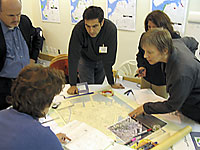
The night was filled with much pointing at posters and speculating about
best-case scenarios as the first public session to address the Brooklyn
Greenway came together at St. Francis College on Remsen Street in Brooklyn
Heights.
The idea of a borough-encircling greenway was put forth in 1993 by Brian
McCormick, who is now chairman of the task force. Since then, they have
sought out private funding, mainly through corporate sponsors, and last
summer received a $75,000 grant from the state’s Waterfront Revitalization
Project for a six-month planning process.
Milton Puryear, director of planning for the Brooklyn Waterfront Greenway
Initiative, said the workshop was called in light of stepped-up waterfront
redevelopment projects that could potentially help or harm their cause.
“As things started to happen with the waterfront, we realized the
window of opportunity really is a window,” said Puryear, and if they
didn’t act fast, “we would use it right up.”
Plans will be presented at another public meeting in February, at which
point feedback will be considered, and a final plan will be drawn up and
presented to a Technical Advisory Committee comprised of private property
owners, elected officials, and members from local and state government
as well as planners from the city departments of Parks and Recreation
and City Planning.
McCormick said he gathered the more than 60 participants at the Nov. 9
meeting from among supporters of the initiative and suggestions from elected
officials. They split into eight groups and eyed maps of community board
districts 2 and 6.
Massive maps of the districts were unfurled on the tables around the room,
all marked with a green line showing where the path would be. Swooping
past the Navy Yard, the greenway juts towards the waterfront in Vinegar
Hill, cutting through DUMBO along the East River, and continuing south
through the planned Brooklyn Bridge Park along piers 1-5 in Brooklyn Heights.
Planners envision it entering Red Hook on Columbia Street, avoiding piers
except where a roadway planned to accommodate cruise ship traffic will
be built at Pier 10, and following down to the Erie Basin, where it wold
branch out onto a pier that Ikea has promised to develop for public use,
and then move back up towards Hamilton Avenue, crossing the Gowanus Canal.
Many of the neighbors who were strangers at the outset, soon warmed into
lively conversations and a deluge of ideas came from each table.
Residents of CB 2 were charged with dealing with the delicate area of
Vinegar Hill, where the path would run along a stretch in front of the
Farragut Houses. The public housing complex sits near the Brooklyn Navy
Yard.
Though some groups advised keeping away from the houses in their presentation,
others said the housing authority tenants should help in designs.
John Muir, of Boerum Hill, eyeing the Navy Yard, suggested “striking
a blow for freedom.”
“It has been closed [to the public] since the 1970s. That’s
a really long time to have exclusive use,” he said, and showed off
a redrawn map with the greenway entering into the fenced-off Brooklyn
Navy Yard and running along the waterfront. The current designs reroute
the path to follow Flushing Avenue, just south of the industrial complex.
Muir’s group also suggested gaining access to the Con Ed site along
Hudson Avenue in Vinegar Hill. A group member said Con Edison might install
a “steam curtain,” similar to a fountain, that would be lit
up at night and could double as a projection screen upon which movies
could be shown. One of the group coordinators said it was similar to a
project that had been installed in Berlin.
Puryear called that plan “a long shot,” but said that he planned
to appeal to Con Ed’s security concerns.
“Wouldn’t it be more secure to have a hundred people pass the
property every hour instead of two dead ends that nobody looks at?”
he said.
Community Board 6 residents, charged with generating ideas for Columbia
Street, redrew the greenway to include accessibility to several of the
piers, including those in consideration for use as a cruise ship terminal.
“Is there any way of extending this up to Gowanus, to Park Slope?”
asked David Alquist, an avid bicyclist.
But Columbia Street itself would be a problem, said Puryear, because of
the private ownership along the way, “one of the major challenges”
of the project in Red Hook.
“The section of the greenway that will be developed as part of the
Columbia Street reconstruction [would be] fairly bare-bones,” he
said.
He said he hoped the taskforce could convince property owners, which include
the Port Authority of New York and New Jersey, Red Hook developer Greg
O’Connell, Bruce Federman, whose Industry City Associates is currently
stalled by litigation over his planned condo conversion of a giant warehouse
at 160 Imlay St., and Ikea, which plans to open a massive store on the
Erie Basin next year, to see a Columbia Street greenway as something that
would increase the value of their waterfront properties.
But appealing to Ikea, which has only committed to a 12-foot right of
way for the bike path, may be another challenge facing the planners.
“We’re very hopeful that we will be able to negotiate for our
standard [of 18 feet wide],” he said.
Puryear said all the ideas will be reviewed, and a “conceptual plan”
will be revealed at another public workshop on Feb. 1.