The area along and around the filthy Gowanus Canal would be reborn with a restaurant atop the grimy Smith and Ninth street subway station, a public market under the viaduct near Lowe’s, “green” industries, new homes and, of course, a clean-flowing waterway under a plan released by an area community group this week.
The Gowanus Canal Community Development Corporation’s proposal outlines a vision for the city’s first environmentally sensitive community with a sustainable mix of local industry, retail, and residential uses.
“We want a San Antonio Riverwalk along the Gowanus,” said GCCD board member Buddy Scotto, who emphasized the need for more affordable housing in the area, particularly for seniors.
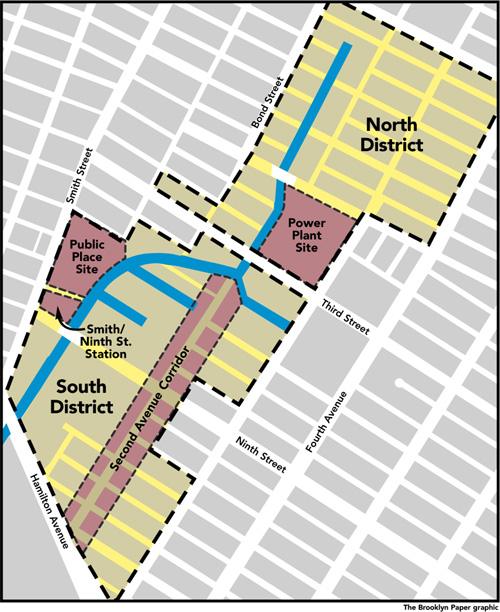
The Quixotic proposal — the latest in a decades-old effort to transform the area — calls for more residential development north of Third Street.
The area south of Third Street would remain mostly industrial, with some retail and residential mixed in.
Specifically, the plan called for the redevelopment of several neighborhood trouble spots, including the intersection of Smith and Ninth streets, a former gas manufacturing plant near Fifth Street that’s commonly known as the Public Place site, and Second Avenue’s industrial corridor.
Of course, before Gowanus can become “green,” it will have to be decontaminated. The neighborhood’s long industrial history has left it much of it soaked with potential hazards.
The report lists 10 “potential contaminants” in the neighborhood’s soil and water, from cyanide to mercury to PCBs.
Aside from the substantial environmental obstacles, these dreams for a better Gowanus will remain just that unless the Department of City Planning gets on board. So far, the agency’s response has been noncommittal.
“In response to community requests, DCP will be conducting a series of meetings, hosted by Community Board 6, to develop a zoning framework to guide future land use decisions in the Gowanus Canal area,” said Jennifer Torres, an agency spokeswoman. “This meeting is the beginning of a discussion and will be the first of many.”
Scotto, for one, is less worried about the city’s tepid response than his own neighbors’ reaction.
“My concern is that there are groups out there representing the old economy who will do everything they can to frustrate the process,” said Scotto, who has fought for the canal clean-up since the late 1960s. He still vows to swim the canal should it ever be de-contaminated.
“Goddamnit, one of these days maybe I’ll be able to do that,” said Scotto.