After nearly six years of construction, the new entrance to the Long Island Rail Road’s critical Atlantic Terminal at Flatbush Avenue is finally open to straphangers.
Though the ground-floor entrance is blocked off until next week’s grand opening, The Brooklyn Paper got a sneak peak of the concourse, which can be accessed via LIRR platforms.
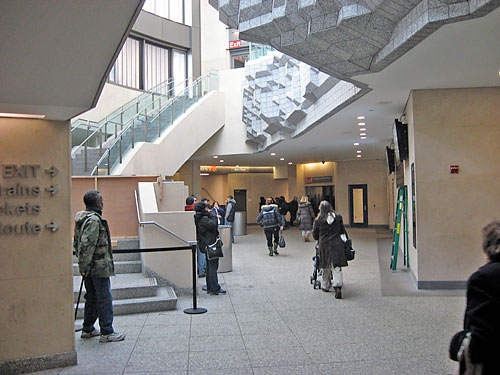
Commuters looking for the ticket office will find that it has moved to a new location on the concourse below the ground floor entrance, where natural light shines through glass that spans from the road to the ceiling, offering views of the Williamsburgh Savings Bank tower across the street.
Bringing in natural light to the concourse below street-level was one of the top priorities of John di Domenico, the head architect with the Queens-based firm, di Domenico and Partners, which designed the facility.
“As a commuter, light serves as a timepiece, as well as being pleasant — and free,” he said, adding that the previous entranceway had been cramped and poorly lit.
One of the distinctive features of the new space is a rough-hewn granite sculpture featuring craggy geometric shapes that loom over commuters emerging from train platforms.
The inspiration for the Cubist forms, according to artist Allan Wexler, came from scenic overlooks at state parks.
“It is a cross between mathematics and nature,” said Wexler. “I don’t want it to be clear where the architecture ends and the sculpture begins.”

More than 50,000 commuters come through the station daily, whether via the subway or Long Island Rail Road. The new, spacious entrance will better accommodate the surge in riders if the nearby Barclays Center ever opens.
Still, the hordes of pedestrians will have to contend with the sarcophagus-sized slabs of stone outside of the entrance, which are meant to ward off terrorists, but are also a grotesque eyesore.
The renovations began in June 2004 with a projected budget of $116 million, according to an MTA press release. A source said that the job was completed $8 million under budget (but then again, the source was “off the record,” so who knows?).
Di Domenico said that the biggest challenge was accommodating so many commuters throughout construction.
“We had to [work] without causing additional inconveniences,” said di Domenico.
Despite the five years it took to build the new entrance — which disrupted foot traffic on Hanson Place — di Domenico said the lengthy construction time was a necessary evil.
“There weren’t delays as far as I’m concerned,” di Domenico said. “We had to make sure the trains ran on time.”