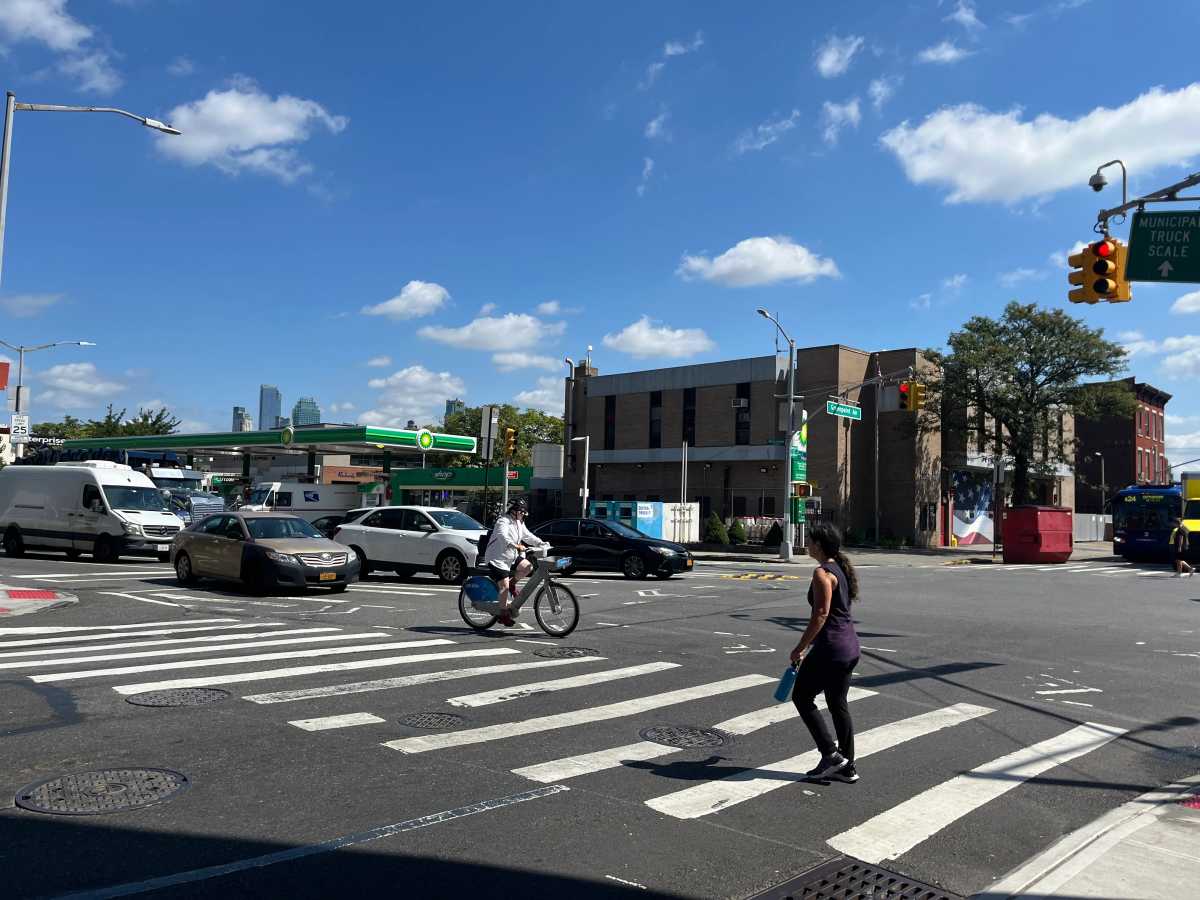
City officials and locals lauded the success of the redesigned southern half of McGuinness Boulevard as the Department of Transportation prepares to extend the design up to Freeman Street.
Since the city removed one vehicle traffic lane in each direction in favor of a parking-protected bike lane between Calyer Street and Meeker Avenue in 2024, the boulevard has seen more cyclists, fewer vehicles and slightly-slower travel times, DOT engineer Zach Wyche told Community Board 1 on April 14.
DOT shares data details ahead of expanded redesign
The redesign was approved for the entirety of McGuinness Boulevard in 2023, but was squashed by then-mayor Eric Adams after one of his top aides was allegedly bribed by local business owners opposed to the plan.
Eventually, the city proposed a “compromise,” and implemented the full redesign on the southern half of the boulevard, with minor changes to the northern half. On his third day in office, Mayor Zohran Mamdani pledged to implement the full redesign “as soon as the weather warms.”
With temperatures reaching unseasonable highs, the DOT returned to CB1 to discuss the data it’s gathered over the past year and a half and hear feedback from neighbors.
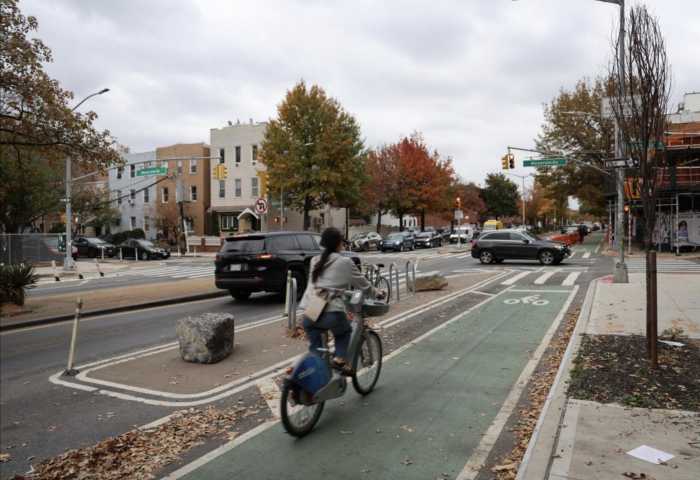
At the start of the redesign process, many locals were worried that removing a vehicle traffic lane would “gridlock” the neighborhood, Wyche said, slowing traffic on McGuinness Boulevard and pushing cars into neighboring streets.
Travel times have increased, he said, but by less than the length of one traffic light cycle. On weekdays, it takes about a minute longer to drive from Meeker Avenue to Calyer Street, per DOT analysis. Driving south, the impact is even smaller, with travel time extended by five to 60 seconds.
Fewer cars are traversing the redesigned portion of McGuinness Boulevard, he said. South of Greenpoint Avenue, the boulevard sees between 100-400 fewer vehicles during peak hours.
Traffic volume north of Greenpoint Avenue has risen, though, and more cars are utilizing Leonard and Humboldt streets, which run parallel to McGuinness Boulevard.
Meanwhile, the number of cyclists on McGuinness Boulevard has more than doubled since 2021, while cycle trips across the Pulaski Bridge, at the northern end of the boulevard, are up 11%. Whereas half of cyclists on McGuinness in 2021 rode on the sidewalk, almost all ride in the street today — reflecting a recent study that found cyclists are less likely to use the sidewalk when they have access to a protected bike lane.
The protected bike lanes are also welcoming a more diverse community of cyclists, Wyche said. Before, most people biking down McGuinness Boulevard were experienced riders and commuters. Now, DOT is seeing more casual Citi Bikers, slower cyclists, and families.
Challenges persist on northern part of McGuinness
Meanwhile, the northern half of the boulevard still struggles with safety issues, Wyche said.
In 2023, the city installed barrier-protected bike lanes on McGuinness Boulevard from Calyer to Freeman streets, with one full-time vehicle traffic lane and one peak vehicle traffic lane that becomes a parking lane during off-peak hours.
That design leaves cyclists vulnerable to turning vehicles, he explained, and doesn’t have a place for pedestrians to wait between the bike and vehicle lanes. Pedestrians are forced to cross a 70-foot-wide boulevard that in some places does not have a safe median for them to wait if they can’t get all the way across the street in one cycle.
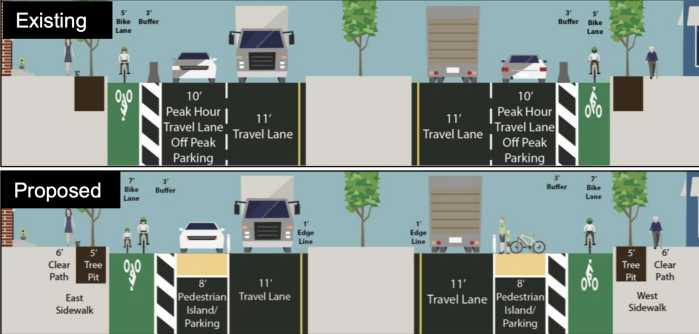
While the redesign on the southern half includes designated loading zones, vehicles on the northern half usually double-park or block the bike lane when they stop.
“We do expect that there will be an adjustment period,” where traffic will worsen and slow, he explained. But the DOT expects traffic patterns to normalize over time, as they have previously.
“As we install the project, we do a lot of monitoring and mitigation,” he said. “We study GPS speeds, we’re counting vehicles. At the same time, we can make changes. We can make changes to the lights, we can make changes to some of the markings … we will be here along the way watching the project go in and monitoring afterwards.”
Construction is expected to start later this spring or summer, Wyche said.
Neighbors embrace full redesign, and push for more
Dozens of locals said they’ve embraced the redesign on the southern half of McGuinness Boulevard, but want DOT to address some lingering issues.
Resident Nicholas Otto said McGuinness had always felt “like a dividing line” in the neighborhood.
“The part of McGuinness with the road diet feels like a part of the neighborhood now that I feel comfortable walking and biking on,” he said. “Sometimes I even enjoy being there. I think that’s something we should strive for, neighborhoods that are primarily there for us as people and keep us feeling safe.”
Several board members and neighbors said they have issues walking, biking and driving in the area of the Graham Avenue slip lane, next to Father Studzinski Square. Others said the intersection of Meeker Avenue, below the Brooklyn-Queens Expressway, is also particularly treacherous for cyclists and pedestrians.
Cameron Shore, a volunteer at the Lentol Community Garden just off Meeker Avenue, said the garden planters along McGuinness Boulevard, but that they don’t feel comfortable sending volunteers out to maintain them because of how quickly cars and trucks exiting from the BQE turn onto the boulevard.
One of the concrete boulders DOT placed to help slow cars was hit by a truck and moved about 35 feet, Shore said. He asked if the agency might be able to place “yield to pedestrian” signs and jersey barriers near the intersection to protect the new crosswalk and bike lane crossing in the intersection.
Greenpointer Jeremy Hinsdale said he would like to see “as much space and protection as possible” for cyclists and pedestrians at every intersection, more greenery, and concrete curbs to prevent drivers from using and blocking bike lanes and pedestrian islands.
Wyche acknowledged that in-house projects like the current redesign can be “a little messy,” and said some of those concerns may be addressed by the larger capital project DOT is planning for McGuinness Boulevard. Capital projects, which require more planning and more time, utilize more permanent physical changes, like concrete curb extensions and greenways.
Then-mayor Bill de Blasio allocated $39 million for the project back in 2021, after teacher Matthew Jensen was killed in a hit-and-run on McGuinness Boulevard. That project is still in the works in the background, he said, and will eventually be presented to the community board when they’re ready to begin soliciting feedback.