
The Brooklyn Museum has faced a barrage of criticism for going too commercial — but that’s the perfect time to trot out the most commercial artist in American history: Andy Warhol.
Opening on Friday, “Andy Warhol: The Last Decade” will accomplish two things: a) give ammunition to the critics who say that the museum is too quick to sellout and b) remind us why that’s not such a bad thing after all.
Face it, any show that highlights Warhol — especially the artist’s underappreciated final 10 years — is a monumental event in New York’s cultural life. From now until September, the world will be beating down the Brooklyn Museum’s door — and with good reason.
As Warhol entered his last decade in 1978, he began to reassess his career, and ventured into more abstract territory, distancing himself from his more iconic screen prints of soup cans and celebrities’ faces that are icons of the second half of the 20th century.
Much of the exhibit is surprisingly uplifting, especially considering Warhol had endured the trauma of being shot only 10 years prior, and that his hypochondria was becoming more pronounced. The “Piss Paintings” — abstract pieces of metal corroded by urine — along with his “Yarn” series — large screen printings of entangled, colorful strings of yarn that are half-homage-half parody of Jackson Pollack — reflect the fun Warhol had in his most-prolific period.
Further reinforcing the pleasure Warhol got from his new burst of creativity is that he continued creating pieces in a series well after he had filled a commission — a remarkable occurrence considering Warhol said he hoped to be “a business artist.”
But perhaps the most intriguing works on display are the ones done in collaboration with Jean-Michel Basquiat, whose painted words and graffiti-like skulls make a striking contrast with Warhol’s abstractionist shades.
In one painting, Basquiat chose to take words that Warhol had painted, “Repent and Sin No More,” and change them to “Sin More” — an ominous touch considering the apprentice would die of a heroin overdose only in only a few years.
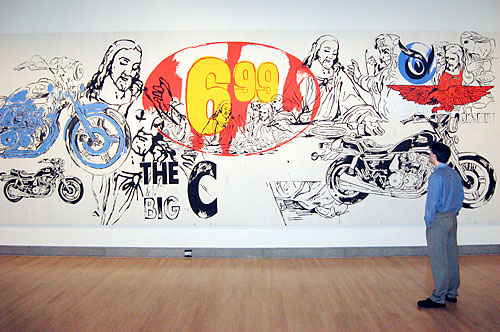
The exhibit — which occupies gallery space on two floors — shifts focus towads the end to a little-known aspect of Warhol: his spirituality. Warhol was typically thought of as a glamorous eccentric who walked in the trendiest circles, but he was also a devout Catholic who regularly attended Mass. His imposing silkscreen images of the Last Supper — some of them branded with the Wise Potato Chips logo and motorcycles — seem a bridge between his more commercial material, which he continued to produce on commission, and the more personal and rewarding art that he was creating simultaneously.
Interspersed throughout the exhibit are videos from Warhol’s television programs, one of which was broadcast on MTV — imagine Warhol’s “Fifteen Minutes” variety show coming on after “The Hills.” The shows give visitors a taste of the glamour that makes Warhol so intriguing, while also providing a “who’s who” of the New York art scene in the 1980s.
In the final room, an ominous self-portrait precedes a Warhol video that concludes with footage from the artist’s own funeral in 1987 — a fitting end for a man whose work foreshadows our wired, reality-obsessed age.
“Andy Warhol: The Last Decade” at the Brooklyn Museum [200 Eastern Pkwy. at Washington Avenue in Prospect Heights, (718) 638-5000], June 18–Sept. 12. Closed Mondays and Tuesdays.