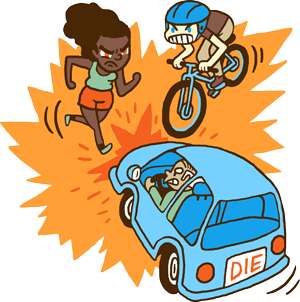
The new Prospect Park West bike lane is so controversial that it has caused a war between the neighborhood’s icons of self-righteousness — parents and cyclists.
Drivers, of course, are up in arms, too (but who cares about them, anyway?).
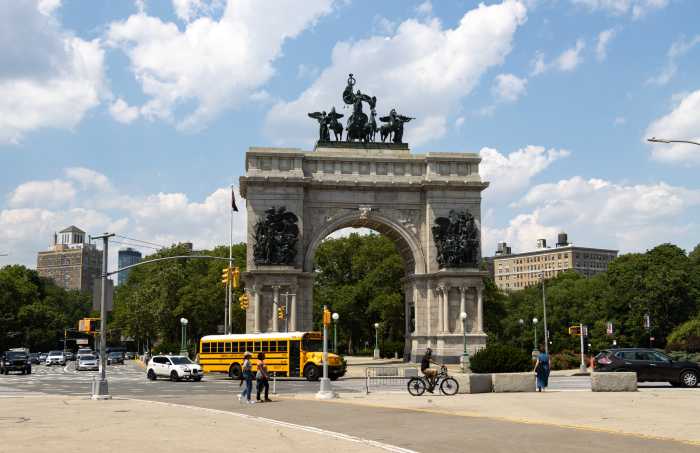
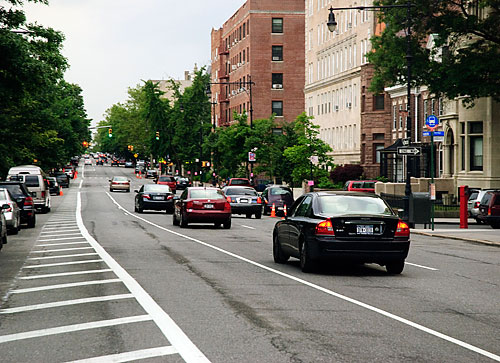
The bike lane — still under construction from Grand Army Plaza to 15th Street
— has already eliminated one lane of car traffic, which has been converted into a two-way strip for bicycle travel.
That’s creating a problem for pedestrians, who are accustomed to only looking at the oncoming car traffic when crossing the street. Now, walkers have to worry about cyclists coming in both directions — and many of the two-wheelers are jerks.
“They think they own the road, they don’t stop when they’re crossing [an intersection],” said Rita Martinez, pushing her 2-year-old son into the park. “They always think they have the right of way — sometimes they’ll just scream to get out of the way when I’m pushing a stroller!”
Other Slopers had similarly frayed nerves.
“Even with the ‘Walk’ sign, I’m afraid to cross because bikers will just zoom by,” said Miriam Stern, another local with a 5-month-old kid.
Sure, it’s always the biker’s fault, isn’t it, mocked the Bike Snob, who literally wrote the book on the cycling worldand sees the latest kerfuffle as just another opportunity for non-cyclists to bash the two-wheelers.
“Obviously, cyclists should not shout at pedestrians who have the right of way,” said the Snob, Eben Weiss. “[But] if a pedestrian jaywalks while listening to an iPod or jockeying a smartphone, that’s also stupid.

“I think people tend to want to rub new bike lanes in cyclists’ face whenever a rider does something stupid on them, which is unfortunate,” he added.
But cycling etiquette aside — the Prospect Park West bike lane was intended primarily as a “traffic calming” measure — albeit one that hasn’t calmed the stroller-pushers who can’t see over the parked cars that form a barrier between the two lanes of auto traffic and the Prospect Park West sidewalk.
“It’s hard to see cars in the street when you’re crossing with the stroller,” said Charlotte Barnett, a nanny in the neighborhood.
Yes, it’s war out there — but one that Department of Transportation spokesman Monty Dean predicted would reach a cease fire once everyone becomes accustomed to the new lane.
“These lanes can be instructive,” said Dean. “For instance, the city’s first protected bike path on Ninth Avenue [a Manhattan street] resulted in a 56-percent reduction of injuries to all street users — cyclists, pedestrians and motorists — and we’ve seen similar results along protected paths elsewhere [such as the Kent Avenue bike lane].”
Another agency spokesman added that 46 percent of bike traffic on Prospect Park West had been riding on the sidewalk on weekdays, presenting a danger to pedestrians. And 14 percent of cyclists were even riding against traffic, creating an even more hazardous situation.
“When complete, the new lanes will make bike travel more predictable and alleviate the chaotic patterns that long preceded the lane,” said the spokesman, Seth Solomonow.
Perhaps, but you do have to remember that we’re all New Yorkers here, added Noah Budnick of Transportation Alternatives, a cycling advocacy group.
“New Yorkers are always thinking about themselves — pushing their way onto the subway, or running red lights in their cars,” he said. “Failure to yield doesn’t only happen with cyclists.”