
Big Brother is watching!
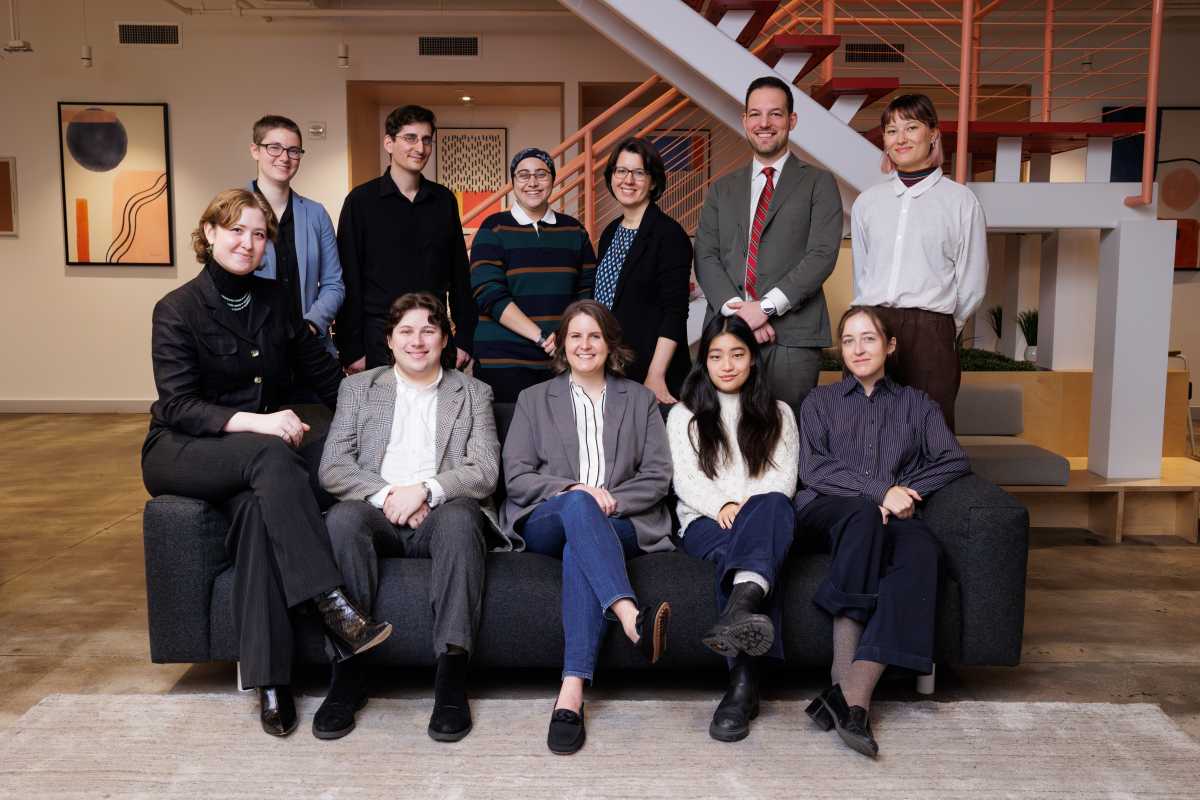
With the rapid advancement of technologies such as drones and AI-powered surveillance, one of Brooklyn Org’s 2026 Spark Prize recipients — the Surveillance Technology Oversight Project (S.T.O.P.), a Brooklyn-based civil rights nonprofit — has been fighting discriminatory surveillance and working to protect the privacy and civil rights of New Yorkers since its launch in 2019.
The organization highlights how tools like facial recognition, NYPD drones, data-sharing systems and other tracking technologies are deployed — often with little oversight — disproportionately affecting low-income, immigrant, Black and Brown, and Muslim communities, as well as protesters. S.T.O.P. conducts investigative research, policy advocacy, community education and litigation.
That commitment is what earned S.T.O.P. a 2026 Spark Prize from Brooklyn Org.
Michelle Dahl, executive director of S.T.O.P., expressed her gratitude to the organization for recognizing the pivotal role the group plays in preventing surveillance infrastructure from becoming entrenched, particularly given the current political climate.
“It’s important to stop the surveillance for all before it becomes the norm across the country. And S.T.O.P. is doing our best to make that happen, to rein in the surveillance and protect New Yorkers and folks across the country from this mass discriminatory surveillance,” Dahl said, noting that the funding enabled the organization to respond swiftly to new surveillance rollouts nationwide. “New Yorkers really deserve safety strategies that don’t come at the cost of civil rights, and S.T.O.P. is working to make that the reality, and we are absolutely, absolutely excited that Brooklyn Org is stepping up to support our work on that front.”
S.T.O.P.’s campaigns include a Geolocation Tracking Ban, which would prevent large-scale location tracking with or without a warrant, and “Ban the Scan,” which pushes for state and city legislation that would ban the use of biometric surveillance by law enforcement and prohibit facial recognition technology by landlords and in places of public accommodation.
“We know that [facial recognition] is very error-prone and often misidentifies, especially people of color. So it’s really a civil rights issue that we’re looking at as well,” Dahl said. “We’ve seen stories of federal ICE agents, for instance, using facial recognition and then telling folks that they’re using the data to add them to a database of domestic terrorists, which is obviously very concerning and has big implications for First Amendment rights to free speech when they are using this against protesters and law enforcement observers.”
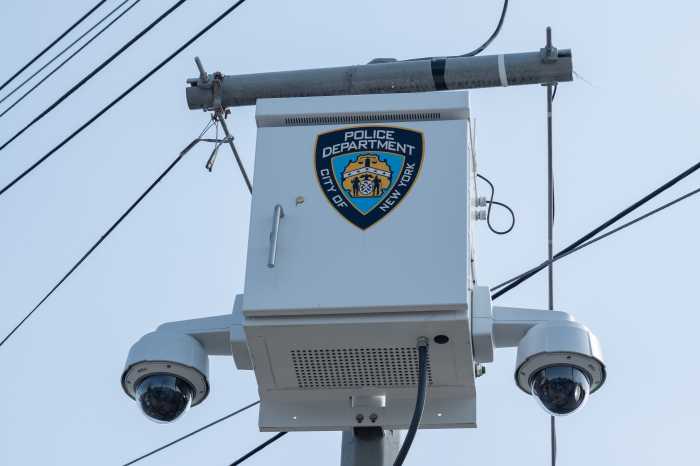
S.T.O.P. is also monitoring the NYPD’s drone program, which the organization says has grown into “a sprawling surveillance operation.”
While the NYPD touts its drone program as a “tool for emergencies,” unmanned aircraft systems have become a familiar sight at protests such as the “No Kings” demonstrations in June and October 2025, at the Labor Day Parade and during backyard celebrations in predominantly Black neighborhoods in Brooklyn, as well as at Juneteenth celebrations across New York City. S.T.O.P. says the drones surveil unassuming New Yorkers with little oversight and few limits.
Eleni Manis, research director of S.T.O.P., told Brooklyn Paper that since the NYPD approved its Drone as First Responder (DFR) program in 2024 — an expansion of the NYPD’s Unmanned Aircraft System program launched in 2018 — the initiative has grown exponentially. The NYPD reported 136 drone flights in 2022, 4,355 flights in 2024 and 13,317 flights in 2025.
“Ever since the drone as a first responder program was approved, the NYPD program has simply exploded, and we see drones flying over the city with very little public accountability regarding what they’re doing, whether they’re filming on their way to and from the sites that they are patrolling, and whether constitutionally protected activities are being recorded,” Manis said. “Where you see physical over policing, digital over policing follows; surveillance cameras, shot spotters, sensors, other kinds of digital tracking compound analog over policing of Black and Brown communities, and they reinforce it.”
S.T.O.P. has also raised concerns about the NYPD’s Domain Awareness System (DAS), a public-private partnership with Microsoft that integrates data from tens of thousands of camera feeds, license plate readers, radiological sensors and other tools for real-time surveillance across the city. In her State of the NYPD address, Police Commissioner Jessica Tisch announced the launch of Domain Awareness System 2.0, which includes enhanced “real-time awareness” through alerts from license plate readers, drone footage and other technologies.
“It aggregates all of the data and builds profiles on individual New Yorkers that the law enforcement agencies can then use to target and surveil them further,” Dahl explained.
In October 2025, S.T.O.P. filed a complaint in U.S. District Court for the Southern District of New York on behalf of two lead plaintiffs who have an NYPD surveillance camera directly outside their home. The camera is aimed at their living room and bedroom windows. According to the complaint, the plaintiffs have covered their windows with foil to block the camera’s view and describe the constant surveillance “as a daily violation,” causing ongoing emotional distress.
Dahl said the plaintiffs’ front yard once served as a welcoming gathering space for neighbors and community members, but since the camera installation, it is no longer used because the community feels spied upon.
“It’s truly a chilling effect throughout neighborhoods; it’s not just limited to public housing, either,” Dahl said. “The Domain Awareness system really creates an entire surveillance infrastructure that covers the entire city, subjecting New Yorkers to surveillance on an everyday basis.”
Other S.T.O.P. projects include “Unintended Traps,” which recommends expanding abortion shield law protections and increasing funding for shield clinics that protect reproductive rights providers.
S.T.O.P. found that medical and financial recordkeeping requirements jeopardize abortion providers and funders, even in states with strong abortion shield laws such as New York. The organization is calling on states that protect reproductive rights to strengthen laws that prohibit abortion-related data disclosure and protect telemedicine abortion access.
In 2024, Texas Attorney General Ken Paxton brought a civil lawsuit against New York doctor Margaret Carpenter for violating Texas abortion laws by providing abortion pills via telehealth to a Texas resident, an attempt to enforce a state abortion ban beyond state lines. In early 2025, a Texas judge issued a more than $100,000 default judgment; in October 2025, a New York trial court dismissed the case because Carpenter was protected under New York’s shield law.
“There are steps that New York can take to ensure that its medical providers are less susceptible to having evidence against them leaked, and this paper was about the kinds of shield laws that states can put in place to protect those reproductive rights providers,” Manis said.
This story is part of a Brooklyn Paper series highlighting the winners of this year’s Spark Prize. This year’s recipients — named for Brooklyn Org’s mission to spark lasting social change in Brooklyn — are the Asiyah Women’s Center, Back Trans Femmes in the Arts (BTFA), the Surveillance Technology Oversight Project (S.T.O.P.), The B.R.O. Experience Foundation and YVote Brooklyn Org.