
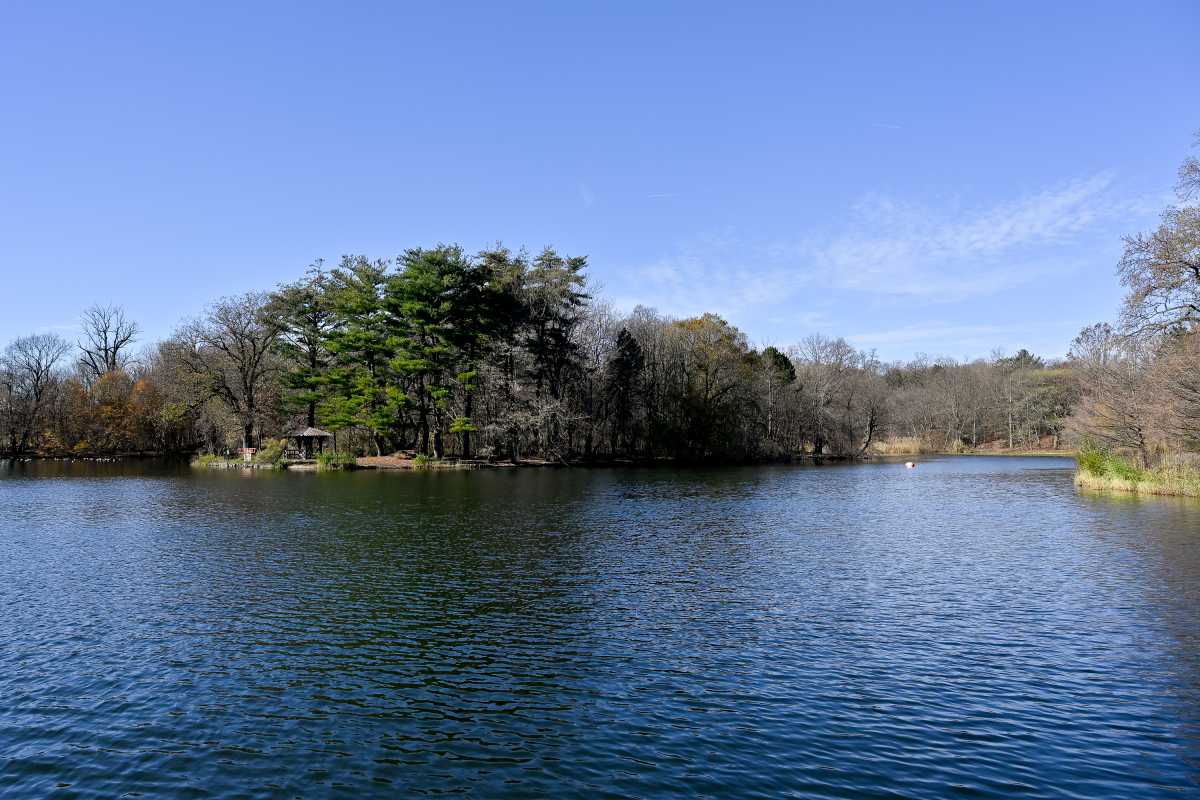
Prospect Park, beloved for its wide lawns and woodsy trails, will soon offer another benefit to the neighborhoods around it: flood protection.
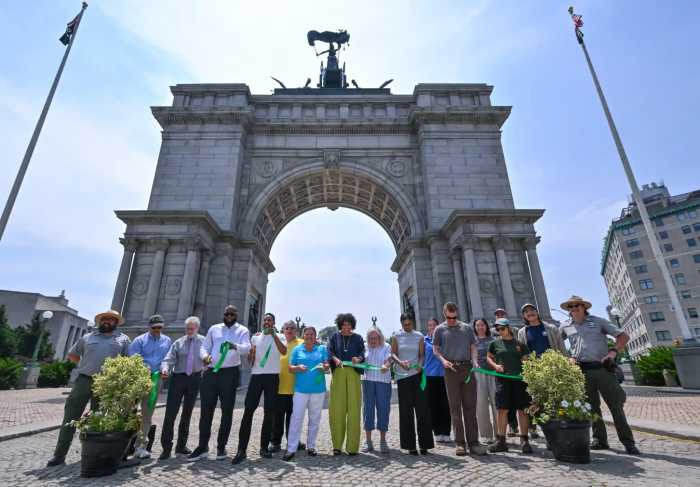
The city will build Brooklyn’s first “Blue Belt” — a “nature-based” flood management system that aims to manage stormwater and improve natural spaces — in the park, building on the Prospect Park Alliance’s ongoing Lakeshore restoration projects.
“This work means faster drainage, new rain gardens, restored wetlands, and nature-based flood protections that keep homes and streets dry,” said Jeff Roth, Deputy Mayor of Operations. “This is government at its best, using science, partnership and shared purpose to meet the challenges of a changing climate.”
Design for the $68 million project has just begun, officials said, but the basic tenants are already in place after a year-long drainage study of the park and the surrounding neighborhoods.
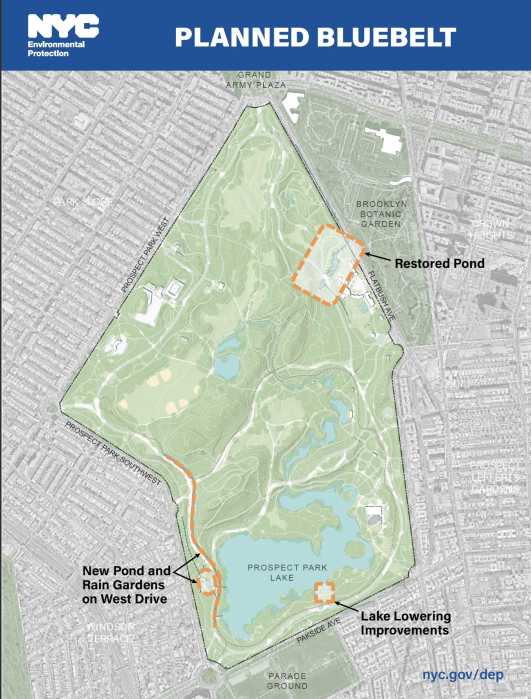
Perhaps the most critical part of the project are improvements to the lake’s drainage system so it can take on more water during large storms.
“Right now, there’s kind of a rudimentary mechanism where there’s like a six-inch plank that [the Alliance] lifts up and [the water] slowly lowers,” said Sangamithra Iyer, Chief of Blue Belts & Urban Stormwater Planning at DEP.
It can take up to two weeks for the lake to lower significantly, she said, and large storms aren’t often predicted so far in advance.
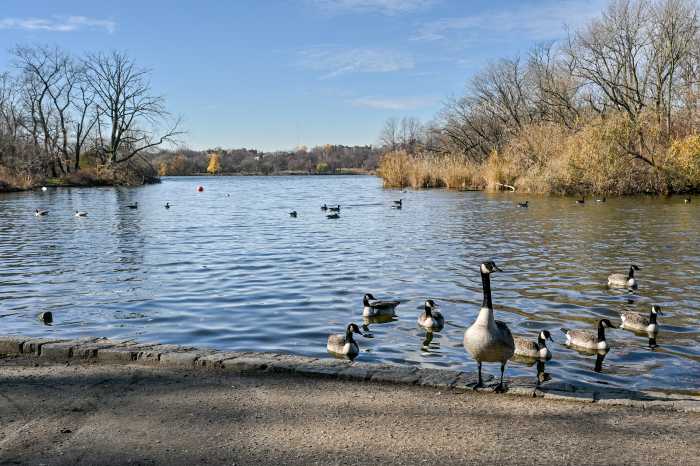
The project will increase the capacity of the drainage system, allowing the lake to be lowered in 36 hours. (The drain will be designed to be protective of wildlife, Iyer said “so the turtles won’t get sucked into it.”)
“What we’re able to do is, when a storm is coming, create space in the lake so the drainage flows into the lake rather than flowing out of the lake, which happens so often,” said DEP commissioner Rohit Aggarwala.
Increased capacity in the lake will allow for the rest of the project to function. The Department of Environmental Protection and parks department will work together to build new ponds and rain gardens to help capture and channel rainwater into the lake, rather than pooling on the ground or running into nearby streets.
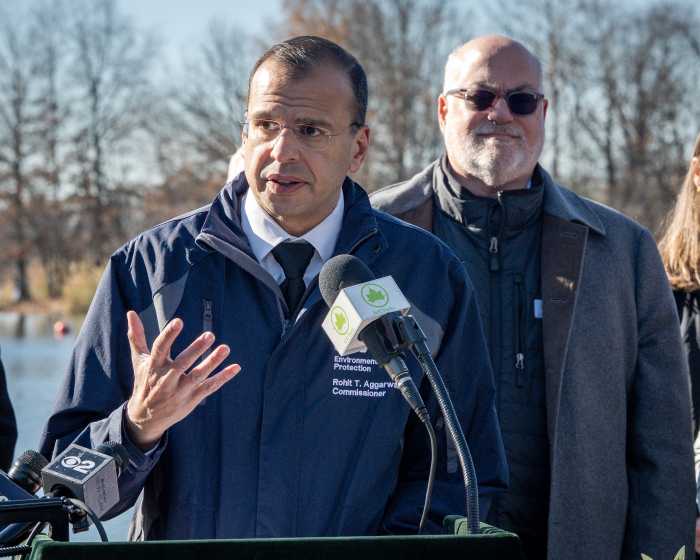
The new project will make use of some of the park’s historic features. Prospect Park was designed so that all stormwater would flow into the lake, said Morgan Monaco, president of the Prospect Park Alliance. But a lot has changed in 150 years.
Studies found that the soil in the park has become compacted and unable to absorb much water. During heavy rainfall, the water flows much faster than it used to, and much faster than the lake can contain.
On top of that, climate change has brought more frequent, more intense storms to New York City — the four most intense rainstorms in the city’s history have all been in the last four years, Aggarwala said — and the park’s infrastructure can’t stand up to them.
One of the new ponds will be constructed near Flatbush Avenue just north of the Prospect Park Zoo — which suffered catastrophic flooding during a massive storm in October 2023. That plan was in the original plans for Prospect Park, Aggarwala said, but was later filled in. When restored, it will help capture rainwater from Flatbush Avenue and prevent flash flooding on the avenue and in the zoo.
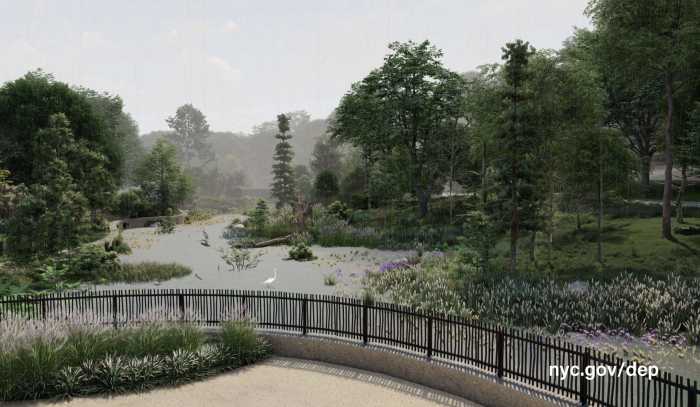
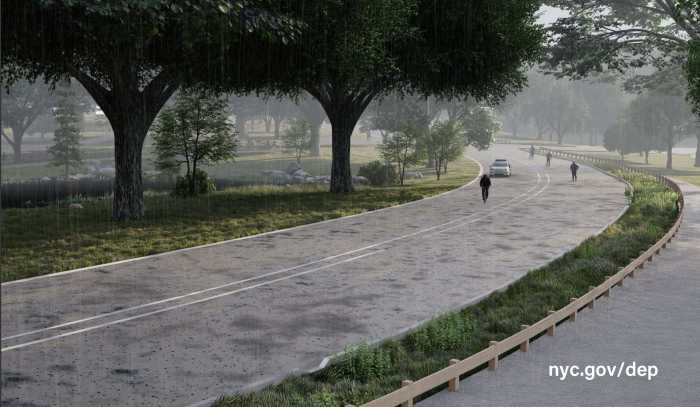
Another pond will be constructed on West Drive, near the park’s southern edge, to help “slow and redirect floodwaters” to protect nearby homes and streets, Aggarwala said.
Rain gardens along West Drive will further help absorb rainwater.
“There will be really lovely park amenities with that, you’ll be able to walk across those waterways and enjoy the newly-restored Bluebelt area,” said Wendy Sperduto, DEP’s assistant commissioner for engineering and planning. “That water will really slow down the west lake path and if it comes out of that area in extreme events, it should be routed to the lake, where the lake can now absorb the additional volume of water.”
The park’s natural topography brings all water to the lake, and the improvements will allow that to happen more slowly, without flooding. The Blue Belt will filter the water before it reaches the lake, Aggarwala said.
With design underway, construction is expected to begin in 2029 and wrap up in 2032. When the Bluebelt is complete, DEP will assess its impact by monitoring flooding on nearby streets using the city’s FloodNet system, Aggarwala said.
Karl-Henry Cesar, chair of Community Board 14 — which includes Flatbush, Midwood and Kensington — said the board had been advocating for flood protections in the area “for over a decade.”
Parts of the district are particularly flood-prone, he told Brooklyn Paper. During heavy rains, intersections and street corners flood, and some storms have inundated homes and apartments with water, causing significant damage. In October, a 39-year-old man drowned in his basement apartment in East Flatbush as a flash flood swept through Brooklyn.
CB14’s efforts have yielded mixed results, Cesar said, but the Blue Belt felt like a victory.

“It is a beautiful thing that both of these agencies together, they’re listening, right? And this work is starting,” he said. “Is it anywhere near the finish line? Not at all, but it’s nice that the work is starting.”
He said he hoped to see consistent transparency and engagement from DEP and parks as the Blue Belt is constructed and afterward. The project might not address all of the neighborhood’s flooding issues, he said, and climate change could create new issues in years to come.
“The thing that would make me feel real bad would be, OK, this project crosses the finish line and that’s the end of the engagement,” he said. “This energy and this collaboration, if we can maintain this and improve it and cultivate it even more, I think that’s something that would be an important need for making sure that if additional measures need to be implemented … we have the environment to do that stuff.”