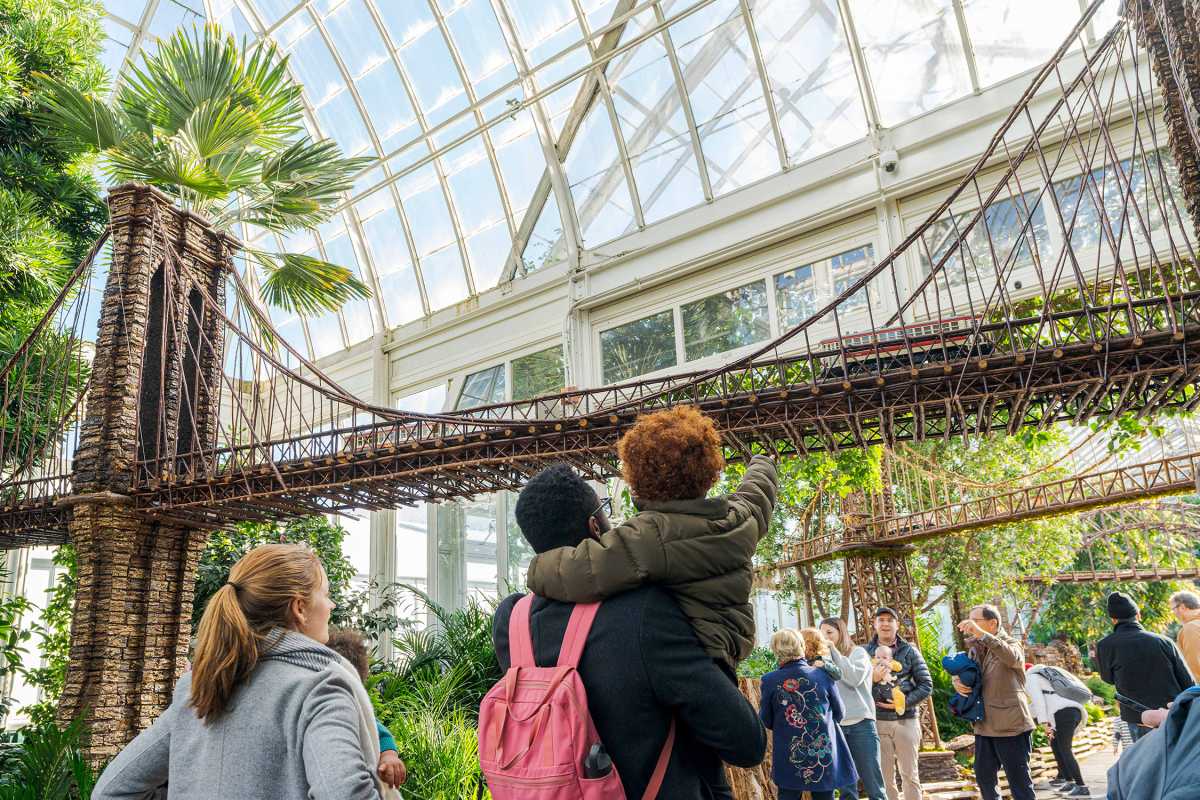
Kenia Pittman, director of exhibition design operations at the New York Botanical Garden, towers over the Brooklyn Bridge as she talks. But this is more of a baby Brooklyn Bridge than the real thing.
While few structures are as symbolic of Brooklyn as this signature bridge, Pittman describes the architecture of the Garden’s massive miniature, built for its holiday train exhibit, along with a series of other landmarks from Brooklyn and beyond, constructed to scale.
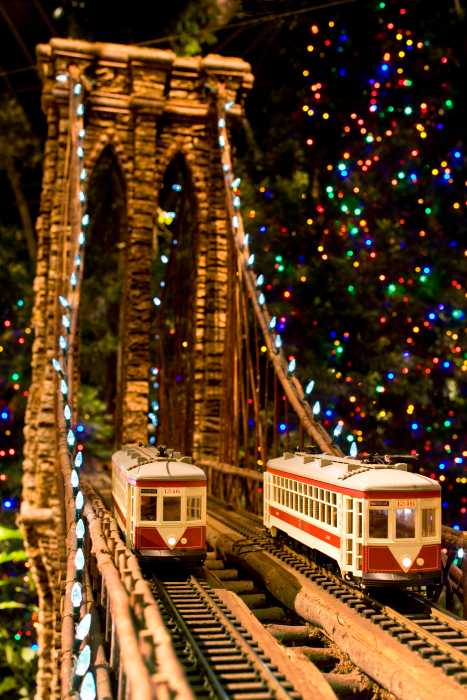
“The Brooklyn Bridge is the largest bridge in the Holiday Train Show,” Pittman said on a guided tour. “It became part of our collection in 2004.”
The real Brooklyn Bridge, a “cable-stayed suspension bridge,” spans the East River from Brooklyn to Manhattan with a main span of nearly 1,600 feet and a deck nearly 130 feet above the water.
It opened May 24, 1884, nearly 150 years ago, originally called the New York and Brooklyn Bridge or the East River Bridge, before being officially renamed the Brooklyn Bridge in 1915.
The bridge was designed by John A. Roebling, with his son Washington Roebling serving as chief engineer, and additional work by Emily Warren Roebling. Nearly a century later, the baby Brooklyn Bridge was born from very different materials.
“Its massive piers are made from oak, elm, ash, and locust bark designed to resemble stone,” Pittman said. “The cables are all willow twigs, and the keystones of the Gothic arches are sugar pinecone scales.”
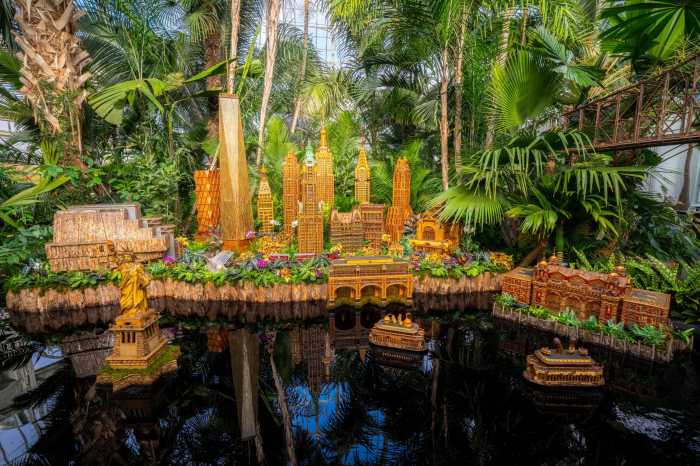
The Holiday Train Show debuted 34 years ago and now features more than 30 G-scale model locomotives and trolleys, along with nearly 200 plant-based replicas of famous local architecture. This year’s exhibition runs through Jan. 11.
Although the trains often get top billing, the miniature buildings — surrounding the tracks — may be the true stars. Many represent Brooklyn’s best-known structures. The trains take visitors on a voyage, but the scenery is what often stops them in their tracks.
The Garden hired Alexandria, Kentucky-based Applied Imagination, a company specializing in miniatures made from natural materials, to construct its scaled New York City, including some of Brooklyn’s most beloved landmarks.
“They use natural materials gathered from nearby woods, including leaves, seeds, twigs, bark, and acorns to create these unique and beautiful pieces,” Pittman said during a tour of the mini city.
Founded in 1991 by Paul Busse, who has since retired, Applied Imagination created this little piece of Brooklyn as well as miniatures at other locations nationwide.
“His artistic vision lives on, and the company is run by his daughter Laura Busse Dolan,” Pittman said, noting she leads a team of 15 full-time artisans, fabricators and model train experts.
Most buildings are grouped by borough, so the Brooklyn Bridge stands near other Brooklyn landmarks like the Lott House and Lefferts Homestead.
“Adjacent to those buildings are our Queens buildings, where visitors will find the TWA building and Queens County Fair, along with several others,” she said.
This little bit of Brooklyn also includes the Coney Island Luna Park Arch, added in 2016, featuring canella berry light bulbs and materials such as eucalyptus and pinecones.
The Williamsburg Art and Historical Society, added in 2003, features a roof of pinecone scales, ridges from willow twigs, eaves from berries and hemlock cones, and siding of birch bark. The Coney Island Galveston Flood Building, added in 2001, incorporates magnolia and eucalyptus leaves, rope, and redbud twigs for its star.
“We haven’t added Brooklyn buildings to the collection in a few years,” Pittman said. “Some of the most recent include pieces from our Coney Island display, such as the Wonder Wheel and Luna Park Arch on display in our Palm Dome this season.”
While the Brooklyn Bridge draws fans, other miniatures also shine, including the Statue of Liberty, Rockefeller Center, and many more recreated from natural materials such as birch bark, acorns, and cinnamon sticks. Pittman said the Lower Manhattan display in the Palm Dome is especially popular.
“This is a scene that we rarely change or move from its location because of its popularity,” she said.
New additions, however, are added each season.
“Each season, we create new displays inspired by a curated mix of New York City buildings, boroughs, and landmarks,” Pittman said. “This keeps our collection evolving while offering visitors a fresh space to explore and the chance to spot buildings they may not have seen the year before.”
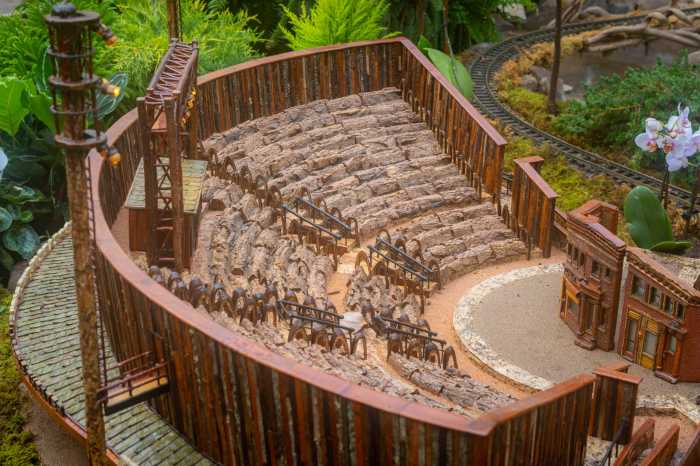
This year, the Garden added miniatures of the Whitney Museum of American Art and the recently redone Delacorte Theater, funded by donations from Larry E. Condon.
“The Delacorte Theater (longtime home to The Public Theater’s Shakespeare in the Park) appears alongside a Central Park tableau that includes the Gothic Arch, Belvedere Castle, the Music Pavilion, the Angel of the Waters Bethesda Fountain, the Dairy and Cop Cot,” Pittman said. “The Delacorte Theater model was constructed using bark from a variety of trees including ash, locust and hickory.
The intricate Whitney Museum model, she said, “captures the museum’s distinctive asymmetrical façade and tiered terraces” and is made entirely from natural materials including polished horse chestnut bark, reeds, and winged euonymus.
While visitors can see the structures day or night, many light up at night, creating a memorable New York City evening scene.
“Not all our buildings light up; some are designed to have internal lighting,” Pittman added. “All exhibition spaces are designed with evening lighting.”
In addition to the show, the Garden hosts activities tailored to the Holiday Train Show, including a sensory-friendly morning on Jan. 3 from 9 to 11 a.m., complete with cookies and chocolates.
Their “Evergreen Express” in the Everett Children’s Adventure Garden runs through Jan. 11, featuring a Story Trail with Dan Salmieri’s Bear and the Wolf, books about evergreens, toy trains, and more. Visitors can also enjoy Tea Around Town on select days, as well as a special Holiday Train Show After Dark on Jan. 10.
The Garden’s shop offers holiday merchandise inspired by the show, including toys, clothing and home décor.
While you might do better trying to build your own miniature monuments with Lego than with bark and leaves, you might just be able to build your own little bit of Brooklyn as well with natural materials.
“I’m always a big advocate for creativity” Pittman said. “Head out to your local trails or city parks and gather a few natural materials. There’s no wrong way to create your own take on a favorite New York City landmark.”
Tickets start at $25 for the Holiday Train Show at nybg.org. Holiday Train Nights are ticketed through NYBG’s presenting partner, Fever.