A coalition of property owners who banded together to fight developer
Bruce Ratner’s Atlantic Yards basketball arena, office tower and
housing proposal showed signs this week of crumbling.
Only a handful of tenants and homeowners living on the two blocks facing
condemnation under the state’s authority of eminent domain came to
testify at Tuesday’s City Council hearing. Of the project’s
opponents who came to testify, most do not live on the site.
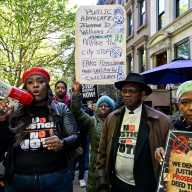
The group, known as Develop Don’t Destroy-Brooklyn, who banded together
earlier this year to hire civil rights attorney Norman Siegel to fight
the plan, has hosted several large-turnout rallies in the past few months,
comprised largely of the people who would either
be evicted or have their property condemned if the plan is approved.
But aside from the conspicuously slim turnout at Tuesday’s public
hearing, there were other, more overt signs of a fractured coalition this
week. Anti-Atlantic Yards posters have come down from the entryway and
most windows of 636 Pacific St., one of many buildings that would face
the wrecking ball to make way for the 21-acre residential, retail and
commercial complex.
Why have the residents gone silent?
Because they’re negotiating with Ratner to sell their homes, sources
told The Brooklyn Papers.
Ratner is the principal owner of Forest City Ratner, best known for constructing
the Metrotech office complex in Downtown Brooklyn.
Just last week, all but two of the 31 condominium owners at 636 Pacific
St., a nine-story building known as the Atlantic Art Building, were negotiating
with Ratner to sell their apartments, sources told The Brooklyn Papers.
The art-deco former storage building, converted into luxury condos last
year, is just one of many buildings facing condemnation as part of the
plan.
Forest City Ratner spokesman Joe DePlasco declined to comment on tenant
negotiations.
But at Tuesday’s hearing Forest City Ratner Vice President James
Stuckey said the company was trying to reduce the amount of condemnation
and said they may be able to do the plan “in a way where we don’t
have to condemn people’s homes.”
It was unclear whether
Stuckey meant shifting the arena or buying out residents.
The sweeping, $2.5
billion Atlantic Yards plan proposes to build a basketball arena for Ratner’s
recently purchased New Jersey Nets and 17 towers over the Long Island
Rail Road storage yards and adjacent blocks emanating from the intersection
of Flatbush and Atlantic avenues and stretching east into Prospect Heights.
Daniel Goldstein, a resident at 636 Pacific St. and a leader of Develop
Don’t Destroy-Brooklyn, said he was not involved in negotiations
with Ratner, but declined to comment on his neighbors’ negotiations.
“If he is able to remove people from their homes by offering buyout
packages, those negotiations were always in bad faith because they always
had the threat of state condemnation behind them,” said Goldstein,
who testified at Tuesday’s hearings.
Those sentiments were echoed by Patti Hagan, a spokeswoman for the Prospect
Heights Action Coalition, a local group also formed to fight the Ratner
arena plan.
Asked about why the other almost 300 residents facing eminent domain eviction
did not show, Goldstein said, “People have to work.”
Salvatore Perry, an architect who, with his wife, owns an apartment at
475 Dean St., which is also facing condemnation, said his building had
not made a deal with Ratner but declined to comment on any ongoing negotiations.
Joel Towers, an urban designer and renter in the building, who testified
at Tuesday’s hearing, said the tenants had met with Ratner in January
and even had a video conference with architect Frank Gehry, who is designing
the arena and surrounding office and residential towers.
While owners are busy negotiating, several renters are worried about what
will happen to them.
Zafra Whitcomb, who moved into the building almost five years ago, said
he doesn’t know what he will do.
“Ratner is not negotiating with tenants,” Whitcomb said.