Borough President Marty Markowitz has hosted another closed-door meeting
about developer Bruce Ratner’s Atlantic Yards proposal, continuing
his policy of shutting out community members who have prominently voiced
opposition to the plan to build a basketball arena as well as 17 residential
and office high-rise towers.
Last October, Markowitz held a similar meeting, shutting out reporters
as well as members of neighborhood groups that openly protested the plans.
According to attendees of both meetings, the policy has resulted in excluding
those living in the Prospect Heights footprint of the planned development,
bounded by Dean Street and Atlantic, Flatbush and Vanderbilt avenues.
This time around, Markowitz relented in allowing members of the anti-Atlantic
Yards group Develop — Don’t Destroy Brooklyn to attend the March
24 meeting, just not their chief spokesman, Daniel Goldstein.
“One reason they gave that I couldn’t come is that I’m
a figurehead of the opposition,” said Goldstein, the last holdout
who has not sold or agreed to sell to Ratner his condominium in the Atlantic
Arts building at 636 Pacific St. within the Atlantic Yards footprint.
“We eventually decided not to go at all, because we don’t think
Borough President Marty Markowitz has the right to say who represents
our group,” said Goldstein. “Instead of making a scene we decided
to step back this time. We will attend the next meeting.”
The groups or individuals were mailed invitations to the Borough Hall
meeting.
Goldstein said DDDB was not initially invited, but after asking another
local group to urge their inclusion, “[Markowitz] said, OK, we could
come, but Daniel Goldstein can’t come. Also Patti and Schellie [Hagan],
and PHAC [Prospect Heights Action Coalition] can’t come either.”
Asked why certain people or groups were barred from attending the meeting,
Markowitz said through a spokeswoman, “This community meeting brought
together leaders of over a dozen civic organizations and elected officials
from the neighborhoods adjacent to the Atlantic Yards and Nets arena who
represented every point of view on the project. The size of the group
was relatively small to create a working group for constructive dialogue.”
Local elected officials, including Councilman David Yassky, Councilwoman
Letitia James, and state Senators Carl Andrews and Velmanette Montgomery
attended.
Prospect Heights Community Neighborhood Alliance President Gib Veconi
said Markowitz “made an effort to reach out to more groups in Prospect
Heights” — the Oct. 17, 2004 meeting had only two arena-area
residents present — but he disagreed with DDDB’s exclusion.
“They have not yet fully included some of the groups that we recommended
that they do include, like DDDB,” Veconi said.
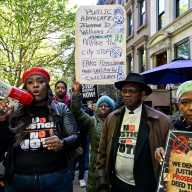
Patti Hagan, co-founder of PHAC, was enraged, and with her sister, Schellie
Hagan, both ardent and vocal foes of the arena plan, protested outside
Borough Hall during the meeting.
“It’s really disgusting how people who can contribute to the
debate are kept out completely,” said Hagan. “It’s like
they don’t want people to know what’s going on.”
Veconi characterized the meeting as a “question and answer session”
that discussed the state environmental review process for preparation
of an environmental impact statement, which is underway now, with representatives
form the lead state agency on the Ratner project, the Empire State Development
Corporation (ESDC).
“That was useful in some respects,” said Veconi. “Unfortunately,
they were not able to answer a number of questions regarding the use of
eminent domain, and we had recommended that the people who were experts
in that area be present, so that was perhaps a disappointment.”
Ruth Goldstein, vice chair of the Fort Greene Association, recalled the
ESDC officials’ response to condemnation questions.
“They told us, in their own defense, ‘Well, the purpose of ESDC
is to really cut through all this red tape.’ And so we’re all
sitting there feeling like red tape,” she said.
Goldstein — no relation to Daniel Goldstein — said she was dismayed.
“I did not feel the level of authority was there,” she said.
“[The ESDC representatives] seemed to be there to give the kind of
information they knew about the EIS process”
The ESDC officials, she said, deferred even environmental questions. “They
had not brought their environmental issues people,” Ruth Goldstein
said.
And city questions, she said, were brushed off as well.
“They were unable to answer them because they’re not familiar
with the city process,” she said.
“A question was asked as to how the state deals with issues that
are raised in the EIS process, and if mitigation is required. They said
they ‘take them seriously’ but what that means isn’t encouraging.”
Overall, Goldstein said it became clear from the meeting and a collaborative
letter written by the groups to Markowitz that those present were not
keen on the process.
Councilwoman Letitia James, a fervent opponent of the arena proposal,
said the meeting was merely a start.
“I appreciate the meeting but obviously this should not be a substitute
for community input,” said James, whose district includes Prospect
Heights. “This was a small segment of the community and they were
not representative.