City officials criticized a judge’s ruling last week allowing a lawsuit against a major rezoning initiative to move forward — saying that the decision to allow the suit to continue would delay construction of new housing on the South Williamsburg site.
Justice Emily Goodman’s decision, city attorneys argued, could stall development of the Broadway Triangle for several months, endangering state money promised to two nonprofit organizations slated to develop it.
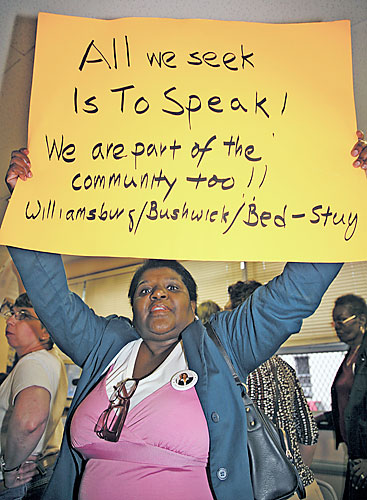
Forty community groups filed a lawsuit in December, accusing the city of discriminating against them by rezoning the area with the strong backing of the City Council.
In ruling against a city motion to toss the case, Goodman said that evidence of discrimination and segregation was substantial enough to continue investigating the city’s plans to redevelop several lots on industrial property north of the former Pfizer headquarters into 1,851 units of housing.
Goodman cited evidence presented by the plaintiffs, the Broadway Triangle Community Coalition, showing a history of public housing discrimination in Williamsburg coupled with the details of the city’s plan which included a significant number of large apartments.
“Further development of evidence of anticipated discriminatory impact is also necessary because of the evidence of racial discrimination in public housing in Williamsburg in decades of litigation, suggesting the need for a brighter light,” said Goodman. She added that the plaintiff’s strongest arguments involve the neighborhood’s history of public housing discrimination and patterns of selective preference for Williamsburg’s Hasidic residents.
Goodman was also sympathetic to complaints that the plan’s preponderance of large apartment units, developed by the United Jewish Organization, could lead to discrimination.
“With such negligible demand for large apartments as compared with smaller ones, it is questionable why in such a daunting housing crisis, there is such so powerful a commitment, with funds, to construct only large, and, therefore, fewer, apartments,” said Goodman.
City officials said that Goodman’s reading of the law is misguided, as all apartments in the new buildings will be open to Brooklynites regardless of race or ethnicity, though half will be open only to residents living in Community Board 1.
And besides, the judge’s decision to allow the case to continue will harm the poor, city attorney Louise Moed said.
“Residents will lose access to affordable housing if the sites are not developed,” she testified.
But the plaintiff’s praised Goodman’s decision to further examine its data comparing the Broadway Triangle plans to the neighborhood’s demographics.
“There’s a great demand for smaller apartments coming from an overwhelming minority demographic,” said Shekar Krishnan of Brooklyn Legal Services. “That demand is not being met here.”