"As long as my people are suffering,"
Fela Kuti, Nigerian founder of the Afrobeat style of music, said
in a 1996 interview with WUSB 90.1 FM’s Lister Hewan-Lowe, "I
will always sing about it." And although the singer, musician,
activist and sex symbol died in 1997, the next generation has
undertaken his music and his message, right here in Brooklyn.
"Fela may be gone from the material plane in body, but his
music and spirit are more popular now than they have ever been,"
says Martin Perna, founder of Antibalas. "He was always
ahead of his time, and now the time for his creation, Afrobeat,
has arrived."
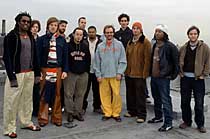
Antibalas, which roughly translated from Spanish means "Bulletproof,"
is a 14-piece band that not only sings and plays the Afrobeat
message, but lives it.
Just after Fela’s death in 1997, Perna was staying in a hotel
in Mexico City, when the inspiration to found an Afrobeat band
overtook him. Upon returning to the States, he organized a septet
that played its first show in May 1998, at St. Nick’s Pub in
Harlem. Within months, the band blossomed into a 14-person extravaganza,
in a rainbow of ethnicity’s and races, including Hispanics, whites,
African-Americans, Africans and Asian-Americans hailing from
Bedford-Stuyvesant, Fort Greene, Williamsburg and Bushwick. If
Fela Kuti preached racial unity through music, then Antibalas
is his prayer realized.
"We try to use culture and music to promote ideas of critical
analysis of the U.S., pacifism, anti-capitalism, gender equality
and immigrant rights," says Perna. The name Antibalas –
literally "anti-bullets" – furthers their message of
peace and racial harmony.
"The music reflects that dichotomy as existing militantly
opposed to war, engaging in a war against war," says Perna.
What’s different about Antibalas is that they’re not just an
Afrobeat band; they are a musical collective.
"Everyone in the group has stepped up and contributed in
their own way and it is a beautiful thing," says Perna,
28, who plays the baritone-sax. "Decisions take a long time
to make but the process is a lot more satisfying."
Afrobeat influenced many other American music legends, only some
of whom inherited Fela’s politics. Twinges of Afrobeat may be
heard among musical acts like James Brown, Public Enemy and Kool
and the Gang, but Antibalas remains true to the Afrobeat sound
while maintaining their own take on it.
"We have over 40 of [our own songs]," says Perna, "but
we play Fela’s tunes as well because no one outside of West Africa
has ever heard most of them performed live. Once Fela recorded
them, he would never perform them live again."
Antibalas wants to bring both the music and the message to a
wider audience.
"Afrobeat is a universe of music and each group has its
own approach," Perna says.
Why are there so many musicians influenced by Afrobeat, but so
few Afrobeat bands?
"The trouble is that it is a huge undertaking to create
a full-on Afrobeat group and few musicians are willing to sacrifice
money and ego to pursue that," says Perna. Afrobeat’s big
sound – a mixture of indigenous rhythms and funk riffs – requires
a stage full of musicians, as opposed to a rapper and a DJ, say,
or the traditional four-member rock band.
"Afrobeat is too complex to borrow from without digging
deep into its musical conventions and traditions," says
Perna. Fela himself often assembled upwards of 30 people on stage,
calling his performances "the underground spiritual game."
"Any less than 12 and you start to see sonic holes in the
music," says Perna. "We are working with dancers right
now to expand the stage show, to have more movement and feminine
energy onstage to balance things out."
Recently, there’s been a resurgence in Afrobeat’s appeal. An
entire exhibit on Fela’s life and music titled "Black President"
just closed at the New Museum in Manhattan. Antibalas contributed
music from their archives for the event, and they’ve partnered
with other Afrobeat pioneers.
"We have been fortunate to have studied and shared the stage
with many of the living musicians that have helped build Afrobeat
with Fela," says Perna, citing musicians such as Fela’s
son Femi Kuti and Tony Allen. "All of them have given us
tremendous encouragement and support along the way and have helped
root us deeper in the Afrobeat tradition."
Following Fela’s lead, Antibalas will continue to sing as long
as people are suffering. Indeed, they’ve taken their sound out
of New York City to Europe and beyond. (But they’ll return to
the Brooklyn Museum of Art on Oct. 4 to give a performance as
part of the free First Saturday program.) Antibalas is at work
on their third studio record, due out in February, and they’ve
just released a new single, "Che Che Cole." In October
they’re headed to Spain for the World Music Expo, and Perna says
they are the only band from the United States to be invited.
"Fela has shown me that fear is the biggest obstacle to
anything," says Perna. "Once you conquer that in your
mind, anything is possible."
Antibalas will play on Saturday, Oct.
4, at 9 pm, at the Brooklyn Museum of Art (200 Eastern Parkway
at Washington Avenue in Prospect Heights) as part of the First
Saturday program, which runs 5:3011 pm. Admission is free.
For more information about First Saturday, call (718) 638-5000
or visit the Web site at www.brooklynmuseum.org.
For more information about Antibalas, a full tour schedule is
available online at www.antibalas.com.