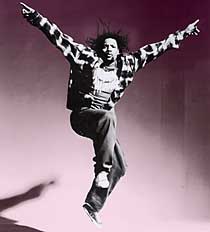
When the performers in Rennie Harris’ hip-hop
company, Puremovement, take the stage, it is impossible not to
watch.
A typical sequence involves a dancer sliding across the stage
on his head, followed up by a headspin that cantilevers to a
cross-legged freeze. What you’re seeing is not so much dance
as an attack on the laws of physics.
On Sept. 20 and Sept. 21, Harris will bring his company to Brooklyn
for free performances in Red Hook’s Coffey Park. This outdoor
performance launches "Dancing in the Park," a multiyear
festival sponsored by the groups Dancing in the Streets and the
Friends of Coffey Park.
For Dancing in the Streets Executive Director Aviva Davidson,
Harris was a fitting choice for the festival’s opening show.
"I have wanted to present Rennie Harris in Red Hook for
several years," she explained. "Our arts education
program focuses on the hip-hop vernacular, and I am eager for
our students and their families to see hip-hop performed by masters."
This performance series is a part of Dancing in the Streets’
Red Hook initiative, which includes an arts program in the public
schools, community celebrations and site-specific performance.
Brandon Albright, assistant artistic director and dancer in Puremovement,
hopes to give the audience a taste of hip-hop’s roots.
"Mainly I want them to learn who created the movement and
the history behind the movement – so that they can understand
what they are doing while they are moving," said Albright.
Harris himself noted in a recent interview with the Metro Santa
Cruz newspaper, "A lot of people don’t realize that there’s
a lot of styles of dance that fall under the umbrella of hip-hop.
You know, you’re talking about robot, popping, boogaloo, strutting,
sagging, boogie. You’re talking about flexing, house, trendy,
vogue, second-line. Then you have B-boy, then you have hip-hop
proper and a lot of times, the public is only bombarded with
the acrobatics of hip-hop, which is B-boying."
For the "Dancing in the Parks" show, Puremovement will
perform selections from the company’s repertoire including "P-Funk,"
"March of the Antmen," "Continuum," and the
title work, "Students of the Asphalt Jungle."
Albright describes the title work as "a vibrant affirmation
of Afro-American heritage through movement handed down through
spirit and instinct."
The company will also present a lecture-demonstration on Friday,
Sept. 19 that traces the progression of hip-hop’s forms, and
its connections to African, Afro-Brazilian, Afro-Cuban and Puerto
Rican dance.
Harris first gained widespread recognition in the modern dance
world for a 1992 solo called "Endangered Species" in
which he flees unseen assailants in a slow-motion popping-and-locking
sequence. This piece, provocative because of its critical look
at urban violence, represented one of the first times hip-hop
dance was created for the theater.
He grew up on the north side of Philadelphia in a neighborhood
called "the Badlands." He started out by copying moves
seen on "Soul Train" and went on to tour with Run DMC,
the Fat Boys, Kurtis Blow and Whodini. In 1992, he formed his
own company with the goal of moving hip-hop dance out from behind
rappers and onto the center stage.
Harris, now 39, continues to act as spokesman for hip-hop’s history
and vibrancy. But his role as the dance’s ambassador doesn’t
stop him from constantly pushing its boundaries as a theatrical
art form. His 2000 "Rome and Jewels," an adaptation
of "Romeo and Juliet," was the first evening-length
narrative hip-hop dance. (Last year, 651 Arts, the leading presenter
of African and African-American dance, music and theater featured
"Rome and Jewels" at the BAM Harvey Theater.)
He followed this effort with "Facing Mekka," another
evening-length piece that highlights hip-hop’s global reach with
a band that included Indian tablas and movement inspired by Japanese
butoh.
While the scope of his projects expands, urban violence remains
a recurring theme. Playful and exuberant moments are often contrasted
with grim images of horror and loss. An early group piece depicts
a slow-motion, drive-by shooting, while the ending of "Facing
Mekka" was based on an experience of coming across a dead
body floating in the water while jogging near the Schuylkill
River.
This tension is perhaps best seen in Harris’ solos. Relying largely
on the early style of locking-and-popping, his solos are both
fluid and jarring, and at times look like something between meditation
and electrocution.
While Harris doesn’t like to ascribe to any analysis of his work,
he does speak of hip-hop as both a link to the past, and as a
kind of spirituality.
"Before hip-hop," Harris said in the Metro Santa Cruz
interview, "it was rhythm and blues, it was rock, it was
jazz, it was classical, it was whatever gave you that sense of
freedom that you could just go ahead and do your thing and just
be in tune with the divine order, so to speak, and understand
the moment of now. It’s not categorized, it’s just another means
by which we can get there, a vehicle to get back to loving ourselves,
and getting back to, ultimately, loving in general."
This weekend, Harris will bring his meditations on love and violence
to Coffey Park. As concert dance goes, little else compares to
the virtuosity and gritty immediacy of his work.
Dancing in the Streets presents "Students
of the Asphalt Jungle," a program by Rennie Harris Puremovement,
on Sept. 20 and Sept. 21, 2-3 pm, at Coffey Park, Dwight Street
between Verona Street and Visitation Place in Red Hook. In case
of rain, performances will take place at PS 15’s auditorium,
at 71 Sullivan St. between Van Brunt and Richards streets.
The "History of Hip-Hop" performance and Q&A will
be Sept. 19, 6-7 pm, at PS 27’s auditorium, 27 Huntington St.
between Columbia and Hicks streets.
The events are free of charge and open to the public. For more
information, call (212) 625-3505.