In a subway station that has served Flatbush for over a century, a series of lush mosaics marry the neighborhood’s theatrical history with the vibrant cultures of its present.
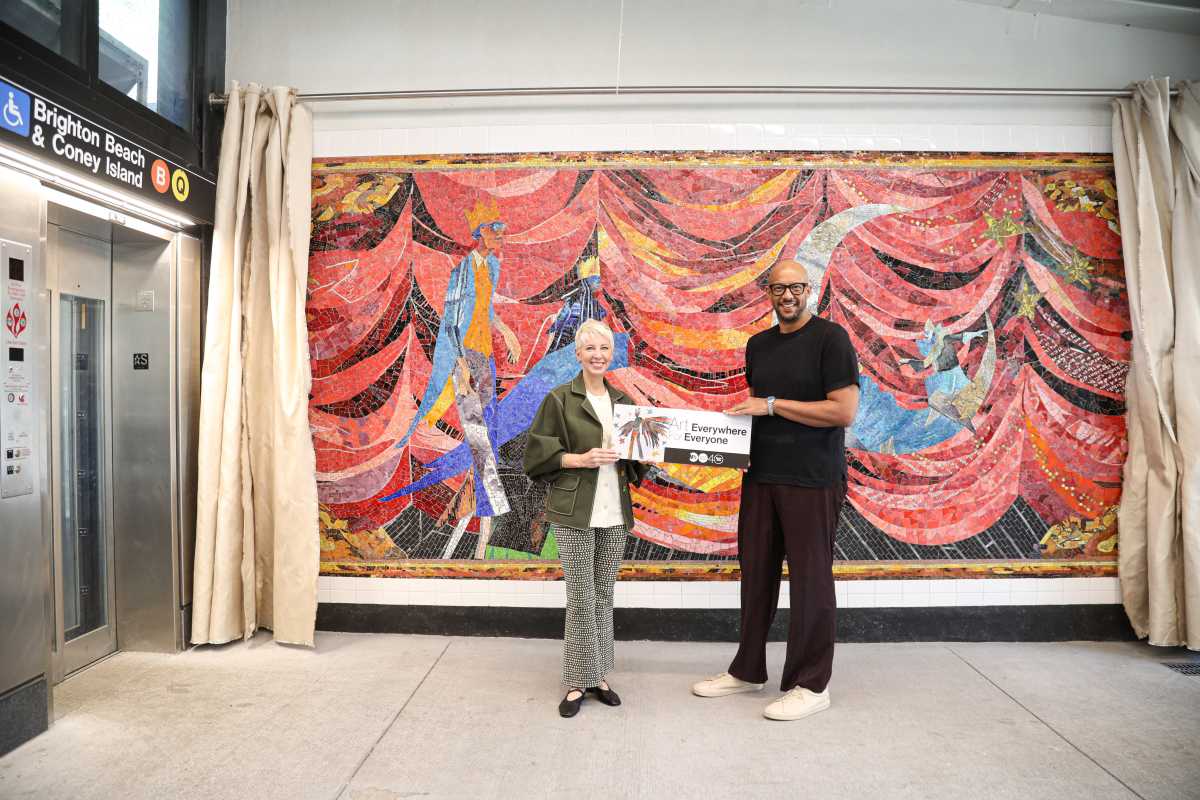
The MTA and artist Christopher Myers unveiled the pieces, titled “If you don’t want your children to know the truth about life don’t send ‘em to the theater,” at the Church Avenue station on April 24.
Myers, a prolific artist whose work explores culture, art, history and displacement, said he was inspired by the “intersecting histories” of Flatbush.
“A lot of my work is research-based. It’s based in the stories of communities, the ways in which our very local history affects and is part of larger world history,” he said.
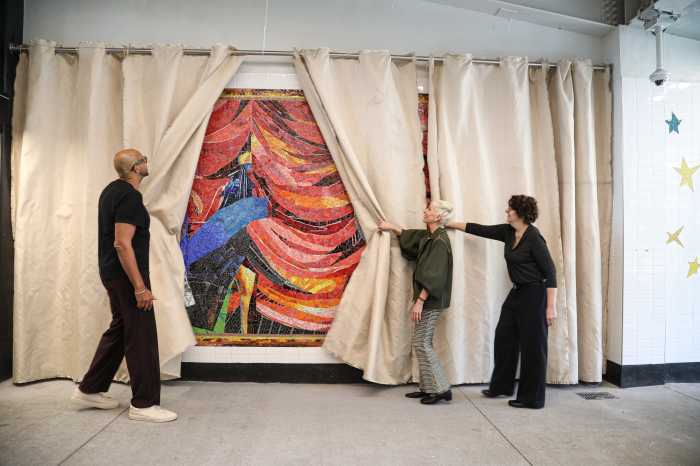
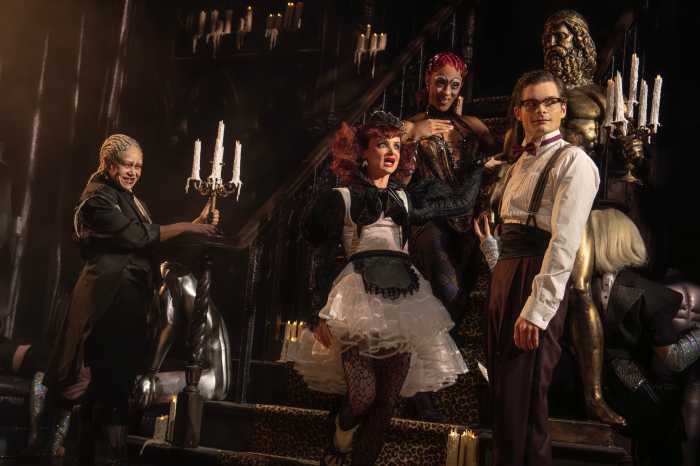
In the 20th century, Flatbush was a theater district, filled with movie houses and vaudeville theaters long since closed. The Kings Theater is a lone relic of the time.
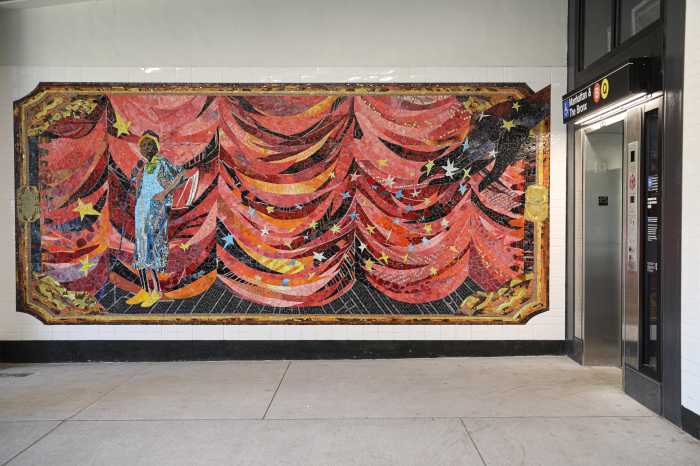
Myers’ mosaics are a callback to that time, featuring draped red velvet curtains adorned with stars and framed in gold. In front of the curtain stand life-size depictions of beloved performers of old – vaudeville actress Bessie McCoy Davis, singer Lottie Collins and comedian Jackie ‘Moms’ Mabley.
But the theater wasn’t his sole inspiration. Myers said he sees theater as “any place in which cultures meet.”
“When you go to the theater, you’re going to expand your world, do something other than yourself,” he explained. “You come to find yourself in that thing that is other than yourself.”
By that definition, he said, the tradition of theater is alive and well in Flatbush.
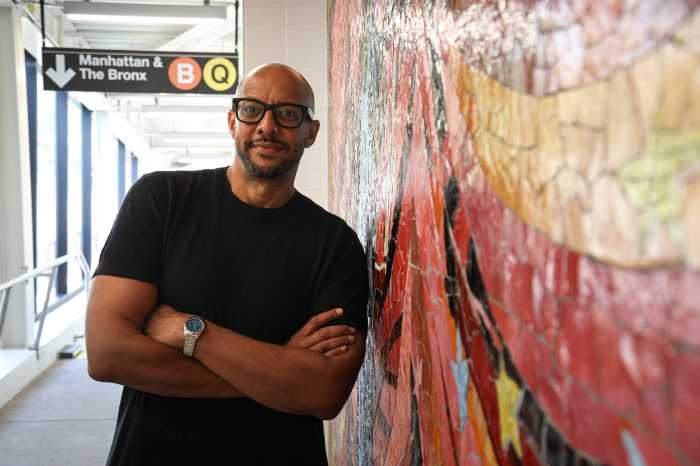
“It continues in the kind of small moments in which we all are with each other on a subway, or in the larger moments, like the history of the Caribbean diaspora and African-American diaspora that run through Flatbush,” he said. “At the Labor Day parade, when you see the carryovers from Carnival in Flatbush, that is also a kind of theater. The kind of place in which we go to meet ourselves and each other.”
Moving between the curtains are three Moko Jumbies, masked stiltwalkers serve as symbols of celebration and protection at Carnival celebrations in the Caribbean, said Tina Vaz, director of MTA Arts & Design. The figures weave Flatbush’s past and present together in one tiled piece.
“I wanted to see all of this theater history — the quotidian theater of everyday life, the history of Carnival and the red velvet curtain, gold-leaf theaters of days gone by — to see it all as part of one continuity,” Myers said.

The pieces, commissioned by MTA Arts & Design as part of the “Art Everywhere for Everyone” anniversary celebration, felt particularly special for Myers. Fabricated by Mosaicos Venecianos de México, they are his first mosaics and his first permanent public work.
Myers was born and raised in New York City and has lived in Brooklyn for decades. For lifelong New Yorkers, the subway is a fixture of the imagination, he said, and he sees the system as a “miracle” despite its many shortcomings.
He still remembers his parents calling the lines by their old times — the IRT, BMT and IND. The Church Avenue B/Q station, where his mosaics were installed, was part of the BMT and first opened in 1878, though the current station was rebuilt in 1907.
“I love when my work is acquired by museums and public institutions,” Myers said. “The subway feels somehow more permanent. It feels like a part of the archeology of the city, and it’s such a gift to integrate my own work, my own little moment, into that long, long history.”

He was thrilled to finally unveil the mosaics to the public. His works aren’t finished until they land with an audience, he said, especially one as broad and diverse as subway commuters.
“At Arts & Design, we believe art has the power to transform a daily commute, to interrupt the ordinary with moments of recognition, connection, and beauty,” Vaz said. “This work does that.”
Myers said he hopes commuters can take a pause and use his mosaics to see themselves and their lives.
“One of my goals is everyone should be able to see themselves on that stage,” he said. “The figures are life-size figures, and ideally people will stand in front of the red velvet curtains that are made in tile and imagine what kind of theater are they making.”