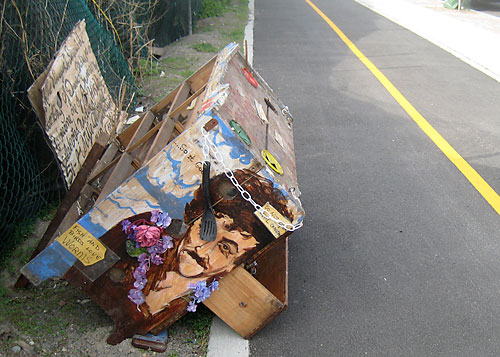
The Kurt Vonnegut dirt-box on Columbia Street is only the beginning.
Days after The Brooklyn Paper went front page with the Vonnegut-covered composting chest near Sackett Street, the worm-loving artist who created it finally revealed herself — and a new secret.
“My next one is for Edgar Allan Poe,” said composting champion, and Tiffany Place resident, Noon Gourfain. “I like what he said about the descent into the maelstrom. I like the idea of linking a dead literary figure to composting.”
Not everyone, apparently, did. Two days after our first story, vandals desecrated the Vonnegut dirt-box, knocking it over and leaving its wormy inhabitants scattered.

The next day, Gourfain righted the box and the worms were back doing their dirty work in their three-drawer dresser.
Residents are invited to toss in shredded paper, banana peels, egg shells or other organic waste.
“It’s intended to be a real compost spot,” Gourfain said. “And, eventually, the box will compost itself. It’s already happening. It’s starting to warp and decay. That’s genuine Swedish furniture, you know.”
Gourfain said she wanted Vonnegut on her first mulch box because of the writer’s approach to life and death in his immortal work, “Slaughterhouse-Five.”

“Whenever someone dies, he writes, ‘So it goes,” she said. “That’s what composting is all about. Compost is expensive — all that gas that goes into transporting it.
“Why not make it ourselves?”
So it goes.